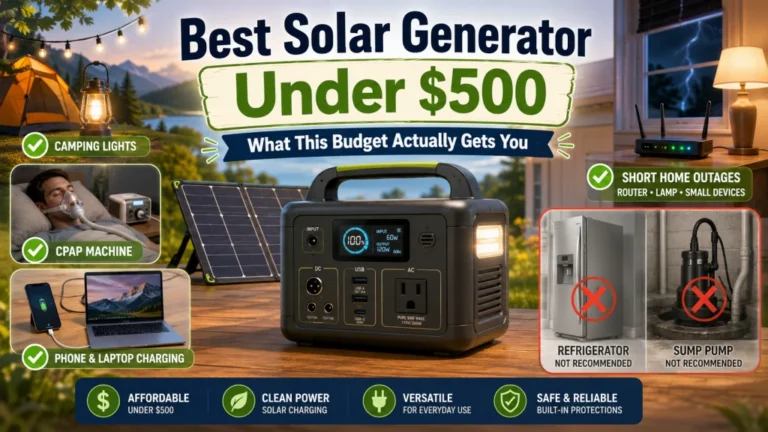

The Most Expensive Unit Is Rarely the Best Solar Generator for the Money
The best solar generator for the money is almost never the most expensive one on the page. I’ve sold enough of these units to know that the buyer who reaches for the highest-capacity option without running the numbers first is usually buying phantom protection, not real preparedness. Two thousand watt-hours covered most of the basic home backup use cases I saw walk through the door. The step up to 3,000Wh is meaningful for a specific set of buyers. For everyone else, it’s extra weight, extra cost, and extra capacity that never gets used.
The cheapest option creates its own problem. A buyer saves $250 on a 500Wh unit, plugs in their refrigerator during an outage, and watches it shut down before midnight. A standard compressor fridge draws between 120 and 200 watts average, with surge draws of 350 to 600 watts each time the compressor starts. A modest unit cannot sustain that. The buyer who goes too small doesn’t save money. They spend money twice. That math shows up in the tier discussion below, and it changes how you look at the price differences between tiers.
Field Note: The pattern I saw repeat most often at the shop wasn’t buyers picking the wrong brand. It was buyers picking the wrong tier. They’d either step up because “more is safer,” or step down because “maybe it’ll be enough.” The ones who sized to their actual load and nothing more walked out with a unit that did exactly what they needed it to do. The ones who guessed came back.
The Four Price Tiers and What Each One Actually Covers
The solar generator market breaks into four distinct capacity classes, each tied to a real price range and a real set of use cases. These tier boundaries have shifted slightly as the market has matured and competition has pushed prices down, but the capability alignment at each level has stayed consistent. Understanding where each tier lands tells you more about the right purchase than any comparison of individual spec numbers.
| Price Tier | Typical Capacity | Designed For | Honest Limitations |
|---|---|---|---|
| Under $500 | 300 to 1,000Wh | Camping, device charging, CPAP backup without humidifier, short outages for non-critical loads | Cannot sustain a refrigerator overnight, cannot start a sump pump, not a 3-day outage solution |
| $500 to $1,000 | 1,000 to 2,000Wh | Home backup essentials, fridge for 8 to 11 hours, weekend camping with recharge, CPAP with humidifier | Multi-day outages need a recharge strategy; cannot run RV air conditioning reliably |
| $1,000 to $2,000 | 2,000 to 3,000Wh | Home backup with buffer, 3-day outage with hybrid recharge plan, boondocking, travel trailer | Still not an overnight RV AC solution; cannot replace grid power for an average home |
| Above $2,000 | 3,000Wh and up | Extended home backup, off-grid cabin, full-time RV use, expandable platforms for growing needs | Still not a whole-home replacement at the portable level; average US home uses 28,800Wh per day |
The performance jump between the under-$500 tier and the $500-to-$1,000 tier is the steepest in the market. Lithium iron phosphate chemistry becomes much more common, AC charging speeds increase meaningfully, and solar input capacity improves. That is the tier where a solar generator stops being a backup for small electronics and starts being a genuine home backup tool. The tier above $1,000 is about adding margin: longer runtime, more simultaneous loads, and in some units, the option to expand capacity over time. If your use case is home backup plus weekend camping, the $500-to-$1,000 range covers it. The question is whether you’re in the majority of buyers that tier handles, or in the narrower group that genuinely needs more.

This 1kWh LFP battery station charges from 0 to 80% in just 50 minutes via AC input, and its LiFePO4 chemistry delivers a 3,000 plus cycle lifespan that is roughly 6 times longer than standard lithium batteries. Capacity is expandable up to 3kWh with additional batteries, making it well suited for camping, RVs, or off-grid living. Its 1,800W output powers across 15 outlets, handling around 90% of household appliances, and accepts up to 500W of solar input for clean, fuel-free charging. The package includes a 5-year customer service guarantee.
Check On AmazonIf you click this link and buy, we earn a commission at no additional cost to you.
The Overspend Trap: Buying for the Outage You’ve Imagined
The most common overspend I’ve watched play out is buying for a worst-case scenario that may happen once in a decade. A buyer in a region where typical outages last 12 to 18 hours picks a 3,000Wh unit because they’re thinking about a five-day ice storm. That storm may be real in their region, but the three or four outages they’ll actually experience before then are going to last one day, maybe two. A 2,000Wh unit handles a 12-hour outage for a fridge, router, lights, and device charging with room to spare. At an average fridge draw of 150 watts, that unit covers roughly 11 hours before hitting a 20 percent reserve. The step up to 3,000Wh extends that to 16 hours, which matters in certain situations and doesn’t matter at all in others.
This isn’t an argument for buying small. It’s an argument for sizing accurately. A buyer who genuinely faces multi-day outages with no reliable solar recharge window, whose daily load runs 200 watts or more across several appliances, belongs in the $1,000-to-$2,000 range. For everyone else, the premium sits in unused capacity. The practical test: estimate your overnight draw by adding up the wattage of the devices you’d actually run during an outage, multiply by the hours you’d need to cover, and compare that to the unit’s usable capacity at 80 percent depth. If a 2,000Wh unit covers it, the next tier up is a spending decision, not a capability decision.

This 220V monitor handles up to 16 amps and reads down to 0.01W resolution at Class 1.0 accuracy, detecting loads as low as 0.20W to catch even standby draw. A backlit LCD with built-in memory retains cumulative kilowatt-hour data through power interruptions. Fire-retardant ABS housing and a 1-year warranty round out a reliable package.
Check On AmazonIf you click this link and buy, we earn a commission at no additional cost to you.
The Underspend Trap: When the Cheapest Option Costs the Most
Going too small is a harder lesson to learn before it’s too late. A 500Wh unit at $249 looks like a reasonable entry point until you factor in what it cannot do. The unit’s inverter may not handle the starting surge of a refrigerator compressor. If it does start the fridge, 500Wh at 85 percent usable capacity delivers roughly 425Wh of real runtime, which at a modest 150-watt average draw runs the fridge for under three hours. That’s not overnight protection. It’s barely a gap-fill. For someone who bought the unit specifically to keep food cold during an outage, this is a failure that looks like a savings until the outage actually happens.
The replacement cost math is what makes the underspend trap more expensive than the overspend trap. Spend $249 on a 500Wh unit, discover it can’t handle the refrigerator, and then buy a 2,000Wh unit at $799. Total outlay: over $1,000 for a problem that had an $800 solution to begin with. This is where “most affordable” becomes the wrong way to frame the decision. The most affordable option is the one that covers the load the first time, at the lowest price that achieves that. Anything cheaper than that threshold isn’t a deal. It’s a step toward a more expensive mistake.
Buy the lowest-priced unit available and see if it works. Discover during an actual outage that it cannot run the refrigerator past midnight. Purchase a replacement unit. Pay for two units to solve a one-unit problem.
Identify the highest-draw appliance you need to run. Look up its running watts and startup surge. Match those numbers to a unit’s continuous inverter output and surge rating before checking price. The cheapest unit that meets those specs is the right buy.
The minimum capacity for running a standard refrigerator through the night reliably is roughly 1,500 to 2,000Wh, paired with a continuous inverter rating of at least 2,000 watts and a surge rating of 4,000 watts or more. Below that, you’re taking a risk on a load that doesn’t leave room for margin.

Starting at 2kWh and expandable up to 8,448Wh with compatible expansion batteries, this LiFePO4 station delivers 2,400W across 11 ports including a 30A TT-30 RV port, dual 100W USB-C, and a dedicated 48V RV charging port. It reaches 80% in just 60 minutes via AC input and fully charges in under 4 hours with 1,200W of solar. The battery is rated for 3,000 plus cycles across a 10-year lifespan.
Check On AmazonIf you click this link and buy, we earn a commission at no additional cost to you.
Battery Chemistry and the Solar Generator Value Calculation Over Time
Battery chemistry is one of the most overlooked parts of comparing solar generator value. Two units at the same price with identical watt-hour ratings can have dramatically different ownership timelines depending on whether they use lithium iron phosphate or NMC lithium-ion chemistry. LiFePO4 is rated for 2,000 to 3,500 charge cycles in most units at depth. A buyer who charges their unit 300 times per year reaches that cycle count in 7 to 11 years before meaningful capacity loss. NMC chemistry typically rates at 500 to 800 cycles, which at the same usage pace means the battery degrades significantly within two years of regular use.
This distinction matters most for buyers who plan frequent use: home backup through active storm seasons, full-time RV living, or off-grid cabin setups that rely on the unit daily. For a buyer who charges the unit once a month and stores it in the garage between outages, the chemistry difference is less urgent over a realistic ownership window. But for anyone expecting regular use, a $600 LiFePO4 unit and a $500 NMC unit at the same watt-hours are not equivalent value propositions. The LFP unit costs more upfront and significantly less over five years of ownership once replacement is factored in. Look for “LFP” or “LiFePO4” listed on the product page before comparing prices across units at the same capacity level.
Key point: Battery chemistry determines how long the unit holds its rated capacity under repeated use. At any price tier where both chemistries are available, LiFePO4 represents the stronger long-term value, particularly for buyers who expect to use the unit regularly rather than occasionally.
Finding the Best Value Solar Generator for Your Specific Situation
Not every value question points to the same answer. A buyer with a hard $500 ceiling needs different guidance than someone deciding between new and manufacturer-certified refurbished. A buyer comparing the major brands from a customer service angle needs a different frame than one evaluating whether an expandable platform is worth the premium. The five guides in this series each cover a distinct value path, with the capacity math, realistic expectations, and honest tradeoffs specific to that approach.
- Under $500: This tier covers camping, device charging, CPAP backup without a humidifier, and short outages for non-critical loads. The guide in this series covers what this budget realistically delivers and, more usefully, what it cannot do before the buying decision is made.
- Under $1,000: The $500-to-$1,000 range is where the performance-per-dollar ratio is highest. LFP chemistry becomes much more common at this level, AC charging speeds improve enough to enable a hybrid recharge strategy for multi-day outages, and home backup becomes a practical rather than marginal capability.
- Expandable platforms: Some buyers know their needs will grow. Expandable units let you add battery capacity later through proprietary battery packs, but the math on expansion cost versus buying the right size from the start deserves a close look before committing to a platform’s ecosystem.
- Brand comparison: The four major brands in this market each have a distinct differentiator: retail availability and long-term storage behavior, UPS switching speed and expandable ecosystem depth, features-per-dollar at purchase time, and app quality with low idle drain. Understanding those differences by category is more useful than a spec sheet comparison.
- Refurbished units: Manufacturer-certified refurbished can offer 30 to 40 percent savings when warranty coverage is clearly included. This is one of the most underutilized value plays in the category, and it has a specific set of sourcing rules to get it right and avoid the deals that aren’t.
For buyers who are still figuring out which primary use case applies before comparing prices, the guide to matching a solar generator to your situation covers how to route by use case first. Home backup, camping, RV, and off-grid each have different capacity and recharge requirements that inform which price tier makes sense before the value conversation starts.

Starting at 2kWh and expandable to 6kWh with two additional batteries, this LFP station reaches 80% in just 43 minutes via combined AC and solar input. Its 3,000-cycle battery outlasts the industry average by 6 times and includes a 5-year service guarantee. With 2,400W output across 15 outlets and X-Boost pushing to 3,400W, it handles 99% of household appliances at a whisper-quiet 30 dB.
Check On AmazonIf you click this link and buy, we earn a commission at no additional cost to you.
Final Thoughts: The Right Wh Is the Right Price
Solar generator value has a straightforward definition once you strip away the marketing. The best value is the lowest-priced unit that fully covers your real load, in the right battery chemistry for your usage frequency, from a brand with credible support infrastructure. Paying for capacity you’ll never draw is guaranteed poor value. Buying short of what your load requires is a more expensive mistake. Both outcomes are avoidable if the sizing work gets done before the purchase rather than after.
The five guides below each pick up where this one leaves off. Start with the one that matches where your budget and situation intersect. The capacity math in each guide is specific enough to make the decision clear, and the honest expectations sections are written to flag the scenarios where a given price tier falls short, not to oversell what a unit can do. Use them in that order: confirm the use case, match the tier, then compare within the tier.

At 39.5 pounds, the Explorer 2000 V2 is 41% lighter and 34% smaller than comparable 2kWh LFP stations, thanks to EV-grade CTB technology that maximizes structural efficiency without sacrificing stability. It delivers 2,200W of AC output across 3 ports plus a USB-C PD 100W port, covering home backup, camping, and small business needs from a single unit. AC charging reaches 80% in just 66 minutes, with a full Emergency Super Charge in 102 minutes, while a Silent Charging mode completes a full charge in 5 hours at just 30dB. A 20-millisecond UPS switchover keeps critical devices running during outages, and the UL1778-certified LFP battery is rated for up to 10 years of use.
Check On AmazonIf you click this link and buy, we earn a commission at no additional cost to you.
Value Guides in This Series
Each guide below covers a specific value angle with the capacity math, confirmed performance data, and honest tradeoffs relevant to buyers at that price point or buying approach. They’re written to stand alone, so you can go directly to the one that matches your situation without needing to read the others first.
| Guide | What It Covers |
|---|---|
| Best Solar Generator Under $500 | The 300 to 1,000Wh capacity range explained with specific appliance compatibility, which loads reliably stay within the tier’s reach, and which loads require stepping up before the purchase is made |
| Best Solar Generator Under $1,000 | Why the $500-to-$1,000 range delivers the best performance per dollar, with confirmed head-to-head test data from independent testing across the major units in this class |
| Best Expandable Solar Generator | The cost math of buying into an expandable platform versus purchasing the right-sized unit upfront, including the proprietary lock-in reality and the point where expansion stops making financial sense |
| Jackery vs EcoFlow vs Bluetti vs Anker | Per-brand differentiation across retail availability, UPS switching speed, customer service track record, app quality, and idle drain from direct retail and ownership experience across all four brands |
| Best Refurbished Solar Generator | Where manufacturer-certified refurbished units are listed, what to verify in a listing before buying, the return policy conditions that make a deal worth taking, and the sourcing mistakes that cost buyers more than buying new |
If none of these five paths fits your situation directly, the starting point is the use case question: home backup, camping, RV, or off-grid. Each use case has its own sizing logic, and the value conversation only sharpens once that question is settled.
FAQs
💡 How many watt-hours do I actually need for home backup?
Add up the running wattage of the devices you’d actually use during an outage: refrigerator (120 to 200W average), router (10W), LED lighting (15 to 30W), device charging (15 to 30W). Most households’ critical load comes in at 180 to 280 watts combined. Multiply that by the hours you need to cover and you have a realistic Wh requirement. At 200W over 10 hours, that’s 2,000Wh, which a standard unit in the $500-to-$1,000 range handles without issue. For the basic backup cases I saw most often, a 2,000Wh unit was usually the right starting point.
🔋 Does cheaper always mean worse quality in solar generators?
Not necessarily, but battery chemistry matters more than price in determining quality over time. A lower-priced unit with LiFePO4 chemistry will outlast a more expensive unit with NMC chemistry under regular use. The spec to look for is listed as “LFP” or “LiFePO4” on the product page. Within the major brands, price differences at similar watt-hour levels often reflect features like UPS switching speed, app connectivity, and solar input capacity rather than fundamental build quality.
📦 What’s the best solar generator bang for buck right now?
From what I’ve seen, the midrange tier consistently delivers the strongest performance per dollar. This is where LFP chemistry becomes much more common, AC recharge speeds improve enough to enable a hybrid strategy for extended outages, and the units start covering real home backup loads rather than marginal ones. The under-$1,000 guide in this series covers the confirmed options at this price level with actual test data.
🏷️ When does buying refurbished make more sense than buying new?
Manufacturer-certified refurbished makes sense when the savings exceed 25 percent on a unit you’ve already confirmed is the right fit for your load. The conditions to verify: the listing specifies battery chemistry, the return policy is clearly stated, and the seller feedback is above 98 percent. A non-returnable listing is a hard pass regardless of price. Manufacturer direct or brand-authorized eBay stores are the reliable sourcing channels. Third-party refurbished without manufacturer backing is a different risk profile entirely.
📈 Is an expandable solar generator worth the premium if my needs might grow?
Sometimes. If you need 1,500Wh now and expect to need 4,500Wh within a few years, buying into an expandable platform avoids the cost of selling one unit and buying a larger one. But if your maximum realistic need tops out at 2,000Wh, the expandable premium doesn’t pay for itself. Every expandable platform uses proprietary expansion batteries, so the cost math needs to account for the specific expansion battery pricing before the decision makes sense.
⚡ What is the difference between a solar generator and a portable power station?
In practical terms, nothing. Both refer to a battery unit with an inverter, AC outlets, DC outputs, and one or more charging inputs. “Solar generator” is the marketing term that emphasizes the solar panel charging capability. “Portable power station” is the more technical product category name. They describe the same hardware. Whether a given unit is useful with solar panels depends on its maximum solar input wattage, which varies significantly by model and determines how quickly panels can recharge it.