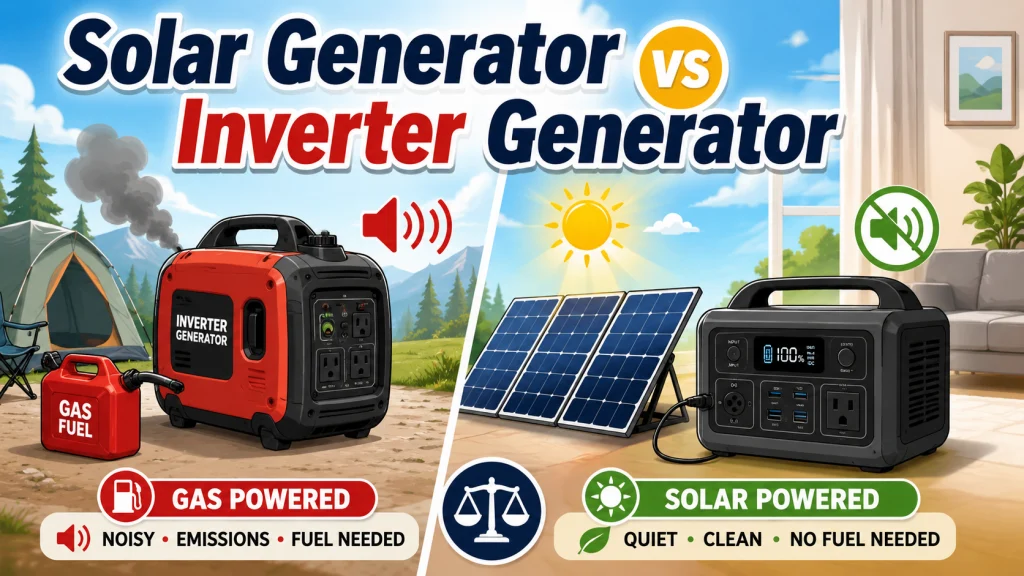
Two Products, One Confusing Name
The confusion is understandable. Both products are portable. Both deliver AC power. Both appear side by side in search results and sometimes in the same retail stores. Add in the fact that “inverter” is also a core component inside every solar generator, and it is easy to see why a buyer might assume these are variations of the same thing. At the shop, I ran into this regularly. Someone would come in asking about an inverter generator, and it would take a few questions to figure out whether they actually wanted gas power or battery power, because they genuinely did not know there was a difference.
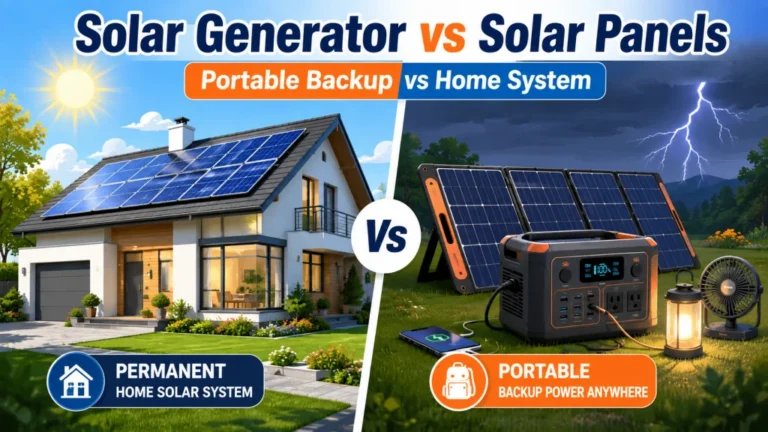
Here is the plain-language distinction. An inverter generator is a gas-powered engine with electronic circuitry that turns generator output into cleaner, more stable power. It still burns fuel. It still produces exhaust. It still makes engine noise. The word “inverter” in the name refers to the electronics inside the unit, not the power source. A solar generator, by contrast, is a rechargeable battery with a built-in inverter and charge controller. It stores energy from solar panels or a wall outlet and delivers AC or DC power without combustion. These are not different versions of the same product.
What an Inverter Generator Actually Is and Why It Exists
Conventional portable gas generators can produce rough, inconsistent AC power. Voltage and frequency may fluctuate as the engine speed changes under different loads. For running a sump pump during a flood or keeping power tools moving on a job site, that may be perfectly adequate. For charging a laptop, running a CPAP machine, or powering any appliance with sensitive electronics, it can be a problem. Unstable AC output can damage those devices or cause them to malfunction in ways that are not immediately obvious.
Inverter generators solved that problem by adding a conversion step between the engine and the outlet. The engine generates power, that power is converted to DC, and then the inverter turns it back into a clean, stable AC sine wave. The output more closely matches what comes from a household wall outlet. The practical result is a generator that can run quieter than a conventional model because the engine speed throttles up and down to match demand instead of running at full speed constantly. Quality inverter generators typically operate between 48 and 60 dB at partial load, compared to 70 to 80 dB or more for conventional models. That is a meaningful difference if you are camping, if neighbors are nearby, or if the generator is running close to where people are sleeping.
Field Note: At the shop, the most common question from RV owners and campers was not about solar at all. It was simple: which generator is quietest? For a long time, the honest answer was usually an inverter generator. What changed the conversation was when solar generators reached 2,000Wh and above at a reasonable price. Once the capacity was high enough to handle overnight and weekend loads, the noise difference became the deciding factor for many buyers.

Starting at 2kWh and expandable to 6kWh with two additional batteries, this LFP station reaches 80% in just 43 minutes via combined AC and solar input. Its 3,000-cycle battery outlasts the industry average by 6 times and includes a 5-year service guarantee. With 2,400W output across 15 outlets and X-Boost pushing to 3,400W, it handles 99% of household appliances at a whisper-quiet 30 dB.
Check On AmazonIf you click this link and buy, we earn a commission at no additional cost to you.
Where the Specifications Diverge
Both product types can cover similar output wattage ranges. A typical inverter generator delivers 1,500 to 4,000 continuous watts. A typical solar generator in the same functional tier can also deliver 1,500 to 4,000 continuous watts. The price ranges overlap as well: inverter generators generally run from $600 to $1,500 for quality units, while solar generators range from $500 to $3,000 depending on battery capacity. That surface-level similarity is what makes the comparison feel reasonable. The differences that matter are not in the wattage column.
Runtime is the first real divide. An inverter generator runs as long as it has fuel. Fill the tank and it runs for 4 to 8 hours; refill it and it runs again. A solar generator runs until the battery is depleted. For a 2,000Wh unit running a combined load of around 200 watts, that usually means roughly 8 to 9 hours before it needs to recharge. The second divide is exhaust. An inverter generator produces combustion exhaust and cannot be used indoors. A solar generator produces none. The third divide is noise. The quietest inverter generators on the consumer market hover around 48 to 52 dB at partial load, which is about the level of a quiet conversation. A solar generator at rest produces zero dB because there is no engine running. During AC charging, a cooling fan may run at 30 to 50 dB. During battery discharge with no external charging, most units are completely silent.
| Specification | Inverter Generator (Gas) | Solar Generator (Battery) |
|---|---|---|
| Fuel source | Gasoline | Stored battery energy from solar panels or wall charging |
| Exhaust | Yes, combustion exhaust | None |
| Noise at load | 48 to 60 dB | 0 to 30 dB |
| Runtime | Unlimited with fuel | Depends on battery capacity and load |
| Continuous output (typical) | 1,500 to 4,000W | 1,500 to 4,000W |
| Price range | $600 to $1,500 | $500 to $3,000 |
| Indoor safe | No | Yes |
| Ongoing fuel cost | Every use | None after initial purchase |
| Maintenance | Oil changes, spark plugs, fuel stabilizer | Minimal, battery management only |
The table makes clear that these are different tools even when the output wattage is similar. They overlap in power delivery capability. They diverge in how that power is produced, stored, and delivered. For most buyers, one or two rows in that table will be the deciding factor, and the better choice usually becomes obvious quickly.

This compact plug-in monitor tracks the energy consumption of any AC 115-volt appliance and displays real-time readings of volts, amps, and wattage at 0.2 to 2.0 percent accuracy. Its large LCD screen lets you calculate electricity costs by the day, week, month, or year, making it easy to spot energy-hungry devices and trim your utility bill. It is also compatible with inverters, adding flexibility for off-grid setups.
Check On AmazonIf you click this link and buy, we earn a commission at no additional cost to you.
When Each Product Actually Has the Advantage
An inverter generator has a genuine edge when runtime is the primary constraint. Remote construction sites without grid access, off-grid locations with poor solar exposure, extended outages beyond two or three days, and high continuous loads that would drain a battery bank in a few hours are all situations where gas power has the advantage. If you need to run a 2,400-watt air conditioner continuously for six or more hours, that is a gas situation. A solar generator large enough to handle that load for that long would cost significantly more than an inverter generator, and it would be depleted at the end of the run with no guarantee that solar recharging would be available before you need it again. Gas generators do not have this problem as long as you have fuel on hand.
A solar generator wins wherever noise, exhaust, or indoor use are real constraints. Campgrounds with enforced quiet hours. Apartments or houses where running a gas engine outside is not practical. Basements and indoor spaces where exhaust cannot be safely vented. CPAP machines running overnight in a tent. Any situation where power needs to be silent, fuel-free, and exhaust-free. There is also the fuel cost consideration. Once you have the unit and the solar panels, recharging from sunlight costs nothing. An inverter generator requires fuel every time it runs, and during extended outages when fuel availability becomes uncertain, that dependency matters in ways that are easy to underestimate until you are actually in the situation. For a full look at how solar generators stack up against other portable battery options beyond just the inverter generator comparison, the comparison between solar generators and portable power stations covers the distinctions buyers often ask about at the same time.
- Inverter generator makes more sense when: you need continuous runtime well beyond what a battery can provide, you are running sustained loads above 3,000 watts, solar recharging is impractical for your location or the season, or you need the lowest upfront cost per watt of continuous output for heavy-use situations.
- Solar generator makes more sense when: noise is a real constraint, indoor use is required, you want zero fuel dependency and free recharging from solar, you need clean and silent power for sensitive electronics, or you want a product that requires essentially no maintenance and no fuel storage.
- Both together makes sense when: extended multi-day outages are a realistic concern for your area and you want battery power for everyday convenience and quiet overnight use, plus a gas option as backup for worst-case scenarios. This is a common setup among serious off-grid users and prepared households.

Built with IBC cells at 25% conversion efficiency, this bifacial panel absorbs sunlight from both sides and bends up to 221 degrees to conform to curved surfaces like car roofs and balconies. At just 4.52 lbs it is 56% lighter than rigid panels, and IP68 waterproofing plus IEC TS 63163 certification across 19 international tests ensure reliable output from -40 to 85 degrees Celsius. A 3-meter flat cable enables flexible installation in under 5 minutes.
Check On AmazonIf you click this link and buy, we earn a commission at no additional cost to you.
Final Thoughts: Same Word, Very Different Products
The inverter in “inverter generator” refers to the electronics inside a gas-powered engine unit. It has nothing to do with solar energy or battery storage. Once that distinction is clear, the two products sort themselves without much debate. One burns fuel and produces exhaust. The other stores energy and produces neither. They overlap on output wattage and price range, but they diverge sharply on the factors that determine whether a product actually fits a given situation.
From what I have seen at the shop and from running my own setup, many buyers who start by asking about inverter generators reconsider once the noise and exhaust differences are laid out plainly. The exceptions are real and worth respecting: sustained high loads, extended runtime without reliable sun, and remote locations where fuel is manageable but solar is not are all legitimate cases for gas. For everything else, if silence and no exhaust matter to you, the choice becomes straightforward. If you are still working through the full landscape of portable power options before making a decision, the complete solar generator guide covers the full picture from understanding the technology to identifying the right specifications for your specific situation.

This 1kWh LFP battery station charges from 0 to 80% in just 50 minutes via AC input, and its LiFePO4 chemistry delivers a 3,000 plus cycle lifespan that is roughly 6 times longer than standard lithium batteries. Capacity is expandable up to 3kWh with additional batteries, making it well suited for camping, RVs, or off-grid living. Its 1,800W output powers across 15 outlets, handling around 90% of household appliances, and accepts up to 500W of solar input for clean, fuel-free charging. The package includes a 5-year customer service guarantee.
Check On AmazonIf you click this link and buy, we earn a commission at no additional cost to you.
FAQs
⚡ Is an inverter generator the same as a solar generator?
No. An inverter generator is a gasoline-powered engine with electronic circuitry that produces cleaner AC output. A solar generator is a rechargeable battery system with no engine and no fuel. The word “inverter” in inverter generator refers to internal electronics, not any connection to solar energy or battery storage.
🔇 Which is quieter, a solar generator or an inverter generator?
Solar generators are significantly quieter. A quality inverter generator runs at roughly 48 to 60 dB at partial load. A solar generator at rest produces zero dB because there is no engine running. During battery discharge, most units are completely silent.
🏠 Can you run an inverter generator indoors?
No. Inverter generators burn gasoline and produce carbon monoxide. Running one indoors or in an attached garage is dangerous and potentially fatal. Solar generators produce no exhaust and are safe for indoor use.
🔋 Can a solar generator and an inverter generator be used together?
Yes. Many off-grid and emergency prep setups use both. The solar generator handles day-to-day quiet use and overnight loads; the inverter generator serves as backup for extended cloudy periods or high-draw situations that exceed battery capacity. They are complementary rather than competing in serious setups.
⛽ Can an inverter generator charge a solar generator?
Yes, if the solar generator has an AC input port, it can accept a charge from any AC source, including an inverter generator. This is a practical strategy during extended stretches of cloudy weather when solar input alone is not enough to keep the battery topped up.
💰 Which is cheaper to run long term, a solar generator or an inverter generator?
A solar generator is cheaper to run over time if solar recharging is practical for your situation. Once you have the unit and panels, recharging costs nothing. An inverter generator requires fuel every time it runs. For light to moderate use, the fuel cost difference adds up quickly over months and years.