The Number Most Solar Generator Articles Refuse to Print
According to EIA data on residential electricity consumption, the average American household uses approximately 863 kilowatt-hours per month, which works out to about 28.8 kilowatt-hours per day. That is the baseline number this question requires, and almost no solar generator buying guide includes it.
The reason is obvious once you see it. A 28.8 kWh daily demand compared against the capacity of even the largest portable unit on the market makes the whole-home replacement pitch fall apart immediately. A top-tier portable unit at around 5,000 watt-hours covers roughly 17 percent of one average day’s home energy use. At that rate, a single charge runs out in four to five hours if the home draws at its normal average rate, and significantly faster during the evening peak when heating, cooking, and high-draw appliances overlap.
To sustain an average home through a cloudy week without any grid or generator supplementation would require approximately 30,000 watt-hours of battery capacity and 6,000 watts of solar panel input. That combination exists in the market. It is called a whole-home battery storage system, it requires professional installation, and it costs $15,000 to $30,000 or more depending on the scope. A portable solar generator is not that product and was never designed to be. Understanding that difference is what separates a purchase that delivers what the buyer expected from one that disappoints within the first real outage.
Field Note: The whole-home question came in two versions at the shop. The first version was a homeowner who had just lost power for four days during an ice storm and wanted a solution that would let them live normally next time. The honest answer to that version was usually a permanent installation, not a portable unit, and I said so directly. The second version was someone who wanted to keep the essentials running during typical outages of 12 to 36 hours. The honest answer to that version was a 2,000 to 3,000Wh unit with a few hundred watts of panels, and I sold a lot of those setups. The two questions look similar on the surface but require completely different answers.

Starting at 2kWh and expandable to 6kWh with two additional batteries, this LFP station reaches 80% in just 43 minutes via combined AC and solar input. Its 3,000-cycle battery outlasts the industry average by 6 times and includes a 5-year service guarantee. With 2,400W output across 15 outlets and X-Boost pushing to 3,400W, it handles 99% of household appliances at a whisper-quiet 30 dB.
Check On AmazonIf you click this link and buy, we earn a commission at no additional cost to you.
The Critical Load Approach: What a Portable Unit Can Actually Do
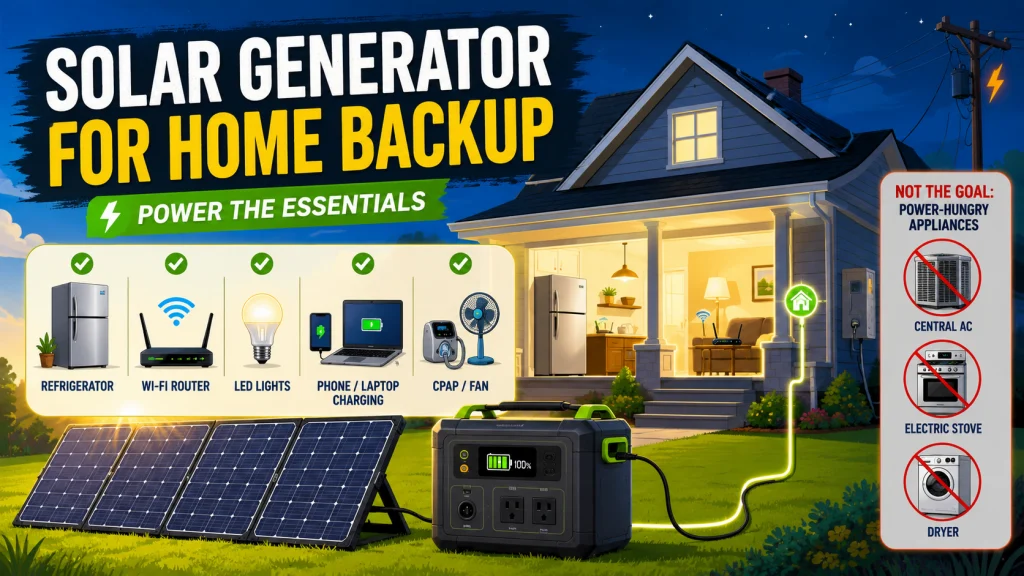
The right framing for this question is not “can it power my house” but “can it power the things I actually cannot lose during an outage.” For most households, that list is shorter than it initially feels. Refrigerator, router, a few lights, phone and laptop charging, and if applicable a CPAP machine or a medical device. Those loads together rarely exceed 3,000 to 5,000 watt-hours per day, which is a very different number from 28.8 kilowatt-hours.
| Critical Load | Typical Draw | Hours/Day | Daily Wh |
|---|---|---|---|
| Full-size refrigerator | 100 to 200W average | 24 hours (cycling) | 800 to 1,600Wh |
| Router and modem | 10 to 20W | 24 hours | 240 to 480Wh |
| LED lighting (5 to 8 fixtures) | 30 to 60W | 6 hours | 180 to 360Wh |
| Phone and laptop charging | 30 to 60W | 3 to 4 hours | 90 to 240Wh |
| CPAP without humidifier | 15 to 30W | 8 hours | 120 to 240Wh |
| CPAP with humidifier | 40 to 80W | 8 hours | 320 to 640Wh |
| Small fan | 20 to 40W | 8 hours | 160 to 320Wh |
A household running a refrigerator, router, lights, device charging, one CPAP configuration, and a small fan lands somewhere between 2,000 and 3,800 watt-hours per day for critical loads only. A 3,000Wh unit paired with 400 watts of solar panels covers that range in most conditions during a standard single or two-day outage, recharging during daylight and providing overnight runtime from stored capacity. For typical outages of under 48 hours, this is a genuine and practical solution.
The loads that blow this math apart are the ones people tend to forget to separate from the essential category. Central air conditioning at 3,500 to 5,000 watts. Electric water heater at 4,500 watts running heating cycles. Electric range at 3,000 to 7,000 watts while cooking. Clothes dryer at 5,500 watts. Each of those individually exceeds the continuous output of most portable solar generators, and running them draws down a 3,000Wh battery in under an hour of operation. They are not critical loads in the outage sense of the term. They are comfort loads, and the distinction matters enormously for sizing.
Sizing for whole-home coverage and expecting to run everything normally. This leads to a unit that handles two hours of actual home demand and leaves the buyer frustrated during the first real outage.
Listing the specific loads you genuinely cannot live without for 24 to 72 hours, calculating their combined daily watt-hours, and sizing the battery and panel input for that number with a day of buffer.

Built with monocrystalline cells at 22.4% conversion efficiency, this 35.3 lb foldable panel uses MPPT optimization when paired with EcoFlow power stations for peak output in any weather. Layered EVA and fiberglass construction with IP68 waterproofing ensures long-term durability on the road, and the adjustable carry case makes transport straightforward.
Check On AmazonIf you click this link and buy, we earn a commission at no additional cost to you.
The Partial-Home Strategy: Subpanel Transfer Switch
There is a middle path between plugging individual appliances directly into a portable solar generator and replacing the entire home electrical system with a whole-home battery installation. It is called a manual transfer switch, and it allows a portable solar generator to feed power to a dedicated subpanel of selected circuits rather than requiring extension cords to every appliance in the house.
The setup requires a licensed electrician to install a transfer switch, which connects between the main electrical panel and a smaller subpanel of circuits you select in advance. During an outage, you connect the solar generator to the transfer switch input, flip the switch, and those selected circuits receive power normally from the generator. Lights turn on with wall switches. The refrigerator runs from its regular outlet. The router stays connected to its cable. The setup looks and functions exactly like normal home power for those selected circuits, with the solar generator supplying the electricity instead of the grid.
The practical constraint is total load. The circuits connected to the subpanel still draw their normal wattage, and the sum of all active loads must stay within the solar generator’s continuous output rating. Selecting a fridge circuit, two lighting circuits, an outlet circuit for device charging, and the internet equipment circuit typically totals 400 to 600 watts of combined draw, well within the output of any 2,000Wh-class or larger portable unit. The transfer switch installation typically runs $300 to $600 in materials and labor depending on the panel configuration and local rates. For buyers who want the convenience of not running extension cords during an outage, that cost is usually worth it.
Pro Tips: Decide which circuits belong on the subpanel before calling an electrician. Fridge, one or two lighting circuits, the outlet where the router and modem plug in, and any medical device circuit are the typical selections. Adding a circuit for the garage door opener is worth the marginal cost if you live somewhere where the car is your primary outage transport. Circuit selection is much easier to change at installation time than afterward.

This compact plug-in monitor tracks the energy consumption of any AC 115-volt appliance and displays real-time readings of volts, amps, and wattage at 0.2 to 2.0 percent accuracy. Its large LCD screen lets you calculate electricity costs by the day, week, month, or year, making it easy to spot energy-hungry devices and trim your utility bill. It is also compatible with inverters, adding flexibility for off-grid setups.
Check On AmazonIf you click this link and buy, we earn a commission at no additional cost to you.
When the Honest Answer Is a Permanent Installation
A portable solar generator is the right answer for a specific set of home backup scenarios. It is not the right answer for every scenario, and being clear about the distinction is more useful than selling everyone on a portable unit regardless of what they actually need.
If you experience extended outages of five days or more on a regular basis, particularly in winter with limited solar input and high heating demand, the portable category does not have a product that addresses your situation adequately. A 5,000Wh unit covers 17 percent of average daily home consumption. Stringing together multiple units improves that figure but adds cost rapidly and still does not eliminate the dependence on grid charging between depleted cycles if the sun is not cooperating. The math points toward a permanently installed whole-home battery system for that situation, and any conversation that suggests otherwise is not giving you accurate information.
Similarly, if you want to meaningfully offset your utility bill on an ongoing basis through renewable generation rather than just provide backup coverage during outages, a portable solar generator is not the tool. The economics of offsetting daily home consumption require a permanent rooftop solar installation connected to the grid or a fixed battery bank. Portable units are designed for backup, portability, and off-grid scenarios with modest loads. They are not designed as grid offset tools.
For buyers deciding between portable and permanent options, or trying to understand where the off-grid solar generator category fits relative to other power solutions, the off-grid solar generator guide covers the honest capacity boundaries for cabins, tiny homes, whole-home use, and other specific scenarios. And if you are still early in evaluating whether any portable solar setup makes sense for your situation, the complete solar generator guide covers how to approach the buying decision from the beginning before narrowing to any specific use case.

At 39.5 lbs with 2,042Wh capacity and 2,200W output, this CTB-built station is 41% lighter and 34% smaller than typical 2kWh units. It charges from 0 to 80% in just 66 minutes via AC, operates at under 30 dB in silent mode, and switches to UPS backup in under 20 milliseconds. The LiFePO4 battery is rated for a full 10-year lifespan.
Check On AmazonIf you click this link and buy, we earn a commission at no additional cost to you.
Final Thoughts: The Right Question Gets the Right Answer
The answer to “can a solar generator power a house” is yes, for the things that matter most during a typical outage, for the duration of most outages in most parts of the country. A 2,000 to 3,000Wh unit handling a refrigerator, router, lights, and device charging is a legitimate solution for the homeowner whose outages last one to three days and whose heating and cooking do not depend entirely on electricity.
The answer to “can a solar generator replace my utility connection permanently for a standard home” is no, and that answer is not going to change based on which unit you buy. The gap between 5,000Wh portable capacity and 28.8 kWh average daily home consumption is too large to bridge with a portable product at any price point currently on the market.
Knowing which question you are actually asking determines which answer applies to you, and that distinction is worth clarifying before any purchase decision in this category.
FAQs
🏠 Can a solar generator run a whole house?
Not for more than a few hours at full home load. The average US home uses 28.8 kWh per day. The largest portable solar generator holds about 5 kWh, roughly 17 percent of one day’s average usage. For full home replacement you need a permanently installed battery system. For critical loads only during outages, a portable unit in the 2,000 to 3,000Wh range is a genuine solution.
⚡ How long can a solar generator power a house?
It depends entirely on the load. Running critical loads only, such as a fridge, router, lights, device charging, and a fan totaling roughly 300 to 500W, a 3,000Wh unit lasts approximately 5 to 8 hours before hitting the 20 percent reserve threshold. Paired with 400W of solar panels and reasonable daytime sun, it can stretch runtime significantly and may cover a daily critical-load budget if solar harvest exceeds the energy used that day. In cloudy weather or with heavier loads, it still needs grid or generator recharge.
🔌 What appliances can a solar generator run in a house?
A 2,000 to 3,000Wh unit handles a refrigerator, router, LED lighting, phone and laptop charging, and a CPAP machine without difficulty. It cannot sustain central air conditioning, electric water heaters, electric ranges, or electric dryers, all of which draw 3,500 to 7,000W and would deplete the battery within an hour or less of operation.
🔧 What is a transfer switch and do I need one?
A manual transfer switch connects between your main electrical panel and a smaller subpanel of selected circuits. During an outage, you connect the solar generator to the transfer switch and those circuits receive normal wall-outlet power rather than requiring extension cords. Installation requires a licensed electrician and typically costs $300 to $600. It is worth it if you want the convenience of running selected circuits normally rather than managing extension cords during an outage.
📊 How much battery capacity does a house need for full backup?
For full home backup through a week-long cloudy outage, the math requires approximately 30,000Wh of battery capacity and 6,000W of solar input. That is a permanently installed whole-home battery system, not a portable unit. For critical-loads-only coverage during typical 1 to 3 day outages, a portable unit in the 2,000 to 3,000Wh range with 400W of solar handles the job adequately.
🌞 Can solar panels keep a house running continuously?
With adequate battery storage and panel capacity, yes, but not with a portable setup at current technology and price points. Sustaining average home consumption continuously requires a permanently installed system. A portable solar generator with panels can sustain critical loads during favorable daylight conditions and draw from battery storage overnight, which is sufficient for outage backup but not equivalent to grid replacement.