
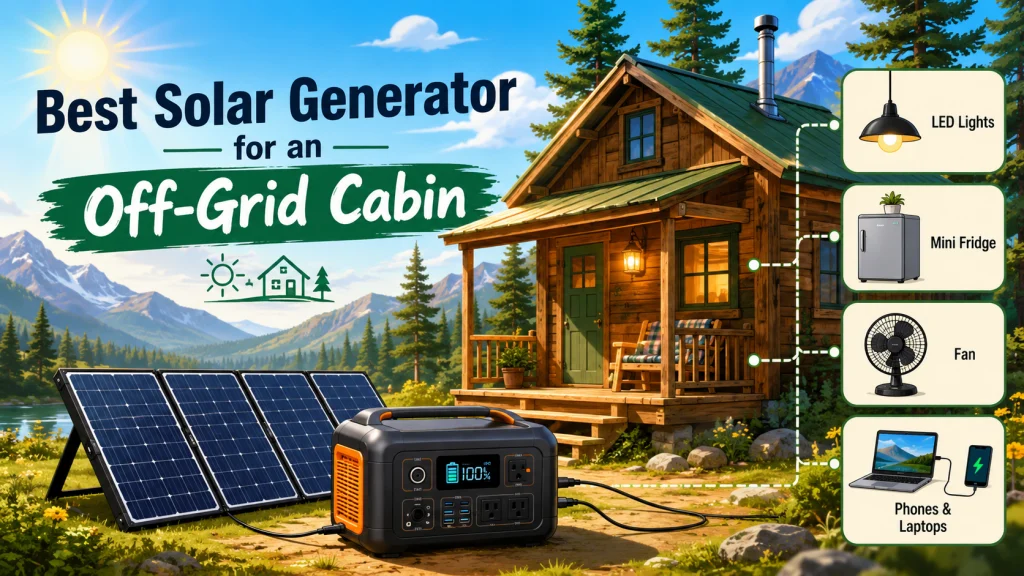
Why the Daily Load Audit Comes Before Anything Else
Every cabin solar generator purchase I have seen go well started in the same place: a list of what the cabin actually needs to power, with a wattage number next to each item. Not a brand comparison, not a price search, and not a YouTube recommendation. Start with the load list. Starting there takes about ten minutes and determines every other decision in the setup, from battery capacity to panel count to whether propane covers certain loads better than electricity ever could.
The most common mistake I ran into at the shop was buyers who came in with a square footage number or a vague sense of how big the cabin was and wanted a unit that would handle it. Square footage tells you nothing about power demand. A 400-square-foot cabin with LED lights, a 12V compressor fridge, and a phone charger uses a fraction of what the same cabin would use with an electric range, a full-size water heater, and a window air conditioner. The loads determine the sizing. The cabin dimensions do not.
For the vast majority of off-grid cabins used seasonally or on weekends, the load profile is modest enough that a portable solar generator is not just adequate, it is often the most practical solution available, especially compared to the cost and complexity of a permanently installed battery system. The math that confirms this starts with the load audit.
Running the Cabin Daily Load Audit
A cabin load audit does not require an electrical engineering background. You need two numbers for each device: how many watts it draws, and how many hours per day it typically runs. Multiply those two numbers together to get watt-hours. Add up the watt-hours for everything on the list and you have your daily energy budget.
Here is what a realistic weekend cabin load profile looks like with actual numbers:
| Load | Watts | Hours/Day | Daily Wh |
|---|---|---|---|
| LED lighting (4 to 6 fixtures) | 20W | 5 hours | 100Wh |
| 12V compressor refrigerator | 40 to 60W average | 24 hours | 960 to 1,440Wh |
| Full-size refrigerator (if present) | Varies widely | 24 hours | 1,000 to 3,000Wh |
| Device charging (phones, laptop) | 20 to 40W | 3 hours | 60 to 120Wh |
| Ceiling fan or box fan | 20 to 40W | 8 hours | 160 to 320Wh |
| TV or entertainment (occasional) | 50 to 80W | 2 hours | 100 to 160Wh |
| Water pump (if pressure system) | 300 to 500W | 0.5 hours | 150 to 250Wh |
A cabin running a 12V compressor fridge, lights, a fan, device charging, and occasional entertainment lands in the 1,400 to 2,100Wh range per day. A cabin with a full-size refrigerator instead of a compact 12V unit can push higher depending on the refrigerator’s age, efficiency, ambient temperature, and duty cycle. That single decision, fridge type, is often the difference between a 2,000Wh setup being sufficient and needing to step up to 3,000Wh or more.
Field Note: Fridge type was the spec that most often surprised cabin buyers. Someone would come in having done a rough load calculation and feeling confident about a 1,000Wh unit. Then I would ask what kind of fridge they had at the cabin. A standard household refrigerator may draw 100 to 150W when the compressor is running, but its actual daily consumption depends on how often it cycles. Efficient newer units may land closer to 1,000 to 2,000Wh per day, while older or less efficient units can push higher. A good 12V compressor fridge usually draws less and is often easier to support from a portable solar setup. Upgrading the fridge was almost always cheaper than upgrading the solar generator.
Once you have your daily total, add 15 to 20 percent for inverter conversion losses, which represent real energy that gets consumed in the process of converting stored DC battery power to AC for your outlets. A 2,000Wh daily load needs a system capable of delivering approximately 2,300 to 2,400Wh of usable energy each day to sustain it reliably.

This 40-liter compressor fridge chills down to negative 4 degrees Fahrenheit without ice, cooling from 77 to 32 degrees Fahrenheit in just 30 minutes with MAX or ECO mode. It holds up to 54 standard 12oz cans and runs efficiently on small solar setups. Three-level battery protection keeps your vehicle battery safe, and the stainless steel build with corner guards and a durable handle is built to travel.
Check On AmazonIf you click this link and buy, we earn a commission at no additional cost to you.
The 3,000Wh and 600W Formula: Why This Combination Works
For a cabin with a daily load in the 1,500 to 2,000Wh range, a 3,000Wh LFP unit paired with 600 watts of solar panels is the practical target. The math behind that pairing is worth understanding because it explains why the combination produces a genuinely self-sustaining setup under normal summer conditions and provides enough buffer for the occasional cloudy day.
Six hundred watts of solar panels in six good peak sun hours produces 3,600Wh of energy input. That is the daily solar gain. If daily consumption runs 2,000Wh including conversion losses, the solar gain exceeds consumption by 1,600Wh. Over a clear day, the battery finishes the day fuller than it started. Over a partly cloudy day at 50 percent efficiency, solar input drops to approximately 1,800Wh, which roughly matches consumption without drawing down the battery much. Over a heavy overcast day at 20 percent efficiency, solar input falls to about 720Wh and the battery absorbs the remaining deficit from its stored capacity. A 3,000Wh battery in that scenario still has meaningful reserve left, assuming the system started the day near full.
In practice, most cabin locations in the continental US get enough sun during spring, summer, and fall to sustain a well-sized setup without drawing heavily on the battery reserve. Winter and extended cloudy stretches are where planning matters, and the seasonal-use pattern of most cabins reduces that concern significantly.
Key point: LFP battery chemistry is the right choice for a cabin setup specifically because of the cycle life. A unit used every weekend from April through October accumulates roughly 25 to 30 charge cycles per year. At that rate, cycle count is unlikely to be the limiting factor for most seasonal cabin owners. Storage temperature, calendar aging, and how the unit is stored between visits will usually matter more than cycle wear.

With a 3,600Wh LFP battery expandable up to 25kWh via extra batteries or smart generators, this station delivers 3,600W across 15 output ports, boosted to 4,500W with X-Boost or 7,200W when two units are paired. A full recharge takes just 1.8 hours via 240V or 2.8 hours with 1,600W of solar input. It may also qualify for the 30% Residential Clean Energy Tax Credit.
Check On AmazonIf you click this link and buy, we earn a commission at no additional cost to you.
The Seasonal-Use Advantage Most Buyers Overlook
A cabin used on weekends rather than full-time has a meaningful advantage that daily-use setups do not: the battery recharges during the week while the cabin sits empty. This changes the sizing calculation in an important way. A cabin owner does not need the solar input to fully replace daily consumption in real time. They need the system to arrive at Friday with a full or near-full battery and run through the weekend without depleting below a safe reserve.
A small permanently mounted 100W panel on the cabin roof, connected to the solar generator during the week, replenishes whatever was used the previous weekend in a few days of modest sun. Arriving at the cabin Friday evening with a nearly full battery means the weekend can run mostly from stored capacity, with whatever solar input comes in on Saturday and Sunday contributing but not required to fully sustain the load. That low-pressure charging dynamic is a significant advantage over a full-time off-grid setup where every day’s consumption must be offset by that same day’s solar input.
For the broader picture of how cabin solar fits into the off-grid solar generator category alongside tiny homes, well pump considerations, and whole-home use cases, the off-grid solar generator guide covers the honest capacity boundaries for each situation. The cabin use case is the strongest fit for portable solar in that entire category, which is worth understanding before sizing for the specific situation that applies to you.
What Belongs on Propane Instead of Your Solar Generator
Three appliances consistently push cabin loads beyond what a portable solar setup can sustain. They all share the same characteristic: they convert electricity to heat, which is one of the least efficient ways to use stored battery energy. Running them from a solar generator is technically possible for brief periods, but building a cabin setup around them makes the math unworkable.
- Electric cooking range: A standard electric range draws 3,000 to 7,000W on active burners. Even a brief cooking session consumes 500 to 1,500Wh. A two-burner propane camp stove or a propane range solves this completely and costs far less per unit of cooking energy than inverter-converted battery power.
- Electric water heater: A standard tank water heater draws 4,500W during heating cycles and may consume 3,000 to 5,000Wh per day. A propane tankless water heater eliminates this load entirely, provides on-demand hot water, and uses no electricity beyond a small ignition circuit that draws under 5W.
- Central or window air conditioning: A window AC unit drawing 900W running continuously for eight hours uses 7,200Wh. No portable solar generator setup in the 3,000Wh range sustains that load for a full day. Ceiling fans at 20 to 40W, good insulation, and cross-ventilation are the practical alternatives for most seasonal cabins where nights cool off.
Remove those three loads from the electrical budget and what remains, lighting, refrigeration, device charging, entertainment, fans, and a small water pump if needed, is entirely manageable. Many cabin owners are already running propane for cooking and heating out of habit or because grid extension to the property was never practical. For those setups, the transition to solar generator power for everything else is a natural fit that does not require lifestyle changes.
Note: If your cabin has a traditional full-size water heater and an electric range, the solar sizing math changes significantly. Before calculating battery capacity, confirm which of those loads you can shift to propane. The answer affects whether you need a 3,000Wh unit or a 5,000Wh unit, which is a meaningful cost difference at purchase.

Putting out 20,000 total BTUs across 2 adjustable burners, this portable stove fits a 12-inch and 10-inch pan simultaneously and runs up to 1 hour on a single 16.4 oz propane cylinder. Wind-blocking panels and a pressure regulator ensure consistent performance in tough outdoor conditions. Backed by a 3-year limited warranty.
Check On AmazonIf you click this link and buy, we earn a commission at no additional cost to you.
Sizing the Right Way: Battery, Panels, and Buffer in One Calculation
The sizing sequence that works consistently is: run the load audit, identify any loads that belong on propane and remove them, add 15 to 20 percent for conversion losses, and then size the battery to cover one and a half to two days of that adjusted daily total. The two-day buffer is the insurance policy against a single cloudy day drawing the battery below a comfortable reserve.
For panel sizing, the formula is your adjusted daily consumption divided by the average peak sun hours in your cabin’s region. Most continental US locations average between 4 and 6 peak sun hours during the cabin season. A 2,000Wh daily load in a location with 5 peak sun hours requires 400W of panel wattage to fully recharge in a single day. Always add 20 to 25 percent to the panel wattage calculation to account for real-world efficiency losses from non-ideal angle, temperature, and partial cloud cover. The theoretical requirement of 400W translates to a practical panel rating of 480 to 500W. For the detailed input-side math including how your unit’s maximum solar input rating affects how many panels you can usefully add, the solar generator guide covers panel and battery sizing from the beginning for buyers still working through the full decision.
The sizing process is not complicated, but skipping steps in it is what produces the frustrated mid-season discovery that the setup runs out of power by Sunday evening. A cabin solar system that is sized correctly runs quietly in the background, never requires anxious monitoring of battery percentages, and still has charge remaining when you pack up to leave.

Built with N-Type cells at 25% conversion efficiency, this 15.9 lb foldable panel includes a 30 to 60 degree adjustable bracket with an integrated angle guide for optimal sun tracking throughout the day. ETFE coating and an IP68 waterproof rating ensure durability in harsh weather, and the included protective bag makes transport straightforward for camping, trekking, or road trips.
Check On AmazonIf you click this link and buy, we earn a commission at no additional cost to you.
Final Thoughts: The Cabin Is the Best-Fit Use Case for Portable Solar
The off-grid cabin is where portable solar generators make the most sense of any use case in the category. The loads are modest. The seasonal-use pattern allows a relaxed recharge cycle between visits. The propane-electric hybrid setup that handles cooking and water heating is often already in place. And the alternative, a permanently installed battery system, is expensive to purchase and requires electrical work that a portable unit entirely avoids.
The buyers who end up happiest with a cabin solar setup are the ones who run the load audit before they buy, size the battery for a day and a half to two days of consumption rather than a single day, and make the propane decision before they finalize the electrical budget. Those three steps consistently produce systems that work as expected rather than systems that get replaced or expanded after the first full season of use.

This compact plug-in monitor tracks the energy consumption of any AC 115-volt appliance and displays real-time readings of volts, amps, and wattage at 0.2 to 2.0 percent accuracy. Its large LCD screen lets you calculate electricity costs by the day, week, month, or year, making it easy to spot energy-hungry devices and trim your utility bill. It is also compatible with inverters, adding flexibility for off-grid setups.
Check On AmazonIf you click this link and buy, we earn a commission at no additional cost to you.
FAQs
🏕️ What size solar generator do I need for an off-grid cabin?
For a cabin with a 12V compressor fridge, LED lighting, device charging, and a fan, daily consumption typically runs 1,400 to 2,100Wh. A 3,000Wh LFP unit with 400 to 600W of panels handles that load comfortably in most US locations during the cabin season. If you have a full-size household refrigerator instead of a compact 12V unit, check the EnergyGuide label or measure actual draw before sizing, because daily consumption can vary widely by model, age, and temperature.
🌞 How many solar panels does an off-grid cabin need?
Divide your daily watt-hour consumption by your region’s average peak sun hours, typically 4 to 6 hours for most of the continental US. A 2,000Wh daily load in 5 peak sun hours requires 400W of panels to fully recharge in a day. Add 20 to 25 percent to that figure for real-world efficiency losses. Also check your unit’s maximum solar input rating before buying panels, since adding more wattage than that limit produces no additional benefit.
🔥 Should I use propane or electric for cooking at an off-grid cabin?
Propane for cooking and water heating is the standard recommendation for off-grid cabin setups, and for good reason. An electric range draws 3,000 to 7,000W during cooking and a water heater draws 4,500W during heating cycles. Both are far too energy-intensive for a portable solar battery to sustain. A two-burner propane stove eliminates thousands of watt-hours from your daily electrical budget.
🔋 What battery chemistry is best for a seasonal cabin solar setup?
LFP (lithium iron phosphate) is the clear choice for a seasonal cabin. Weekend cabin use might accumulate 25 to 30 charge cycles per year. At that rate, cycle count is unlikely to be the limiting factor for most seasonal cabin owners. LFP also tolerates storage at partial charge better than NMC chemistry, which matters for a setup that sits unused for weeks between visits.
☁️ What happens at the cabin during a cloudy weekend?
A properly sized setup handles one cloudy day by drawing from battery reserve. If the panels still bring in 600 to 800Wh on an overcast day, a 3,000Wh battery can usually stay above the 20 percent reserve line with a 2,000Wh daily load. Without meaningful solar input, that same daily load leaves only about 400Wh of cushion above the reserve threshold, so two fully cloudy days may require load reduction or a backup recharge plan.
💡 Can I leave a solar panel permanently mounted at the cabin while I am away?
Yes, and this is one of the practical advantages of a cabin setup. A single 100W panel permanently mounted and connected to the solar generator continues charging the battery during the week between visits. Arriving at the cabin Friday with a near-full battery eliminates the pressure of needing to fully recharge during the weekend stay itself. For a seasonally used cabin, this passive midweek recharge is a significant operational advantage.