How Simultaneous AC and Solar Charging Actually Works
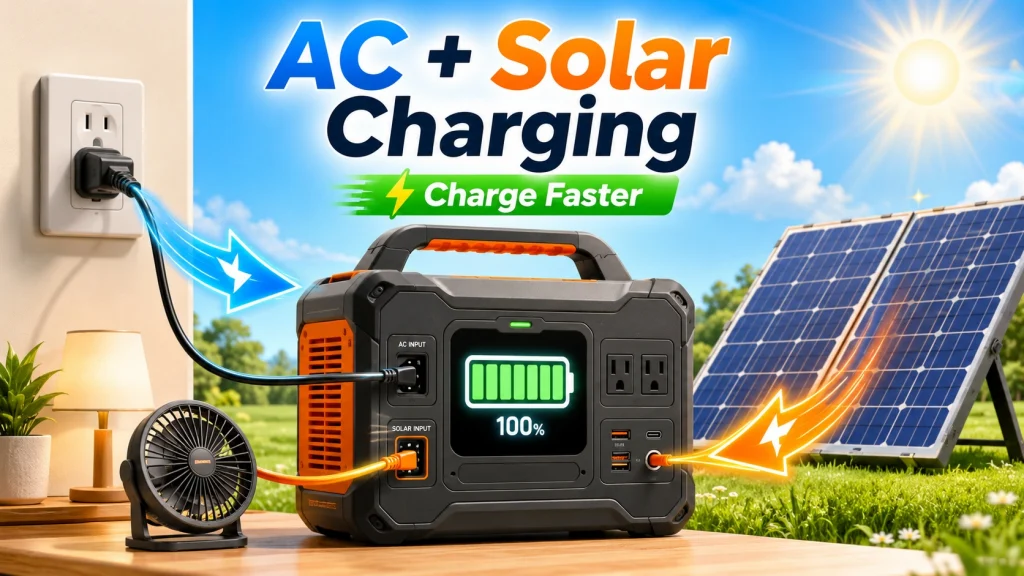
Solar generator simultaneous charging is additive. Whether you have heard it called dual charging, combined input, or just charging from two sources at once, the underlying mechanic is the same: a unit accepting 1,800W from a wall outlet and 400W from connected solar panels is pulling in 2,200W total. On a unit with a maximum combined input ceiling around 2,400W, a roughly 2,000Wh battery can reach 80 percent charge in about 43 minutes, but maximum combined input varies significantly by model, and many units sit well below that ceiling. What matters is understanding the ceiling on your specific unit and making sure both inputs are actually delivering their rated wattage, which is the part most setups fail to achieve.
The first thing to confirm before counting on combined input is that your specific unit supports simultaneous charging. Most do, but not all. The second thing to understand is that each input source has its own ceiling. Your unit has a maximum AC input wattage and a separate maximum solar input wattage. Those ceilings are independent. Adding solar panels beyond the maximum solar input limit produces no additional charging speed, regardless of how many panels you connect. And an AC source that exceeds the unit’s maximum AC input will be capped, not leveraged. Each ceiling is a hard stop. If you want to understand how each charging method works individually, including what limits each one’s real-world performance, that is worth reading before you start optimizing a combination strategy.

Starting at 2kWh and expandable to 6kWh with two additional batteries, this LFP station reaches 80% in just 43 minutes via combined AC and solar input. Its 3,000-cycle battery outlasts the industry average by 6 times and includes a 5-year service guarantee. With 2,400W output across 15 outlets and X-Boost pushing to 3,400W, it handles 99% of household appliances at a whisper-quiet 30 dB.
Check On AmazonIf you click this link and buy, we earn a commission at no additional cost to you.
Charging and Running Loads at the Same Time
Most major portable solar generators in this class support pass-through power, but you should still confirm the pass-through rating and any charging restrictions for your specific model. Assuming it does, you can run appliances from the outlets while the unit is actively charging. The battery is not a one-way valve. What matters is the arithmetic behind the net charge rate, because that is what determines whether you are gaining charge, holding steady, or slowly losing ground while the inputs are active.
Net charge rate equals total input watts minus total load watts. If your unit is accepting 400W from solar and you have a 150W device plugged in, the battery charges at 250W net. If the load exactly matches the input, the battery holds at its current percentage while the solar powers the load directly. If the load exceeds the input, the battery drains at the difference. None of this is a problem as long as you account for it. The mistake is expecting full charge rate regardless of what is running.
Field Note: One of the things I ran into regularly at the shop was buyers who set up solar charging, plugged in a full-size refrigerator, and then wondered why the battery was barely moving after six hours in decent sun. They had a 200W panel producing maybe 150W real output, and the refrigerator was averaging 120W with its compressor cycling. That left 30W net charging rate. At 30W net, a 1,000Wh battery takes over 33 hours to fully charge. The setup was not broken. The math just had not been done.
The table below shows how net charge rate shifts across typical combined input and load scenarios. These numbers apply to any unit operating within its rated input ceilings. The time-to-full column assumes a 1,000Wh battery starting from empty.
| AC Input (W) | Solar Input (W) | Active Load (W) | Net Charge Rate (W) | Est. Time to Full (1,000Wh) |
|---|---|---|---|---|
| 0 | 200 | 0 | 200 | ~5 hrs |
| 0 | 200 | 150 | 50 | ~20 hrs |
| 0 | 400 | 400 | 0 | Battery holds steady |
| 1,000 | 200 | 0 | 1,200 | ~50 min |
| 1,000 | 200 | 400 | 800 | ~75 min |
| 1,800 | 400 | 0 | 2,200 | ~27 min |
The zero net row is worth a closer look. When 400W of solar input is powering a 400W load, the solar is running the appliance directly and the battery is neither gaining nor losing charge. This is actually a useful configuration during peak daylight hours when you want to preserve stored energy for overnight use. The unit acts as a pass-through buffer, the battery sits idle, and the load runs on live solar production. It is a legitimate strategy, not a failure mode.

Featuring 16BB N-Type cells at 25% efficiency, this panel outperforms standard 200W panels and folds down to backpack size at just 13.89 lbs, with a magnetic closure for tool-free setup. Three built-in ports including USB-C PD 45W, and two USB-A ports charge devices directly, while MC4 output connects to most power stations and 12V battery systems. Four adjustable kickstands offer 40, 50, and 60 degree angles, and IP65 rating plus UL 61730 certification ensure durability and safety backed by a 2-year warranty.
Check On AmazonIf you click this link and buy, we earn a commission at no additional cost to you.
The Efficiency Consideration Nobody Mentions
Here is the part that most combined-charging explanations skip. When you have both a wall outlet and a solar panel available at the same time, the watts entering through the solar DC input port are more energy-efficient than the same watts entering through the AC input port. The difference is one conversion step, and that step has a real cost.
AC charging passes incoming power through the unit’s internal AC-to-DC conversion circuit before it reaches the battery cells. That conversion wastes roughly 10 to 15 percent of the energy as heat. Solar input through the DC port goes directly through the MPPT charge controller into the battery, skipping that conversion entirely. If you route your panel watts through an inverter to create AC power and then feed that AC into the wall charging port, you are paying the conversion tax on every one of those watts, every session.
In practice, this matters most for anyone running solar as a near-permanent part of their setup: van lifers, off-grid homesteaders, extended camping setups. If a gas generator is providing AC input and solar panels are also available, the most efficient configuration is panels directly into the DC solar port and generator power into the AC input port. The better setup is not to route everything through AC when your panels can feed the DC solar port directly. The solar DC path is doing more work per watt. This is the kind of thing that does not feel significant in one session but is genuinely meaningful across hundreds of charge cycles.
This efficiency logic is part of a broader approach to treating a solar generator as a system where all the parts interact. The full picture of that, from initial setup through long-term ownership, is laid out in the complete operational guide for portable solar generators.
If simultaneous charging matters to your use case, the spec sheet should clearly list separate AC input wattage, solar input wattage, combined input behavior, and pass-through support. A unit with high AC charging capacity but a weak solar input ceiling may recharge fast from the wall but still feel limited off-grid. A unit with strong solar input but a restricted pass-through rating may be less useful during an outage where you need to run loads while recovering charge. Those details matter more than the headline battery capacity alone.

This 220V monitor handles up to 16 amps and reads down to 0.01W resolution at Class 1.0 accuracy, detecting loads as low as 0.20W to catch even standby draw. A backlit LCD with built-in memory retains cumulative kilowatt-hour data through power interruptions. Fire-retardant ABS housing and a 1-year warranty round out a reliable package.
Check On AmazonIf you click this link and buy, we earn a commission at no additional cost to you.
When a Gas Generator Is Your AC Source for Combined Charging
Using a gas generator to supply the AC input while solar panels cover the DC input is a real and common scenario for off-grid setups and extended outage situations. The combined input math still applies. But there is a power quality requirement that catches a lot of owners off guard, and it is specific enough to be worth addressing directly.
Portable solar generators require clean AC power on the input side. Clean here means pure sine wave output, which is what the internal AC charger is built to accept. Many standard open-frame gas generators produce less stable AC with higher distortion than inverter generators. Some solar generators will reject the charge entirely when connected to one of these. Others will charge, but the internal conversion circuit runs less efficiently and generates more heat than it should. Neither outcome is desirable.
Inverter-type gas generators produce pure sine wave output. Standard open-frame gas generators typically do not. If you plan to combine gas generator AC input with solar DC input for faster charging, the type of gas generator in your setup is not a minor variable. It is the variable that determines whether the AC side works at all.
Before running a gas generator into your unit’s AC input port, a few things are worth confirming:
- Check whether the gas generator produces pure sine wave output. This will be listed in its spec sheet. An “inverter generator” designation on the label is a reliable indicator. “Generator” alone tells you nothing about output quality.
- Verify the gas generator’s rated AC output wattage is comfortably above your solar unit’s maximum AC input. A 2,000W generator feeding a unit that accepts 1,800W AC is running at near-capacity with no headroom for fluctuation. A 2,500W or larger generator is a more stable pairing.
- Run the gas generator for a full minute before connecting the solar unit, so the output has time to stabilize. Cold starts can produce voltage spikes that sensitive chargers will reject.
- Watch the input wattage on the display during the first few minutes of connection. Erratic readings or an immediate fault code usually indicate a power quality issue on the AC side rather than a problem with the unit itself.
One thing the solar DC side does not care about is what is happening on the AC side. Panels connected to the DC solar input port continue operating normally regardless of whether the AC input is active, rejected, or not connected at all. If the gas generator fails to pair cleanly, the solar charging continues uninterrupted. The two inputs are independent in that respect, which means a gas generator that turns out to be incompatible does not affect what the panels are contributing.

At just 39 lbs with a built-in handle, this 1,850 running watt inverter runs at 53 dBA and delivers clean power under 3% THD across two covered 120V 20A outlets, safe for sensitive electronics. A 1.1-gallon tank lasts up to 11.5 hours at 25% load, and Economy Mode reduces fuel consumption and noise during lighter use. Parallel-ready for doubled output, and backed by a 3-year warranty with free lifetime technical support.
Check On AmazonIf you click this link and buy, we earn a commission at no additional cost to you.
When Simultaneous Charging Is Actually Worth Using
Combined charging is a genuinely useful feature, but it is not always the right tool for the situation. Knowing when it makes sense saves you setup complexity without costing you anything in performance.
The scenarios where it earns its place: you need to restore battery capacity quickly before an outage worsens or before sunset, you are running mid-draw appliances during the day and want the battery to stay stable rather than drop, or you are maximizing a short window of good sun and want wall power to pick up the gap your panels cannot cover. In any of these, combining inputs is doing real work for you.
The scenarios where it is not worth forcing: the battery is already above 80 percent and you have no imminent load or deadline, your solar input is weak late in the afternoon and adding it to AC barely moves the combined rate, or the setup requires extra cables and adapters that create more connection points to troubleshoot. In those cases, a single clean AC charge is often the better practical choice. Keeping a setup simple and reliable matters more than chasing the last few watts of combined input when conditions are not cooperating.

At 39.5 lbs with 2,042Wh capacity and 2,200W output, this CTB-built station is 41% lighter and 34% smaller than typical 2kWh units. It charges from 0 to 80% in just 66 minutes via AC, operates at under 30 dB in silent mode, and switches to UPS backup in under 20 milliseconds. The LiFePO4 battery is rated for a full 10-year lifespan.
Check On AmazonIf you click this link and buy, we earn a commission at no additional cost to you.
Final Thoughts: You Have More Charging Flexibility Than Most Owners Use
Solar generator simultaneous charging is one of the more practical features these units offer, and it tends to be underused simply because owners do not realize both inputs can run together. Once you know your input ceilings and your active load, it becomes a planning tool rather than a mystery feature. The math is not complicated. The numbers on your spec sheet are the ones that matter.
The DC efficiency point is worth holding onto if you run solar panels on a regular basis. Keeping panel watts on the DC solar input port and reserving the AC port for wall or generator power is a small habit that costs nothing to implement. It does not produce dramatic results in a single session, but it is the kind of decision that compounds positively over a full season of use. Using the inputs the way the unit’s internal architecture is designed for is just good practice.
FAQs
⚡ Can you charge a solar generator from AC and solar panels at the same time?
Yes. Most modern portable solar generators accept AC and solar input simultaneously, and both sources are additive. A unit taking in 1,800W from the wall and 400W from panels is charging at 2,200W total. Confirm your specific unit supports simultaneous input by checking its spec sheet before relying on it.
🔋 Can I use my solar generator while it is charging?
Yes. Most modern portable solar generators in this class support pass-through power, meaning you can run appliances while the unit charges, but the exact limits vary by model. The net charge rate is total input watts minus total load watts. If the load is larger than the input, the battery drains slowly rather than charges, but the appliance continues running.
📊 How do I calculate net charging rate while running appliances?
Subtract your total active load watts from your total input watts. If the unit is accepting 400W from solar and you have a 150W device running, the battery charges at 250W net. At 250W net, a 1,000Wh battery takes four hours from empty to full.
🌞 Is solar DC input or AC wall charging more energy-efficient?
Solar panel input through the DC port skips the unit’s internal AC-to-DC conversion step, making it roughly 10 to 15 percent more efficient per watt than AC input. When both inputs are available, sending panel watts through the DC solar port and other power through the AC port is the more efficient combination.
🔌 Can I use a gas generator and solar panels together to charge faster?
Yes, but the gas generator must produce pure sine wave AC output. Many standard open-frame gas generators produce less stable power that some solar generators may reject or charge from inefficiently. Inverter-type gas generators produce clean output. If the AC side fails to connect, the solar input continues charging independently.
🧮 What happens if my solar input equals my load draw exactly?
The battery holds at its current charge level while the solar powers the load directly. This is a legitimate strategy during peak daylight hours when you want to preserve stored energy for overnight use. The unit acts as a buffer, and the battery neither gains nor loses charge while the load runs on live solar production.