When Weight Is Not the Problem, Capacity Is
Finding the best solar generator for car camping starts with a realization most buyers miss: you are loading this into a truck bed or the back of an SUV. The weight constraint that drives every other solar generator buying decision simply does not apply here. A unit that makes sense for backpacking makes almost no sense for this setup, and the buyers who treat those situations as equivalent end up undersized every time.
The most common mistake I saw from car campers at the shop was buying a 500Wh or 1000Wh unit because it seemed manageable and the price was easy to justify. Then day two of the trip arrived, the battery was empty by mid-afternoon, and the solar panels were spending all day just working back to a partial charge. Car camping gives you the freedom to carry real capacity. Most people do not use it. A 35-lb unit in the back of a truck is not a hardship. An undersized battery that runs dry every afternoon is.
Field Note: Car campers were often the buyers I had to talk up, not down. They had already settled on a small unit because they were comparing it to what a hiker might need. Once I asked what they were actually planning to run over a three-day weekend, a 2000Wh unit became the obvious answer in about ninety seconds. The math is not complicated. It just has to happen before the purchase.
The Weekend Load Math
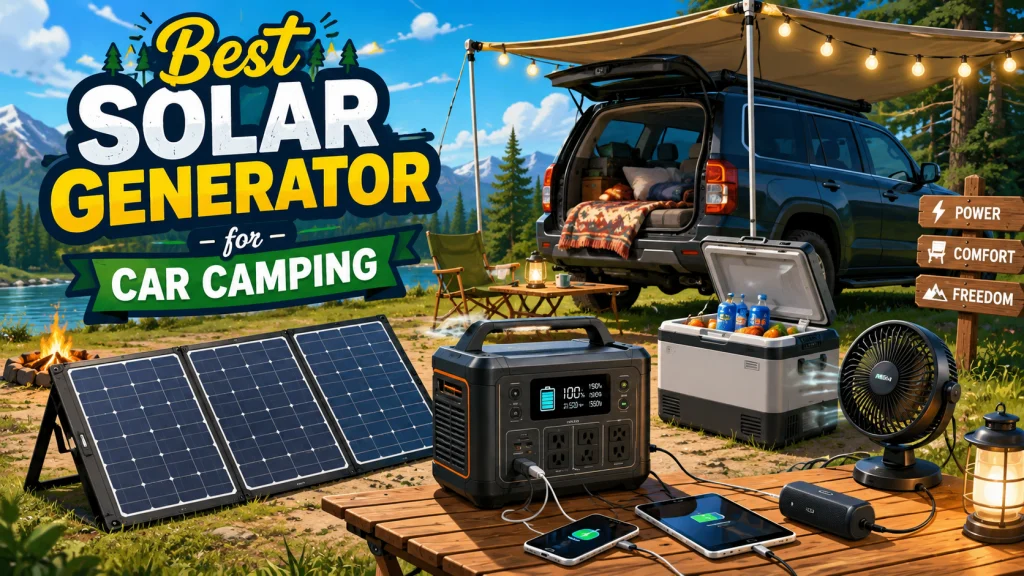
A typical car camping power setup is not complicated. A 12V portable cooler or small fridge draws 40 to 60W on average. A small fan runs 15 to 25W. Phone and device charging adds another 15 to 20W. Camp lighting, depending on what you have set up, uses another 10 to 20W. Add it all up and you are looking at roughly 100 to 150W in combined draw during the hours everything is running simultaneously.
At 120W average draw, you consume about 1,440Wh over a twelve-hour active camp period. A 2000Wh battery, at 85 percent usable efficiency, gives you roughly 1,700Wh before you hit the safe lower limit. That covers a full active day with margin remaining. Pair it with 200W of solar input and, in six hours of good sun, you add back approximately 1,200Wh. The numbers work out to a self-sustaining three-day weekend without needing a wall outlet at any point.
The 1000Wh version of this same scenario covers one full day and then needs to recover. In sunny conditions with 200W of panels, it gets there. But if day two has cloud cover, you are actively managing power instead of enjoying the campsite. Car camping does not require that tradeoff. The capacity is available to you. Size for the weekend, not for the lowest purchase price.
| Load | Average Draw | Over 12 Hours |
|---|---|---|
| Portable cooler / small fridge | 50W | 600Wh |
| Fan | 20W | 240Wh |
| Device charging | 20W | 240Wh |
| LED camp lighting | 15W | 180Wh |
| Total | 105W | 1,260Wh |
Real owner reports from camping deal forums back this up: a 2kWh LFP unit powers 99 percent of typical campsite loads across a full trip without stress. That matches what I saw at the counter again and again: buyers who sized before the trip avoided day-two battery anxiety.

Starting at 2kWh and expandable to 6kWh with two additional batteries, this LFP station reaches 80% in just 43 minutes via combined AC and solar input. Its 3,000-cycle battery outlasts the industry average by 6 times and includes a 5-year service guarantee. With 2,400W output across 15 outlets and X-Boost pushing to 3,400W, it handles 99% of household appliances at a whisper-quiet 30 dB.
Check On AmazonIf you click this link and buy, we earn a commission at no additional cost to you.
Why Your Portable Fridge Draw Changes More Than You Think
The 40 to 60W average draw used in the load table is a reasonable working estimate, not a fixed number. Real-world fridge draw varies significantly depending on conditions you will almost certainly encounter. On a hot day, the compressor runs longer to maintain temperature. Open the lid frequently to grab drinks and the compressor kicks on again. Leave the fridge sitting in a sun-exposed spot rather than under a shade canopy and the draw climbs further. These are not edge cases. They describe a typical summer camping day.
What this means for sizing: a fridge that draws 50W in your kitchen at home can draw 80 to 100W on a hot afternoon at a campsite where ambient temperature is working against it. Over a twelve-hour day, that difference adds up to 360 to 600Wh of extra demand on top of your baseline estimate. For a 1000Wh unit, that gap is the difference between making it through the day and running short by late afternoon. For a 2000Wh unit, it is absorbed without drama.
Pro Tips: Pre-chill both the fridge and the food before you leave home. A unit that starts at temperature does far less compressor work on day one than one starting from ambient. Park it in shade when you set up camp. Keep the lid closed unless you are actually grabbing something. These habits reduce draw meaningfully and let a smaller battery go further.
The buying conclusion here is straightforward. If the fridge is a non-negotiable load, size your battery for a hot day, not for the spec-sheet average. That points to 2000Wh over 1000Wh without needing much debate. That extra capacity absorbs the gap between spec-sheet draw and a hot July afternoon where the lid gets opened every twenty minutes.

This 22.27 lb compressor fridge cools from 77 to 32 degrees Fahrenheit in just 15 minutes and reaches -5 degrees in 50 minutes, with no ice needed. ECO mode draws under 36W and MAX mode stays below 45W, consuming less than 1kWh per day. Three-level battery protection prevents vehicle battery drain, and a 45 dB noise level plus 30-degree incline tolerance make it reliable for RVs, trucks, and off-road use. Includes AC and DC power cords with 2-year tech support.
Check On AmazonIf you click this link and buy, we earn a commission at no additional cost to you.
Two Things Most Car Camping Reviews Skip
Campground Noise Limits
Many campgrounds enforce quiet hours with a noise ceiling around 60 decibels. Many NPS sites post this limit, and many private campgrounds use similar quiet-hour rules. A gas or propane generator running at 60 to 80 dB pushes right up against that threshold or over it, which means a ranger visit or a complaint from the adjacent site. A solar generator runs at 0 to 30 dB depending on whether the cooling fan cycles on. It is usually compliant at 3 a.m., which matters if you want to keep a fridge running through the night.
I talked to more than a few buyers who had defaulted to gas for campsite power without ever checking whether their campground allowed it during quiet hours. Once that reality registered, solar made more sense, especially for weekend trips where keeping the fridge cold overnight was the main goal.
The Foldable Panel Wind Problem
Foldable kickstand solar panels look like the ideal car camping solution. You set them up, angle them toward the sun, and walk away. In practice, a consistent failure pattern shows up: the kickstand folds, the panel tips forward, and you spend the afternoon producing half your expected wattage or nothing at all. This was documented by real users on deal forums as recently as mid-2024, specifically with foldable designs that rely on a single hinged prop to maintain the angle. One user reported never being able to reach rated wattage across an entire camping trip because the panel kept losing its position.
For car camping, this is a solvable problem in a way it simply is not for backpacking. You have a vehicle, gear, and coolers nearby. A 200W panel with a weighted base, staked to the ground, or bungee-strapped to something solid stays aimed and keeps producing. It is not a sleek setup, but car camping rarely needs sleek. What it needs is reliable wattage through the afternoon while the battery recovers.
If you prefer foldable panels and are not ready to give them up, at minimum run a cord through the fold and stake it to the ground, or prop the bottom edge against a full cooler. The lightweight kickstand prop is the failure point. It takes almost no wind to lose it, and a panel producing zero watts is not saving you anything on weight.

Featuring 16BB N-Type cells at 25% efficiency, this panel outperforms standard 200W panels and folds down to backpack size at just 13.89 lbs, with a magnetic closure for tool-free setup. Three built-in ports including USB-C PD 45W, and two USB-A ports charge devices directly, while MC4 output connects to most power stations and 12V battery systems. Four adjustable kickstands offer 40, 50, and 60 degree angles, and IP65 rating plus UL 61730 certification ensure durability and safety backed by a 2-year warranty.
Check On AmazonIf you click this link and buy, we earn a commission at no additional cost to you.
What to Actually Look for in a Car Camping Unit
With weight off the table, the selection filters narrow to a short practical list. I would start here and not move forward with any unit that does not clear these before you start comparing prices or reading reviews.
- 1500Wh minimum capacity, 2000Wh if you are running a fridge. Anything under 1500Wh forces you into active power management by day two unless conditions are perfect. Car camping does not require that compromise.
- 200W or higher maximum solar input. The unit’s solar input cap is the actual ceiling on how fast you recharge, regardless of how many panels you add. A unit that maxes at 200W cannot charge faster than 200W even if you connect 400W of panels. Check this spec before buying separate panels.
- At least 3 AC outlets. Running a fridge, a fan, and a device charger simultaneously from a single outlet with a power strip works, but three native outlets keeps the setup clean and avoids single-outlet circuit concerns.
- LiFePO4 (LFP) battery chemistry if your budget allows. LFP tolerates more full charge cycles before degradation and holds charge more reliably during off-season storage. For a unit you are charging and discharging on multiple camping trips per year, the chemistry choice matters more than it does for a rarely-touched emergency backup.
- Passthrough charging capability. The ability to run loads while simultaneously charging from panels means you do not have to manage separate charge windows. The unit handles both at once, which simplifies the camp day considerably.
One thing I would actively avoid in this use case is buying a small, light unit and telling yourself the panels will compensate. In three-day trips with partly cloudy days and a real fridge running, panels alone will not cover an undersized battery. Size the battery for the load first. Panels extend range. They do not replace capacity.
Which Capacity Class Fits Your Setup
The criteria above tell you what to look for. This tells you where to start based on what you are actually bringing.
| Your Setup | Capacity Class | Reasoning |
|---|---|---|
| Devices and lighting only, no fridge | 1000 to 1500Wh | Combined draw under 80W, 200W panels recover comfortably each day |
| Portable fridge plus devices, 2 to 3 days | 2000Wh | Covers real-world fridge draw including hot-day variation, solar keeps it topped up |
| Fridge plus fan plus multiple users, 3 or more days | 2000 to 3000Wh | Higher simultaneous draw plus buffer for cloudy days without reliable solar recovery |
| Fridge, accessories, group trip | 3000Wh or more | Multiple high-draw loads running together; check the solar input cap carefully at this class |
Most car campers land in the second row. The fridge is the primary load, the panels handle daytime recovery, and 2000Wh covers the overnight buffer without stress. Moving to 3000Wh makes sense if more than two people are drawing from the unit or the trip extends beyond a long weekend.
If you are still deciding which camping style applies to your situation, the camping solar generator guide covers the full spectrum from car camping to van life to ultralight backpacking, with routing by how you actually camp. And if you are earlier in the process and still working through whether a solar generator fits your situation at all, the general solar generator overview covers the core sizing and use-case questions without assuming you have committed to anything yet.

This compact plug-in monitor tracks the energy consumption of any AC 115-volt appliance and displays real-time readings of volts, amps, and wattage at 0.2 to 2.0 percent accuracy. Its large LCD screen lets you calculate electricity costs by the day, week, month, or year, making it easy to spot energy-hungry devices and trim your utility bill. It is also compatible with inverters, adding flexibility for off-grid setups.
Check On AmazonIf you click this link and buy, we earn a commission at no additional cost to you.
Final Thoughts: Size for the Weekend, Not the Price Tag
Car camping is genuinely one of the most forgiving use cases for a solar generator. No weight limit, a predictable set of loads, enough daylight to recover battery through the day, and campground compliance that gas generators often cannot match after dark. The math works in your favor if you size correctly. The buyers who end up frustrated are almost always the ones who approached it like a weight-constrained decision and optimized for cheapness or compactness when neither constraint actually applied to them.
Get the load math right before you buy. Check your campground’s noise policy. Secure your panels against wind if you are using foldable designs. Those three things separate a car camping power setup that works smoothly from one that requires daily troubleshooting. If your camping situation involves living out of a van full-time rather than weekend trips, the selection logic shifts considerably. Idle drain and 24/7 runtime become the dominant factors, which is a different problem than what car camping presents.
FAQs
🏕️ How many Wh do I need for a 3-day car camping trip?
For a portable fridge, fan, lighting, and device charging, plan on roughly 1,200 to 1,500Wh of daily use. A 2000Wh unit with 200W of solar input handles a three-day weekend comfortably in most conditions. If your loads are heavier or sun is limited, size up rather than hope the panels cover the gap.
🔇 Can I run a solar generator at a national park campground overnight?
Yes. Solar generators run at 0 to 30 dB, well under the 60 dB quiet-hour limit many campgrounds enforce. Gas generators typically cannot meet that threshold. Running a solar generator overnight to keep a fridge going is usually acceptable at campgrounds that allow battery power during quiet hours.
☀️ Will solar panels keep up with power use during a car camping trip?
In good sun conditions with 200W or more of panel input, panels can recover most of your overnight draw during the day. They are not a substitute for adequate battery capacity, though. Size the battery for your load first, then add panels to extend range and reduce grid dependence.
⚡ What is the minimum solar input I should look for?
At minimum, 200W of maximum solar input. That gives you a reasonable recovery window on a sunny day. More importantly, check the unit’s maximum solar input cap in the spec sheet. Adding more panel wattage than the cap allows produces no additional charge speed.
🌬️ Why do foldable solar panels keep falling over at camp?
The single-hinge kickstand on most foldable panels is the failure point. Light wind closes it and drops the panel face-down. For car camping, stake the panel into the ground, prop the base against something heavy, or use a weighted stand. A panel face-down in the dirt produces nothing.