The 240-Volt Problem No Marketing Material Mentions
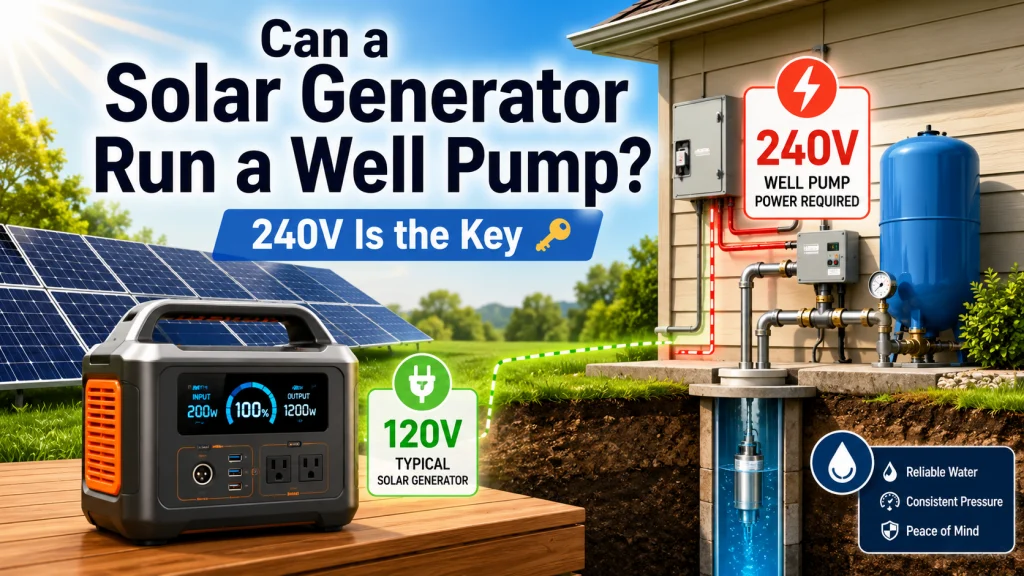
A standard residential submersible well pump is wired to a 240V circuit. This is not an unusual or legacy configuration. It is how the overwhelming majority of residential well pumps in the United States are installed, because 240V motors run more efficiently and generate less heat than 120V equivalents at the same power output. When you look at the circuit breaker serving your well pump, the breaker almost certainly occupies two slots, which is the visual indicator of a 240V circuit.
A standard portable solar generator outputs 120V from its AC outlets. Connecting a 120V inverter output to a 240V pump circuit does not work. It is not a matter of wattage. Adding more watt-hours to the battery does not resolve a voltage incompatibility. Running the pump at half voltage does not work either; the motor will attempt to start, draw excessive current, overheat, and fail. The connection simply cannot deliver what the pump requires, regardless of how capable the solar generator is in every other respect.
This point is worth stating plainly because the information gap here is significant. Popular solar generator review sites and brand marketing pages consistently describe units as suitable for “off-grid” and “emergency backup” without distinguishing the 240V requirement that applies to well pumps. Buyers in rural areas who depend on well water are making purchasing decisions based on specs that are technically accurate but irrelevant to their actual use case. Wattage is the wrong number to check for well pump compatibility. Voltage is the right number, and it comes first.
Warning: Do not attempt to run a 240V well pump from a 120V solar generator output using any combination of adapter, extension cord, or step-up transformer not specifically designed and rated for that application. Motor damage and overheating are the likely results.
Field Note: The well pump question was one of the few where I had to stop a sale rather than complete one. Someone came in with a $1,500 budget looking for a unit to keep their well pump running during outages. Their pump was a standard 240V submersible, which was true of every residential well pump I had ever seen. Nothing in our portable lineup at the time output split-phase 240V. I explained why the units they were comparing would not run their pump, pointed them toward the higher-tier 240V-capable options that were above their budget, and mentioned the gas generator and DC pump alternatives. They left without buying. That was the right outcome for them.
What a Well Pump Actually Needs to Start and Run
Understanding the power requirements of a well pump involves two separate wattage figures that both matter: running watts and surge watts. Running watts are the continuous power draw while the pump operates normally. Surge watts, also called starting watts, are the spike of current the motor requires to start from a stopped position. For well pumps, the surge figure is substantially higher than the running figure, and it determines whether a solar generator can successfully start the pump at all.
A common 0.5 horsepower residential submersible pump draws approximately 900 to 1,000 watts while running. Its surge requirement at startup typically reaches 2,000 to 3,000 watts. A 1 horsepower pump runs at approximately 1,500 to 2,000 watts and surges to 4,000 to 5,000 watts. These surge figures must stay within the solar generator’s rated surge output capacity, which is a separate specification from continuous output and is frequently much higher. A unit rated at 3,600 watts continuous might handle 7,200 watts for the brief surge window, which is sufficient for a 1 HP pump start. A unit with a lower surge rating may trip its internal protection circuit when the pump motor tries to start, even if the continuous draw is well within spec.
| Pump Size | Voltage Required | Running Watts | Surge Watts at Start |
|---|---|---|---|
| 1/3 HP submersible | 240V | 600 to 750W | 1,500 to 2,500W |
| 1/2 HP submersible | 240V | 900 to 1,000W | 2,000 to 3,000W |
| 3/4 HP submersible | 240V | 1,200 to 1,400W | 3,000 to 4,200W |
| 1 HP submersible | 240V | 1,500 to 2,000W | 4,000 to 5,000W |
The voltage column on that table is not optional. Every entry is 240V. Confirming the voltage requirement of your specific pump is the first step before any other evaluation, and it takes about two minutes: find the nameplate on the pump control box or pressure tank near the pressure switch, and look for the voltage specification. If it reads 230V or 240V, the information in the rest of this article applies directly to your situation.
Units That Actually Output 240V and What That Costs
Split-phase 240V output from a portable solar generator is not a standard feature across the product category. It appears in a small subset of higher-capacity units, typically through a combination of the base unit plus an optional accessory or a specific hardware configuration. The price tier is meaningfully higher than the mainstream portable solar generator market.
The units confirmed to output split-phase 240V fall in the $2,500 to $5,000 range at current pricing, and most require either an optional voltage-converter accessory or a specific dual-unit connection to achieve the 240V output. This is not the $800 to $1,500 price range where most portable solar generator purchases happen. For buyers whose budget sits below the 240V-capable tier, the honest answer is that a portable solar generator cannot run their well pump, and a conventional gasoline or propane generator is the more practical and cost-effective backup option for that specific load.
Before purchasing any unit for well pump backup, verify two things directly with the manufacturer or the spec sheet: first, that the unit outputs true split-phase 240V AC, and second, that the surge watt rating exceeds the startup surge requirement of your specific pump. Both specifications must be met, not just one.
Key point: “Split-phase 240V output” is the specific technical term to look for. Some units advertise high wattage and are marketed for heavy loads without clarifying that the output is 120V only. If the spec sheet does not explicitly state split-phase 240V AC output, assume the unit outputs 120V and confirm before purchasing for any well pump application.

With a 3,600Wh LFP battery expandable up to 25kWh via extra batteries or smart generators, this station delivers 3,600W across 15 output ports, boosted to 4,500W with X-Boost or 7,200W when two units are paired. A full recharge takes just 1.8 hours via 240V or 2.8 hours with 1,600W of solar input. It may also qualify for the 30% Residential Clean Energy Tax Credit.
Check On AmazonIf you click this link and buy, we earn a commission at no additional cost to you.
The 12V DC Pump Alternative
There is a lower-cost path that some rural property owners have adopted, particularly for seasonal properties, remote cabins, or situations where the existing AC well pump serves the house full-time but a backup water source during outages is the primary concern. The solution is a dedicated 12V DC submersible pump installed in a secondary position, either in the existing well alongside the main pump or in a separate shallow well or cistern, and connected directly to a solar generator’s DC output.
12V DC pumps draw from the solar generator’s 12V output port rather than its AC inverter output, which bypasses AC inverter conversion entirely. A 12V pump rated at 8 gallons per minute draws roughly 100 to 200 watts from the DC port. A 2,000Wh battery running a 150W pump provides approximately 10 hours of continuous pumping before hitting the 20 percent reserve threshold, enough to fill a significant storage tank or supply daily household water needs through a multi-day outage.
The tradeoff is flow rate and installation complexity. A 12V DC pump cannot match the flow rate of a residential 240V submersible on a standard pressure system. For filling a storage tank that then gravity-feeds the house or supplies a pressure tank through a 12V pressure pump, the flow rate is adequate. For replacing the pressure system experience of the existing well pump directly, the flow rate is generally insufficient. The DC pump approach works best as a dedicated backup water supply rather than a direct replacement for the primary well pump.
Installing a secondary pump in an existing drilled well requires confirming the well diameter can accommodate a second pump alongside the primary unit, or pulling the primary pump temporarily. For most buyers who want well water access during an outage without spending $3,000 to $5,000 on a 240V-capable portable unit, a 12V pump paired with a 1,000 to 2,000Wh solar generator and a 50 to 100 gallon storage tank is a practical and affordable backup water strategy.

This stainless steel submersible pump runs on 12V solar panels or battery systems, delivering 3.2 GPM flow at up to 100 feet submersion depth and a max lift of 230 to 330 feet. It connects directly to solar panels or wind generators with or without a voltage controller, suits irrigation, livestock, pond, and deep well use, and includes a waterproof power cable for outdoor reliability.
Check On AmazonIf you click this link and buy, we earn a commission at no additional cost to you.
When a Gas Generator Is the Right Answer for Well Pump Backup
The portable solar generator category is not the right answer for every backup power problem, and the well pump scenario is the clearest example of where a conventional gasoline or propane generator is the more practical choice for a meaningful segment of buyers.
A dual-fuel gasoline and propane generator in the 5,500 to 7,500 watt range natively outputs 240V split-phase power, handles well pump surge requirements without the need for optional accessories, and typically costs $500 to $900. For a rural homeowner whose primary concern is running their well pump and refrigerator during outages of one to four days, the operational math for a conventional generator is straightforward: store ten gallons of treated gasoline or keep a full propane tank, start the generator when the power goes out, and run the well pump and critical loads directly. The fuel management requirement is the tradeoff, along with the noise and the prohibition against indoor operation.
Solar generators are quieter, require no fuel storage, and can recharge from panels during daylight. For the well pump use case specifically, those advantages matter significantly less than the voltage compatibility problem. A buyer who needs 240V output and has a $1,000 budget is better served by a conventional generator than by a portable solar unit in that price range, because the solar option at that budget simply cannot run the pump regardless of its other capabilities.
For an overview of how the well pump question fits within the broader off-grid power planning picture, including cabin setups, tiny homes, and full-home backup strategies, the off-grid solar generator guide lays out the honest capacity and voltage boundaries for each situation. For buyers evaluating solar generators for other uses beyond the well pump, the complete solar generator guide covers how to match unit capabilities to actual load requirements from the beginning of the buying process.

Built from food-grade, UV-resistant HDPE, this 55-gallon tank is stackable via built-in grooves to maximize space in garages, basements, or sheds. Integrated spigots and utility valves allow easy dispensing for drinking, cooking, or washing. The high-visibility blue body and large capacity make it a practical choice for emergency prep, off-grid living, or disaster readiness.
Check On AmazonIf you click this link and buy, we earn a commission at no additional cost to you.
Final Thoughts: Check Voltage Before Anything Else
The well pump question has a clear decision sequence. Step one is confirming your pump’s voltage from the nameplate on the control box. If it reads 240V, which it almost certainly does, you need to choose between three realistic options: a 240V-capable portable solar generator in the $2,500 to $5,000 range, a 12V DC pump installed as a dedicated backup water supply, or a conventional gasoline or propane generator that natively handles 240V.
Each option has a different cost profile, a different operational requirement, and a different scope of what it actually solves. The 240V solar generator is the only option that also handles the rest of your critical home loads silently and without fuel. The 12V DC pump is the lowest-cost path to backup water access without requiring a high-tier solar unit. The conventional generator is the most practical option if the budget is under $1,500 and well pump operation is the primary concern.
What none of these options is: a standard 120V portable solar generator in the $800 to $1,500 range used to run a 240V residential well pump. That combination does not work, and the wattage specification on the product listing does not change that.

Built with monocrystalline cells at 22.4% conversion efficiency, this 35.3 lb foldable panel uses MPPT optimization when paired with EcoFlow power stations for peak output in any weather. Layered EVA and fiberglass construction with IP68 waterproofing ensures long-term durability on the road, and the adjustable carry case makes transport straightforward.
Check On AmazonIf you click this link and buy, we earn a commission at no additional cost to you.
FAQs
💧 Can a solar generator run a well pump?
Only if the solar generator outputs split-phase 240V AC power and its surge watt rating exceeds the pump’s startup surge requirement. Most portable solar generators output 120V only and cannot run a standard residential submersible well pump regardless of their watt-hour capacity. Confirm the voltage output on the spec sheet before any purchase for this application.
⚡ Why do well pumps need 240V?
Standard residential submersible well pumps use 240V motors because they run more efficiently and generate less heat at that voltage than equivalent 120V motors. The 240V circuit is identifiable at the breaker panel by the fact that it occupies two breaker slots rather than one. The voltage requirement is determined by the pump motor and cannot be changed without replacing the pump itself.
🔋 How many watts does a well pump need to start?
Startup surge for a common 0.5 HP residential submersible pump runs 2,000 to 3,000 watts. A 1 HP pump surges to 4,000 to 5,000 watts at startup. The solar generator must meet both the running watt requirement and the surge watt requirement simultaneously. Check both figures on the pump nameplate and the solar generator spec sheet before assuming compatibility.
🔧 What is a 12V DC pump and can it replace my well pump?
A 12V DC submersible pump runs directly from a solar generator’s 12V DC output port, bypassing the voltage conversion entirely. It works as a dedicated backup water supply rather than a direct replacement for a 240V residential pressure system. Flow rates are lower than a standard submersible, making it best suited for filling a storage tank during an outage rather than directly feeding a full home pressure system.
💰 How much does a 240V-capable solar generator cost?
Units confirmed to output split-phase 240V fall in the $2,500 to $5,000 range at current pricing, and most require an optional accessory or specific configuration to achieve that output. This is meaningfully above the mainstream portable solar generator price range of $800 to $1,500. For buyers with a budget below the 240V tier, a conventional gasoline or propane generator is the more practical choice for well pump backup specifically.
🏡 Should I use a solar generator or a gas generator for my well pump?
It depends on budget and total backup needs. A conventional dual-fuel generator at $500 to $900 natively handles 240V and well pump surge requirements without additional accessories. A 240V-capable solar generator at $2,500 to $5,000 handles the well pump and all other critical home loads silently without fuel storage. If the well pump is the only high-priority load, a conventional generator is the more economical choice. If whole-home quiet backup is the goal, a 240V solar generator is the better fit for buyers whose budget reaches that tier.