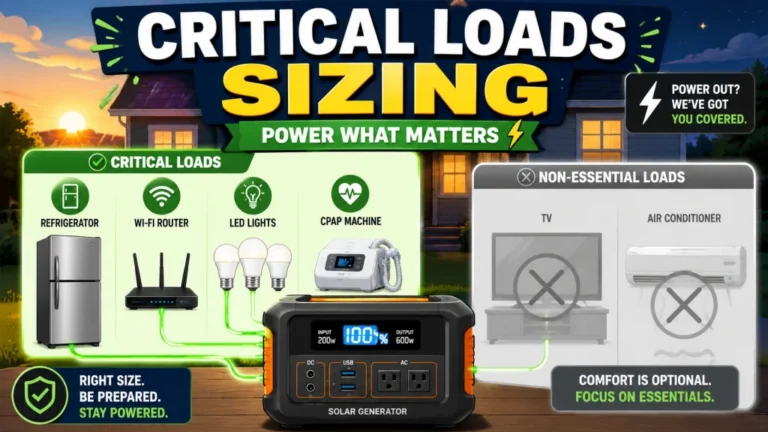
Two Numbers, Not One
Before getting into the formula, it helps to understand what you are actually solving for. Sizing a solar generator means finding two separate numbers. The first is watt-hours (Wh), which determines how long the unit runs before the battery is empty. The second is continuous and surge watts, which determines whether the unit can start and run your loads without tripping an overload. A unit can be more than adequate on one and completely wrong on the other.
This solar generator sizing formula covers the Wh calculation, which is where most buyers start and where most mistakes happen. The surge side is a separate check that runs in parallel, not after, and I will point you to it at the end. The goal here is to get from a list of appliances to a minimum Wh number that accounts for real draw, load overlap, efficiency loss, and a safety margin. That number tells you what class of unit to shop in. What you do with it from there is a different question.
Field Note: The single most common mistake I watched repeat at the shop was buyers dividing a unit’s Wh rating by the wattage on their appliance label and treating the result as runtime. Someone would pick up a 2,000Wh unit, look at the 1,500W label on their space heater, and conclude they had about 1.3 hours of heat. That math is wrong in two directions. The label is the maximum rated draw, not the average, and the efficiency factor eats into the stated capacity before any of it reaches the outlet. The correct calculation takes a few more steps, but it is not complicated once you see it laid out.
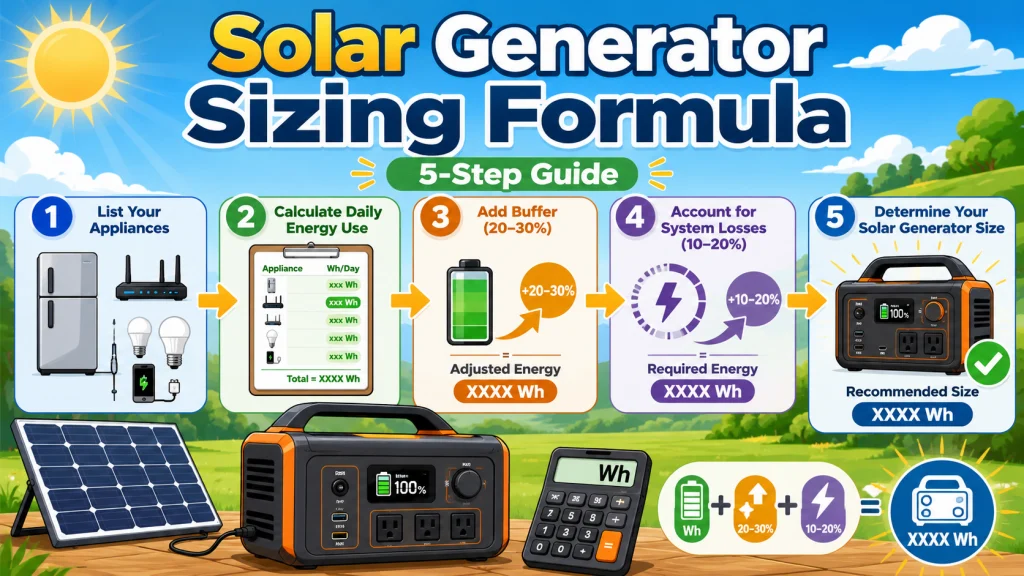
The Five-Step Sizing Process
The formula at a glance:
Raw Wh = watts x hours (per appliance, summed across all loads)
Adjusted Wh = Raw Wh / 0.85
Minimum capacity = Adjusted Wh x 1.25
Then check surge watts separately.
Step 1: List Every Load and Its Real Watt Draw
Write down every appliance you plan to run during an outage. Next to each one, write the real watt draw, not the nameplate maximum. For resistive loads like a space heater or a hair dryer, the label number is close enough because those appliances draw close to their rated wattage when they run. For cycling loads, the label is nearly useless.
A refrigerator labeled 300W might average 100 to 150W in actual use because the compressor cycles on and off rather than running continuously. Using 300W in your calculation will overstate that appliance’s load by a factor of two to three. Older units and units running in warm environments draw more than newer ones in conditioned space, so if your fridge has some age on it, bump the estimate accordingly. The right way to get an accurate number on any cycling appliance is with a plug-in watt meter that measures actual consumption over 24 to 48 hours. More detail on that process is in the guide to finding real appliance wattage, but for now, use your best estimate and note where you are guessing.
Step 2: Identify Simultaneous and Staggered Loads
Not every appliance on your list runs at the same time, and the sizing formula needs to reflect that. A refrigerator runs in the background continuously. A router runs all day. A microwave runs for three minutes. A phone charger runs for an hour, stops, runs again. Treating all of these as simultaneous draws will inflate your Wh number significantly and push you toward a unit that is larger than you actually need.
Think in terms of a usage window, typically 8 to 12 hours for an overnight scenario or 24 hours for a full-day outage. Within that window, multiply each appliance’s real draw by the hours it actually operates. The fridge runs for roughly 8 of every 12 hours at its average cycling draw. The microwave runs for maybe 0.05 hours total. Both go into the sum, but they contribute very differently to the total, and neither displaces the other in a meaningful way for this calculation.
Step 3: Calculate Total Watt-Hours
Multiply each appliance’s real watt draw by its hours of operation in the window. Add up all the results. That sum is your raw Wh requirement before any correction. This is the number many sizing guides stop at, which is why the units those guides recommend often disappoint people. A raw total of 1,520Wh does not mean a 1,500Wh unit will get through the window. The correction in Step 4 is what closes that gap.
Step 4: Apply the Efficiency Factor and Add a Safety Buffer
Every solar generator loses some energy in the conversion from stored battery capacity to usable AC power. The standard efficiency factor is 85 percent, meaning a 2,000Wh battery delivers roughly 1,700Wh of usable output. To account for this, divide your raw Wh total by 0.85. That gives you the actual battery capacity required to deliver your calculated load.
Then add a safety buffer. Battery capacity degrades over time, real-world draws vary from estimates, and you do not want to be running on single-digit percent charge during a three-day storm. A 25 percent buffer is the standard. Multiply your efficiency-adjusted total by 1.25. The final number is your minimum recommended unit capacity.
Key point: These two adjustments, the efficiency factor and the buffer, are not conservative overcaution. The efficiency factor reflects a real conversion loss. The buffer reflects the fact that a battery rated at 2,000Wh at the time of manufacture will deliver less than that after 500 cycles of use. Both belong in every sizing calculation.
Step 5: Check Surge Watts as a Separate Calculation
The Wh formula tells you how long the unit will run. It says nothing about whether the unit can start your loads in the first place. A refrigerator compressor might draw 150W in steady operation but require 600 to 1,200W for the two-second surge when the motor kicks on. If the unit’s rated surge output falls below that requirement, it will shut down or throw an overload error at startup regardless of how much battery remains.
This check runs alongside the Wh formula, not after it, and it has its own methodology. If you are planning to run a refrigerator, a chest freezer, a sump pump, or any motor-driven appliance, do not skip it. The full process for calculating your surge watt requirement is covered in the surge watt sizing guide.
A Worked Example With Real Numbers
Here is the complete calculation applied to a typical outage load list. The scenario is a standard home backup window: a frost-free refrigerator, a router, four LED lights, and device charging over 12 hours. These are the loads most households consider genuinely essential when the grid goes down.
| Appliance | Real Watt Draw | Hours in Window | Wh Contribution |
|---|---|---|---|
| Frost-free refrigerator | 150W average (cycling) | 8 of 12 hours active | 1,200 Wh |
| Router | 10W | 12 hours | 120 Wh |
| 4 x LED lights | 20W total (5W each) | 6 hours | 120 Wh |
| Device charging | 20W | 4 hours | 80 Wh |
| Raw total | 1,520 Wh |
Apply Step 4: 1,520 divided by 0.85 equals 1,788Wh. Multiply by 1.25 for the buffer: 1,788 times 1.25 equals 2,235Wh. That is the minimum battery capacity this load list needs to get through a 12-hour window.
A 2,000Wh unit covers this scenario, but with thin margin. You are starting the window with roughly 200Wh of buffer after the efficiency and buffer adjustments, which can disappear quickly if the fridge runs harder than expected or the lights stay on longer. A 2,500Wh unit gives real breathing room. A 3,000Wh unit means you could run the same load list for about 18 hours before needing a recharge.
Note: The 150W refrigerator figure above assumes a modern, mid-sized unit in a conditioned space. An older unit, a fridge in a warm garage, or one that is mostly empty will draw more. If that describes your situation, bump the estimate to 175 or 200W and recalculate. That shift alone moves the comfortable minimum from the 2,500Wh range into the 2,500 to 3,000Wh range.
One thing the table above does not show: the refrigerator’s startup surge. The Wh math is correct. But without confirming that the unit’s surge watt rating clears the compressor’s startup requirement, the Wh number is only half the answer for anyone running motor-driven loads.

Starting at 2kWh and expandable to 6kWh with two additional batteries, this LFP station reaches 80% in just 43 minutes via combined AC and solar input. Its 3,000-cycle battery outlasts the industry average by 6 times and includes a 5-year service guarantee. With 2,400W output across 15 outlets and X-Boost pushing to 3,400W, it handles 99% of household appliances at a whisper-quiet 30 dB.
Check On AmazonIf you click this link and buy, we earn a commission at no additional cost to you.
What the Formula Does Not Include
The five-step process gives you a minimum Wh number based on the loads and window you specify. That number is correct. But it rests on two inputs that the formula cannot verify on its own.
The first is appliance wattage accuracy. In the worked example above, the refrigerator is assigned 150W average draw. That number is reasonable for a modern frost-free unit in a typical environment, but it is not universal. A unit running in a 90-degree garage might average 200W or more. Using an inaccurate draw number produces an inaccurate result, and the formula has no way to catch that. Getting a real measurement from a plug-in watt meter before doing the math removes the biggest variable in the calculation.
The second is the loads this formula is designed to handle. Some appliances do not belong in a standard Wh calculation because their draws are too large or too variable to manage with a portable unit. Here are the loads that change the math significantly:
- Space heaters and window air conditioners: Resistive and compressor-based heating and cooling draw 1,000 to 1,500W continuously. Adding either to the load list above roughly triples the raw Wh requirement and often pushes the minimum into ranges no single portable unit can cover for more than a few hours.
- Electric cooking appliances: A microwave at 900 to 1,200W runs briefly and contributes a manageable Wh total. An electric range or oven running at 2,000 to 5,000W is a different category entirely and is outside the practical scope of portable solar generator use.
- Sump pumps and well pumps: These cycle on demand rather than on a predictable schedule, and their surge requirements can be high. They belong in the calculation but require real draw measurements and a surge check to size correctly.
- CPAP and medical devices: Most CPAPs draw 30 to 60W per night, which is a manageable addition. Some models with heated humidifiers draw closer to 100 to 120W. Confirm the actual draw from the device’s manual or a watt meter if someone’s health depends on it.
The formula handles all of the loads in the worked example correctly and extends naturally to most ordinary household appliances. What changes when you apply it to your own setup is not the method, but the watt draw, runtime window, and surge check behind each item on your list.

This compact plug-in monitor tracks the energy consumption of any AC 115-volt appliance and displays real-time readings of volts, amps, and wattage at 0.2 to 2.0 percent accuracy. Its large LCD screen lets you calculate electricity costs by the day, week, month, or year, making it easy to spot energy-hungry devices and trim your utility bill. It is also compatible with inverters, adding flexibility for off-grid setups.
Check On AmazonIf you click this link and buy, we earn a commission at no additional cost to you.
Translating Your Wh Number Into a Shopping Range
Once you have a minimum capacity number, the next step is to use it correctly. The minimum is a floor, not a target. If your calculation comes out to 1,788Wh, you are not looking for a 1,788Wh unit. You are looking for units in the class above that number. This is because capacity is sold in discrete size classes, and buying exactly at your minimum leaves no margin for error, for battery aging, or for the load estimates that turned out to be slightly low.
Here is how I would read the common results from this formula in practice:
- Result under 1,000Wh: Look at the 1,000 to 1,200Wh class. These units handle lights, a router, and device charging comfortably. They are not adequate for a full-size refrigerator on their own.
- Result between 1,000 and 1,500Wh: Look at the 1,500 to 2,000Wh class. A smaller fridge, shorter window, or lighter essential-load setup can fit here. A full-size refrigerator plus 12-hour essential loads often pushes higher once efficiency and buffer are included.
- Result between 1,500 and 2,200Wh: The 2,000Wh class is close but tight. If the calculation puts you anywhere in this range, the 2,500Wh class is the more reliable choice. The price difference is often smaller than the margin difference, especially when the smaller unit is already near its limit.
- Result above 2,200Wh: You are in the 2,500 to 3,000Wh class. At this size, you are also approaching the point where surge watt rating and recharge speed start to matter as much as raw capacity.
After capacity, run the surge check. A unit that clears the Wh requirement but cannot start your refrigerator compressor or sump pump is the wrong unit regardless of what the capacity label says. Use your Wh result to filter out units that are too small. Use the surge check to filter out units that cannot handle motor starts. What remains is the right shopping range for your specific load list.

At 39.5 lbs with 2,042Wh capacity and 2,200W output, this CTB-built station is 41% lighter and 34% smaller than typical 2kWh units. It charges from 0 to 80% in just 66 minutes via AC, operates at under 30 dB in silent mode, and switches to UPS backup in under 20 milliseconds. The LiFePO4 battery is rated for a full 10-year lifespan.
Check On AmazonIf you click this link and buy, we earn a commission at no additional cost to you.
Final Thoughts: Run the Numbers Before You Pick the Unit
The pattern I have seen repeat most often is buyers who start with a unit and work backward, trying to confirm it is enough. That is the wrong order. Run the formula first. Get a Wh number. Then look for units that meet or exceed it, with enough continuous and surge watt output to handle your specific loads. The calculation takes 20 minutes with a list of your appliances and a phone calculator. It stops you from buying something that fails on its first real test, and it stops you from spending significantly more than necessary because you never did the math.
If you want to understand the broader framework behind how this calculation fits into a complete sizing decision, the solar generator sizing methodology guide covers how Wh and surge watts work together as the two-number method. And if you are still working out where to start on the sizing question overall, the complete size selection framework routes to the right calculation depending on your specific scenario.
FAQs
🧮 How do I calculate what size solar generator I need?
List every appliance you plan to run, write down the real draw for each (not the nameplate max), and multiply each draw by the hours it operates in your window. Sum the results for a raw Wh total. Divide by 0.85 for efficiency loss, then multiply by 1.25 for a safety buffer. The final number is your minimum battery capacity.
⚡ What does the 85% efficiency factor mean in solar generator sizing?
It accounts for the energy lost between storage and usable AC output. Roughly 15% of a battery’s rated capacity does not reach the outlet. Dividing your load total by 0.85 sizes you against what the unit actually delivers, not the number on the label.
🔌 How many watt-hours do I need to run a refrigerator overnight?
A frost-free refrigerator averaging 150W over a 12-hour window contributes about 1,200Wh to the raw total. Add router, lights, and device charging, apply the efficiency correction and buffer, and the minimum comes out around 2,235Wh. A 2,000Wh unit is marginal; 2,500Wh is the comfortable choice.
🏠 Can I use this formula for camping as well as home backup?
Yes. The process is identical regardless of use case. The appliances change, the window length changes, and the target Wh changes. The five steps apply equally to a weekend camp setup, a van build, and a multi-day home outage.
🔋 Does a 2,000Wh solar generator actually give me 2,000Wh of usable power?
No. After conversion losses, a 2,000Wh battery delivers closer to 1,700Wh at the outlet. Battery aging reduces that further over hundreds of cycles. This is why the 85% efficiency correction belongs in the formula from the start, not as an afterthought.