Day 1 Is Easy. Days 2 and 3 Are Where the Plan Falls Apart
A 2000Wh solar generator handles the essentials through a standard overnight outage without breaking a sweat. Fridge stays cold, router stays on, you keep the lights to a reasonable level, and the unit still has reserve left by morning when the grid comes back. Day 1 of a three-day outage plan is a solved problem. The whole industry is built around it.
The problem starts when the power does not come back in the morning. Hurricanes, ice storms, and grid failures after major regional weather events rarely resolve in 12 hours. And the moment you cross into day 2 with a depleted battery and no grid connection, the math turns into a different equation than the one most buyers planned for. I have seen this play out enough times to know it catches people off guard even when they thought they had prepared.
The question worth asking before you buy anything is not “can this run my fridge tonight?” It is “how does this unit get refilled while the grid is down, and is that refill rate fast enough to cover my load across three full days?” Those are two different questions. The second one determines whether you end day 3 comfortable or watching a battery indicator at 6 percent at midnight.
Your Actual Daily Energy Budget During an Extended Outage
The first number you need is a realistic figure for what you are drawing every 24 hours. Most buyers either overestimate this and overspend, or underestimate it and discover the problem on day 2. The real loads that matter during an outage are not that complicated once you write them out.
A modern refrigerator draws roughly 100 to 150 watts on average when the compressor cycles. A home router runs 10 to 15 watts. LED lighting throughout the house adds about 20 to 30 watts if you are being sensible about which lights stay on. Device charging adds another 15 to 20 watts. That puts combined constant draw at roughly 150 to 215 watts. Run that for 24 hours and you are looking at approximately 3,600 to 5,160 watt-hours per day for a multi-day power outage scenario. Call it 4,000 to 5,000Wh as a working estimate.
The refrigerator is almost the entire story. Take the fridge out of the equation and your remaining loads barely reach 1,000Wh per day. If you want to work through the refrigerator calculation in detail first, the breakdown of how to size a solar generator specifically for running a refrigerator covers the compressor surge math and runtime formulas in full. Come back here once that number is settled.
Key point: A 24-hour critical-load draw of fridge, router, lights, and device charging adds up to roughly 4,000 to 5,000Wh. A mid-size 2000Wh unit does not store enough energy for that full 24-hour budget with comfortable reserve. A recharge strategy is not optional on day 2 of an extended outage, regardless of which unit you buy.
This is where the common mistake happens. Buyers see a 2000Wh unit and mentally picture “running the fridge for a while” without working through the full 24-hour math. That unit handles 12 to 14 hours at a constant 150-watt fridge draw. Day 1, no problem. Day 2 starts with a depleted battery and no grid. That is not a unit sizing problem. It is a recharge planning problem.

Built with monocrystalline cells at 22.4% conversion efficiency, this 35.3 lb foldable panel uses MPPT optimization when paired with EcoFlow power stations for peak output in any weather. Layered EVA and fiberglass construction with IP68 waterproofing ensures long-term durability on the road, and the adjustable carry case makes transport straightforward.
Check On AmazonIf you click this link and buy, we earn a commission at no additional cost to you.
What Solar Recharge Actually Delivers When You Need It Most
Solar recharge is the first answer most buyers reach for, and it works well under the right conditions. The math on a clear day is clean. A 200-watt panel in 5 to 6 peak sun hours can return roughly 800 to 1,100 usable watt-hours after real-world losses. A 400-watt panel setup in those same conditions returns around 1,600 to 2,200Wh. For a 2000Wh unit, a clear sunny day with 400 watts of panels gets you close to a full recharge. In good weather, solar covers day 2 and day 3 without much drama.
The problem is that the outages most buyers are actually preparing for bring exactly the conditions that hurt solar output the most. Hurricanes, nor’easters, and winter ice storms arrive with sustained cloud cover that can persist for the full duration of the outage. Three consecutive heavily overcast days can drop real solar output to 20 to 30 percent of rated capacity. A 400-watt panel setup that normally returns 2,000Wh a day might return 400 to 600Wh under thick cloud cover. That is not enough to keep pace with a 150-watt constant refrigerator load, let alone the full 4,000Wh daily draw.
Field Note: This is the pattern I watched repeat at the shop more than any other. Someone would buy a solid solar setup, feel genuinely confident about their outage prep, and then a winter storm would knock out power for three days. The solar panels underdelivered by 60 to 70 percent because the storm itself blocked the sun. They called back on day 3. Solar recharge is part of the answer, but treating it as the whole answer for hurricane or ice storm scenarios is the mistake that leaves people scrambling.
There is one more thing worth knowing about solar input limits. Every solar generator has a maximum rated solar input, and adding panels above that ceiling produces zero additional benefit. If your unit accepts 400 watts of solar input maximum, a 600-watt array charges it no faster than a 400-watt one. The excess panel capacity is simply capped out by the unit’s charge controller. Check this spec on your unit before buying panels. Oversizing panels past the input limit is one of the more quietly common ways buyers waste money in this category.
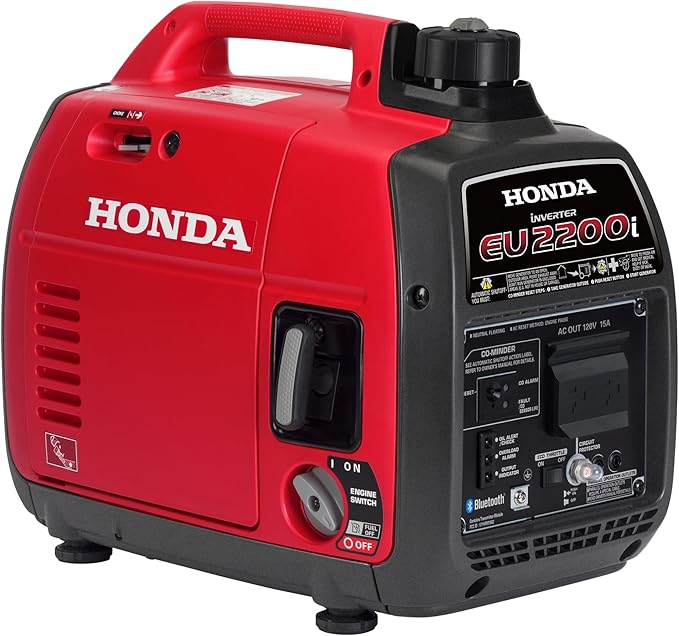
Running at just 48 to 57 dB, this inverter generator is quiet enough for campgrounds, RV sites, and residential use while delivering clean power safe for computers and sensitive electronics. It handles microwaves, refrigerators, hair dryers, and small AC units, and pairs with Honda's My Generator app for Bluetooth remote monitoring, wireless stop, and service reminders. Backed by a 3-year residential warranty.
Check On AmazonIf you click this link and buy, we earn a commission at no additional cost to you.
The Hybrid Strategy: What Actually Gets You Through All Three Days
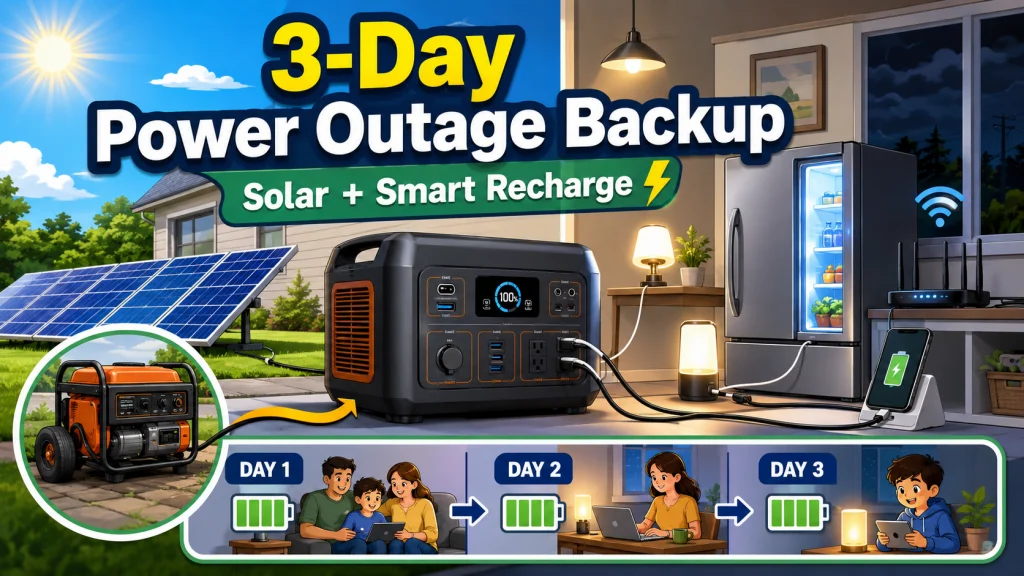
Here is the approach that solves the three-day solar backup problem without requiring a $4,000 battery unit. It is a hybrid setup: pair a mid-size 2000Wh solar generator with an existing gas generator used only for short, targeted AC recharging. Not continuous gas generator operation. One hour in the morning, then shut it off and run the solar unit silently for the rest of the day.
The process is straightforward. A solar generator with a high AC input rating can reach 80 percent charge in approximately one hour when plugged into a 1,800-watt AC source. Run the gas generator for that one hour in the morning. The solar unit hits 80 percent. Turn the gas generator off. The solar unit runs your fridge, router, and lights silently for the next 12 to 14 hours while the compressor cycles. One gas-assisted top-up per day, and the solar unit handles everything else.
Over three full days, two one-hour gas cycles consume less than 2 gallons of fuel at typical small generator consumption rates. If you have ever tried to find a gas can during a regional outage with stations closed or backed up for blocks, you know how meaningful that number is. Two gallons is an amount you can store, plan for, and actually have available when it matters. Compare that to running a gas generator continuously for 72 hours, which burns 15 to 20 gallons depending on load and generator efficiency.
| Day | Primary Recharge Source | Gas Used | Solar Contribution |
|---|---|---|---|
| Day 1 | Start on full charge, solar during the day | 0 gallons | 400 to 2,000Wh depending on weather |
| Day 2 | 1-hour AC top-up morning, solar supplemental | 0.5 to 0.8 gallons | Supplemental if conditions allow |
| Day 3 | 1-hour AC top-up morning, solar supplemental | 0.5 to 0.8 gallons | Supplemental if conditions allow |
The spec that makes or breaks this strategy is the AC input wattage on the solar generator. A unit that accepts 1,800 watts of AC input fills roughly 1,440Wh in a single one-hour gas cycle. A unit that accepts only 300 to 400 watts of AC input takes 4 to 6 hours to reach the same level. For the hybrid approach to work on a one-hour cycle, you need a unit rated for at least 1,200 to 1,800 watts AC input charging. This number varies significantly across models and is not always prominently displayed. Look it up in the full spec sheet before buying if the hybrid strategy is part of your plan.
- What to confirm on the solar generator: Maximum AC input charging rate in watts. This is the limiting factor for how fast the gas generator fills the battery in a single cycle.
- What to confirm on the gas generator: AC output wattage. It needs to meet or exceed the solar unit’s AC input rating to achieve the fastest possible fill rate.
- Fuel math for 3 days: Two one-hour cycles at 0.5 to 0.8 gallons per hour equals 1 to 1.6 gallons total. Storing 2 gallons gives you comfortable margin, including if the outage runs a fourth day.
- When to skip the gas top-up: If day 2 brings clear sky and your panel setup returns 1,500Wh or more, skip the gas cycle entirely and run on solar. Check the battery level in the morning and decide then.
- When this strategy does not apply: If you do not own a gas generator and have no intention of buying one, the standalone large-unit path is your alternative. The math on that changes significantly.
Focus on a 2000Wh class unit with at least 1,200 to 1,800W AC input charging and 400W solar input. This setup handles winter storms, hurricanes, and any multi-day cloudy outage on under 2 gallons of gas. You do not need 5,000Wh of battery to survive 3 days.
Focus on a 3000Wh unit minimum with at least 600W solar input. This works reliably in clear or partly cloudy weather. In sustained heavy overcast during a winter storm, you will need to manage loads carefully on day 3. A 5000Wh class unit gives more buffer, but still depends on solar conditions.
Whatever path you choose, there is a daily operating rhythm that makes a meaningful difference over 72 hours. In the morning, check the battery level before deciding whether to run a gas top-up. If it is above 60 percent and the sky is reasonable, skip the gas and deploy the panels. Midday is the best window for solar charging. In the evening, cut nonessential loads: turn off fans, skip the TV, stop charging anything that does not need it. Overnight, the fridge and router are all that should be drawing power. Avoid high-draw appliances like microwaves, kettles, space heaters, and coffee makers during the full 72-hour window unless you have confirmed the remaining battery margin first. This routine alone can add several hours of reserve each day, which on day 3 is exactly the margin that matters.

Starting at 2kWh and expandable to 6kWh with two additional batteries, this LFP station reaches 80% in just 43 minutes via combined AC and solar input. Its 3,000-cycle battery outlasts the industry average by 6 times and includes a 5-year service guarantee. With 2,400W output across 15 outlets and X-Boost pushing to 3,400W, it handles 99% of household appliances at a whisper-quiet 30 dB.
Check On AmazonIf you click this link and buy, we earn a commission at no additional cost to you.
Going Gas-Free: What the Standalone Solar-Only Option Actually Requires
If the hybrid approach does not fit your situation, either because you do not own a gas generator or because you want a fully self-contained solar setup, the numbers shift considerably. The math here is less forgiving, but it is still worth understanding so you go in with realistic expectations.
A 3-day outage at a 4,000 to 5,000Wh daily draw requires somewhere between 12,000 and 15,000Wh of total stored capacity if you assume zero recharge input. The largest single portable solar generator currently on the market tops out around 5,000Wh. A truly standalone, zero-recharge 3-day solution covering full critical loads is simply not achievable with one portable unit. That is not a knock on the category. It is just the honest math.
What is achievable with a standalone solar approach is a large-capacity unit paired with serious panel input that keeps pace with your load in reasonable weather. A 3000Wh unit with 600 watts of solar panels gains approximately 3,000 to 3,600Wh in 5 to 6 hours of clear sun, which roughly matches a conservative daily draw. In good weather, that setup can sustain a 3-day solar generator outage scenario. Real-world owner reports confirm that the largest units in the 3000Wh class can power a fridge, router, fans, and lighting for close to two full days on a single charge before needing any input. In clear conditions on day 2, solar carries the rest.
Note: The standalone solar path performs best when your regional outages tend to be warm-season events such as summer thunderstorms or brief fall windstorms, where the weather clears quickly and leaves sunny skies for recharging. Winter ice storms and multi-day hurricane systems are the hardest scenarios for solar-only approaches. If those are your likely outage types, the hybrid strategy is more reliable.
If you are weighing a 5000Wh unit as your solar generator for a multi-day outage and the budget works, that is a reasonable choice for a conservative outage strategy. Just be clear about what it solves. A large unit with poor solar conditions on day 2 still depletes. A mid-size unit with a hybrid recharge plan does not. Capacity and strategy are not the same thing, and one does not substitute for the other.

At 3,072Wh with 3,600W output and 7,200W surge capacity, this CTB-built station powers a household for up to 15 hours and keeps a fridge running 1 to 2 days. Its UL-certified UPS switches in under 20 milliseconds, LiFePO4 batteries last 4,000 cycles, and a full recharge takes just 1.7 hours via hybrid input. It is 47% smaller and 43% lighter than comparable 3kWh units.
Check On AmazonIf you click this link and buy, we earn a commission at no additional cost to you.
Final Thoughts: The 3-Day Problem Is a Recharge Problem
Most buyers shopping for a solar generator for hurricane power outage or winter storm scenarios are focused on the wrong number. They fixate on battery capacity and underestimate the recharge question entirely. From what I have seen, both at the shop and in conversations with people who went through real multi-day outages, the ones who came out comfortable were almost always the ones who had thought through day 2 and day 3 recharging before they bought anything.
A 2000Wh unit with a fast AC input and an existing gas generator consistently outperforms a 4000Wh unit with no recharge plan in a real 3-day winter outage. The large battery looks more capable on paper. But if it depletes overnight on day 2 with no recovery path, it is functionally worse than the hybrid setup that kept the fridge cold through the whole event on 1.5 gallons of gas.
If you are still working out the broader home backup picture, the guide to matching a solar generator to your specific home backup situation covers the full range of outage scenarios and helps route you toward the right sub-strategy. And if you have not yet sorted out which overall category applies to your situation, the overview of how to choose the right solar generator based on your use case is the right starting point before going further into extended outage planning.

This compact plug-in monitor tracks the energy consumption of any AC 115-volt appliance and displays real-time readings of volts, amps, and wattage at 0.2 to 2.0 percent accuracy. Its large LCD screen lets you calculate electricity costs by the day, week, month, or year, making it easy to spot energy-hungry devices and trim your utility bill. It is also compatible with inverters, adding flexibility for off-grid setups.
Check On AmazonIf you click this link and buy, we earn a commission at no additional cost to you.
FAQs
🔋 How many watt-hours do I need to get through a 3-day power outage?
A realistic critical-load draw of fridge, router, lighting, and device charging totals roughly 4,000 to 5,000Wh per day. Over 3 days with zero recharge, that is 12,000 to 15,000Wh. No single portable solar generator stores that much. The practical path is a mid-size unit paired with a daily recharge strategy, either solar, AC from a gas generator, or a combination of both.
☀️ Can I rely on solar panels alone during a 3-day outage?
In clear weather, yes. In heavy overcast typical of hurricanes and winter ice storms, no. Real-world solar output can drop to 20 to 30 percent of rated capacity on continuously cloudy days. Treating solar as your only recharge source works well for warm-season outages that clear quickly. For winter and hurricane scenarios, a backup recharge method is worth having.
⛽ How much gas does the hybrid solar-plus-gas approach actually use over 3 days?
Two one-hour AC top-up cycles across days 2 and 3 consume roughly 1 to 1.6 gallons total at typical small generator fuel consumption rates. Storing 2 gallons gives you comfortable margin. That is a manageable reserve during a regional outage when fuel availability may be limited.
🔌 What AC input wattage do I need for the hybrid recharge strategy to work?
At least 1,200 watts AC input on the solar generator, with 1,800 watts preferred. This lets you recover 1,200 to 1,440Wh in a single one-hour gas generator run. Units with only 300 to 400 watts AC input take 4 to 6 hours to reach the same charge level, which makes short gas cycles impractical.
❄️ Is a solar generator reliable for a winter ice storm outage?
It depends on your recharge plan. Winter ice storms are the most difficult scenario for solar-only approaches because they bring sustained cloud cover for the full outage duration. A solar generator with a hybrid gas-assisted recharge strategy handles winter outages more reliably than one relying on panels alone.
🏠 Can a solar generator power my whole house during a 3-day outage?
Not in any realistic sense. An average US home uses roughly 28,800Wh per day. The largest portable solar generators hold around 5,000Wh. A solar generator for a multi-day outage is sized for critical loads only: fridge, router, lighting, and device charging. Full home replacement requires a permanently installed battery system.
📦 What size solar generator is best if I want no gas backup at all?
A 3000Wh unit with at least 600 watts of solar panel input is the minimum viable standalone setup for a 3-day outage in decent weather. In clear conditions, that panel setup returns enough watt-hours per day to roughly match your critical load draw. In sustained overcast, even a 5000Wh unit will deplete over three days without some form of AC recharge.