Why Tiny Home Power Math Is Nothing Like Regular Home Power Math
The average US household uses roughly 28 to 30 kilowatt-hours of electricity per day. That number is the product of decades of design choices: electric water heaters, full-size refrigerators, electric stoves, HVAC systems, and general electrical waste built into every square foot of a conventional home. A portable solar generator system capable of covering 28 kWh per day would move beyond the portable category entirely. That is why the question “can a solar generator power a home” has a short answer and a useful answer, and the short answer is almost always wrong.
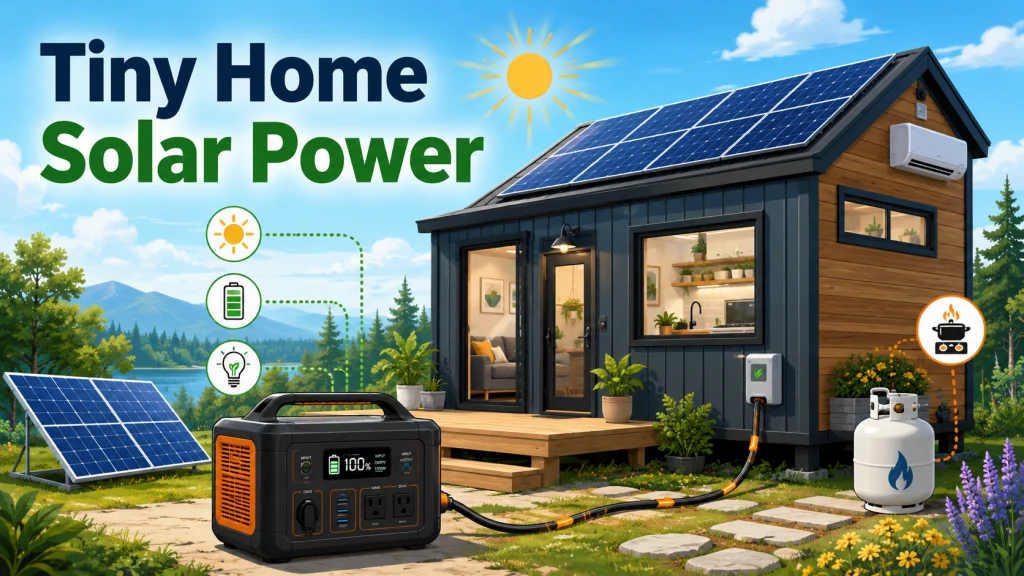
A well-designed tiny home is not a scaled-down version of a conventional home. It is a system built around intentional load management from the beginning. Efficient insulation reduces heating and cooling demand. Propane handles high-wattage thermal loads, cooking and water heating, that would otherwise dominate the electrical budget. LED lighting, a 12-volt refrigerator or small apartment-style compressor fridge, and minimal phantom loads keep daily electrical consumption in a range that portable solar can actually cover.
The OUPES blog, writing about off-grid power options in December 2025, put the threshold plainly: for a highly efficient tiny home with modest loads, 1 to 5 kilowatt-hours per day allows a large portable power station to serve as the core of the system. That 1 to 5 kWh window is the key number. Whether your specific tiny home falls inside it or outside it depends on the audit below.
The Daily Load Audit: What Actually Draws Power in a Typical Tiny Home
The load audit is the only honest starting point. Skipping it and sizing a system based on square footage or general “tiny home” assumptions produces either an oversized system that costs more than needed or an undersized system that fails the first cloudy week in October. The audit is not complicated: it is a list of every electrical load, its wattage, and how many hours per day it runs.
Here is what a realistic well-designed tiny home load profile looks like, built around the propane-electric split described below:
| Load | Running Watts | Hours/Day | Daily Wh |
|---|---|---|---|
| LED lighting (3-4 fixtures) | 20W | 5 hrs | 100Wh |
| Small apartment refrigerator (modern inverter) | 80W average | 24 hrs | 1,920Wh |
| Laptop | 40W | 6 hrs | 240Wh |
| Phone/tablet charging | 20W | 2 hrs | 40Wh |
| Router / modem | 10W | 24 hrs | 240Wh |
| Induction cooktop (if not propane) | 1,800W | 0.5 hrs | 900Wh |
| Mini-split (moderate climate, used 4 hrs/day) | 600W average | 4 hrs | 2,400Wh |
Without the mini-split and with propane handling cooking, the daily total for the remaining loads comes to roughly 2,540Wh. That is solidly within the 1 to 5 kWh range where a well-matched portable solar setup can operate sustainably. Add the mini-split at 4 hours per day and the total climbs to 4,940Wh, still within range but now pressing against the upper boundary, particularly in shoulder seasons with fewer peak sun hours. Add the induction cooktop on top of both and you are at roughly 5,840Wh, outside the reliable range for most single-unit portable solar systems.
The numbers above are starting points for your own audit, not universal facts. Your refrigerator may draw 100W average rather than 80W. Your lighting situation may be more or less than estimated. The specific mini-split, its efficiency rating, your climate, and how many hours per day you actually run it will dominate the total. The exercise is worth doing with your actual appliance specs before sizing any system.
Field Note: The load audit step is where most conversations at the shop went sideways before they ever got to product questions. People would tell me they wanted to power their tiny home and I would ask what loads they planned to run. The ones who had actually listed it out, with watts and hours, almost always ended up with a reasonable, achievable system. The ones who skipped that step often came back six months later with a system that worked fine in June and fell apart in November when the sun hours dropped and they started running the heater.

This compact plug-in monitor tracks the energy consumption of any AC 115-volt appliance and displays real-time readings of volts, amps, and wattage at 0.2 to 2.0 percent accuracy. Its large LCD screen lets you calculate electricity costs by the day, week, month, or year, making it easy to spot energy-hungry devices and trim your utility bill. It is also compatible with inverters, adding flexibility for off-grid setups.
Check On AmazonIf you click this link and buy, we earn a commission at no additional cost to you.
The Propane-Electric Split: How Real Tiny Home Builders Actually Make It Work
The most common off-grid tiny home power strategy is not “solar for everything.” It is solar for electrical loads and propane for thermal loads. The distinction matters because thermal loads are where the largest, most consistent electrical draws live. An electric water heater runs at 1,200 to 4,500 watts. An electric stove draws 1,200 to 3,000 watts per burner. A resistive electric space heater runs at 750 to 1,500 watts for hours at a stretch in winter. None of these are reasonable to power from a portable solar system without significantly oversizing the battery bank.
Replace those loads with propane, a tankless propane water heater, a two-burner propane cooktop, and a propane space heater for backup heating, and the electrical demand drops to the device and refrigeration loads in the audit table above. Suddenly the math works. A 3,000Wh LFP battery paired with 600W of solar panels can cover a well-designed propane-hybrid tiny home indefinitely through most of the continental US in spring, summer, and fall. Winter at northern latitudes is a separate calculation because peak sun hours drop below the level needed to fully recharge a 3,000Wh battery in a single day.
The full propane-electric approach is confirmed practice in the off-grid building community, not a workaround. It is how experienced builders size systems from the beginning because they understand that trying to electrify everything is how you end up with a 20kWh battery bank and a $30,000 system for a 200-square-foot home. The goal is right-sizing the electrical system by offloading the loads that propane handles more efficiently and cost-effectively at residential scale.

With a 3,600Wh LFP battery expandable up to 25kWh via extra batteries or smart generators, this station delivers 3,600W across 15 output ports, boosted to 4,500W with X-Boost or 7,200W when two units are paired. A full recharge takes just 1.8 hours via 240V or 2.8 hours with 1,600W of solar input. It may also qualify for the 30% Residential Clean Energy Tax Credit.
Check On AmazonIf you click this link and buy, we earn a commission at no additional cost to you.
The Minimum Sustainable Setup for Full-Time Tiny Home Use
Based on the load audit above with propane handling thermal loads, the minimum portable solar setup that works sustainably for full-time tiny home use is a 3,000Wh LFP battery with at least 600W of solar input capability. Here is why those specific numbers.
The 3,000Wh floor accounts for the refrigerator’s continuous draw, the evening lighting and device usage that runs without solar input, and a buffer for cloudy days when the battery does not fully recharge from solar. Running a 2,540Wh daily load on a 2,000Wh battery with no buffer is a system that works on sunny days and fails on cloudy ones. Adding 1,000Wh of buffer turns a tight system into a reliable one.
The 600W solar input number comes from the recharge math. At 6 peak sun hours, a 600W array delivers approximately 3,600Wh per day at 100 percent efficiency, or roughly 2,520 to 2,880Wh at real-world efficiency (70 to 80 percent of rated output). That matches or slightly exceeds the daily load, meaning the system replenishes in good weather what it used overnight. For how to calculate the panel count and wattage that achieves a specific daily recharge target for your location, how many solar panels you need to fully recharge your solar generator in a day covers the input-side math in full.
Key point: The minimum sustainable tiny home solar setup is 3,000Wh LFP + 600W solar input, assuming propane handles cooking and water heating. At under 3,000Wh, cloudy-day buffer is too thin for reliable full-time operation. Under 400W of solar input, recharge time on a sunny day extends beyond one day, causing the battery to gradually discharge across a normal week.

Powered by IBC bifacial cells at up to 26.7% conversion efficiency, this panel outperforms conventional PERC panels and maintains strong output in low-light conditions. Six panels together can fully charge a 2,042Wh power station in just 2.5 hours, and 10-second setup with an ergonomic handle makes deployment effortless. IP68 waterproofing and an operating range of -4 to 149 degrees Fahrenheit ensure year-round reliability across all weather conditions.
Check On AmazonIf you click this link and buy, we earn a commission at no additional cost to you.
Where Most Tiny Home Solar Setups Hit Their Actual Limit
Cooling is the load that pushes more tiny home solar setups past their realistic capacity than any other single factor. A mini-split heat pump in heating mode at mild temperatures draws 300 to 500 watts. The same unit in cooling mode at 95 degrees Fahrenheit draws 700 to 1,000 watts, depending on the unit size and ambient conditions. Running it for 6 to 8 hours in a hot southern summer afternoon adds 4,200 to 8,000Wh to a daily load that otherwise sits comfortably under 3,000Wh.
This is not a fatal problem for tiny home solar, but it is a constraint that requires honest sizing. A tiny home in northern Vermont that uses the mini-split primarily for shoulder-season heating can get away with a 3,000Wh system. The same tiny home in central Texas running air conditioning through June, July, and August needs a 5,000Wh system minimum, and would benefit from 6,000 to 8,000Wh with commensurate solar input to handle the additional daily recharge requirement.
The honest answer for hot-climate tiny home owners planning to run standard AC cooling is: size up. The gap between a 3,000Wh system and a 6,000Wh system is significant, roughly double the battery cost, but the alternative is a system that works nine months of the year and fails the three months you need it most. Buying the minimum system with intentions to expand is a reasonable approach if the specific unit supports expandable battery packs. Not all portable solar generators do. Check the spec sheet for expandability before buying rather than after.

Starting at 4,096Wh and expandable up to 48kWh with additional batteries or smart generators, the DELTA Pro 3 delivers 4,000W of output scalable to 12,000W with X-Boost, capable of running a 3-ton central AC or a 1 HP water pump on 120V or 240V. It supports 7 individual and 18 combination charging methods including solar, AC wall outlets, EV charging piles, gas generators, and the EcoFlow Smart Home Panel 2, eliminating fuel dependency entirely. Automotive-grade LFP cells with an IP65-rated battery pack and a 10-millisecond switchover protect NAS systems, servers, and sensitive electronics during outages. Whisper-quiet X-Quiet technology keeps operation as low as 30dB, and the whole system is backed by a 5-year warranty.
Check On AmazonIf you click this link and buy, we earn a commission at no additional cost to you.
When Portable Solar Is the Wrong Tool for a Tiny Home
Portable solar generators are designed around portability as a core feature. That design involves tradeoffs, sealed battery packs, integrated BMS and inverter, proprietary expansion systems, that make them well-suited for flexible deployment but not always optimal for a fixed, permanent installation. A tiny home that will stay in one place indefinitely may be better served by a purpose-built home battery system or a fixed off-grid solar installation than by a portable power station.
The specific scenarios where portable solar is the wrong choice for a tiny home:
- Full electric heating in a cold climate. If you intend to heat with electricity through winter at northern latitudes, the battery and solar input requirements move well beyond what portable systems efficiently provide. A fixed installation with a larger battery bank is the right tool.
- All-electric cooking without propane. An induction cooktop at 1,800 watts, a toaster oven at 1,200 watts, and an Instant Pot at 1,000 watts running regularly will exhaust a 3,000Wh battery before the evening load starts. Propane for cooking is not optional at this scale. It is load management.
- Workshop or power tool loads. A table saw at 1,800 running watts and 3,600 surge watts, or a dust collector running alongside a router, are loads that portable inverters handle poorly even when they technically have the rated wattage. The surge behavior of motor-driven tools is hard on portable inverters sized near their limits.
- Tiny home permanently connected to shore power. If your tiny home will park in a location with consistent grid access, a battery backup system makes more economic sense than a portable solar generator at the watt-hour sizes needed for full-time living.
The broader off-grid use case context, when a portable solar system is enough for full-time use versus when a more permanent installation is needed, is covered in the complete off-grid solar generator guide. For buyers specifically evaluating seasonal or part-time off-grid cabin use rather than full-time tiny home living, what solar generator sizing looks like for an off-grid cabin covers a somewhat different load profile and seasonal use pattern.

An upgrade over the AC200MAX, this 2,400W station expands up to 8,192Wh via multiple compatible battery pack options and covers all connections across 11 ports including a 30A RV port and 48V DC output. It charges from 0 to 80% in just 45 minutes via AC, or fully in as little as 1.7 hours with 1,200W of solar input. A D40 voltage regulator enables efficient RV battery charging.
Check On AmazonIf you click this link and buy, we earn a commission at no additional cost to you.
Final Thoughts: Do the Audit, Then Size the System
The question “can a solar generator power a tiny home” has an honest answer: yes, if the tiny home was designed with the propane-electric split and keeps daily electrical loads under 3 to 5 kWh, and if the system is sized at 3,000Wh or above with commensurate solar input. No, if the tiny home expects to run electric cooking, electric water heating, or full summer cooling off a single portable unit sized at 2,000Wh or below.
The load audit is the tool that turns that general answer into a specific one for your situation. Take 30 minutes to list every load, its wattage, and daily hours. Add it up. Compare against the 1 to 5 kWh window. The result tells you whether you are shopping for a system in the right category or a different category entirely.
Panel sizing for the recharge side of the equation, how many panels at what wattage to reliably recharge your system in a single good sun day, is the next calculation after the battery capacity question is settled. how many solar panels you need to fully recharge your solar generator covers that math specifically, including the maximum solar input limit that your unit’s spec sheet sets as a ceiling on how many panels you can usefully add. For the broader purchase framework across all off-grid use cases, the solar generator situation guide covers which category applies to your use case before you start comparing products.
FAQs
🏡 Can a solar generator power a tiny home full time?
Yes, under specific conditions: the tiny home uses propane for cooking and water heating, daily electrical loads stay between 1 and 5 kWh, the system is sized at 3,000Wh or above, and solar input is at least 600W. Outside those conditions, particularly with electric cooking or full summer cooling in a hot climate, a portable solar generator alone is undersized for full-time use.
⚡ How much power does a tiny home use per day?
A well-designed efficient tiny home with propane handling thermal loads uses approximately 2,000 to 3,500 watt-hours per day for lighting, refrigeration, device charging, and a router. Adding a mini-split for moderate climate control pushes that to 4,000 to 5,000Wh. Adding full summer cooling in a hot climate can exceed 6,000 to 8,000Wh on peak days.
🔥 Why do tiny home solar builds use propane?
Propane handles thermal loads, cooking, water heating, and backup heating, that draw 1,200 to 4,500 watts and would otherwise dominate the daily electrical budget. Offloading those loads to propane reduces daily electrical consumption enough that a portable solar system can cover what remains. It is not a compromise but a deliberate design strategy used by experienced off-grid tiny home builders.
🌡️ Can a solar generator run a mini-split in a tiny home?
In mild climates with limited hours of use, yes. A mini-split at 600W running 4 hours per day adds 2,400Wh to the daily load, manageable with a 5,000Wh battery and 800W of solar. In hot climates where the unit runs 8 or more hours per day, the daily demand from cooling alone can reach 5,000 to 8,000Wh, which pushes most single portable solar generator setups past their sustainable capacity.
📏 What size solar generator is needed for a tiny home?
The minimum for full-time sustainable use with propane handling thermal loads is 3,000Wh with 600W of solar input. Units under 2,000Wh lack the buffer needed for multi-day cloudy periods. Hot-climate tiny homes with regular AC use should size at 5,000 to 6,000Wh with proportionally higher solar input.
🔌 Can I expand a portable solar generator for a tiny home later?
Only if the specific unit supports expandable battery packs. Not all do. If you plan to start with a 3,000Wh system and expand to 6,000Wh as budget allows, confirm before purchasing that the unit supports additional battery modules. Buying a non-expandable unit with plans to add capacity later is a common mistake that results in two systems rather than one scaled one.