The Honest Answer to Why I Left
Every few months someone asks me why I walked away from retail management to run a homestead in rural Nevada off solar generators. The version I give to strangers is something about self-sufficiency and wanting control over my own situation. The more honest answer is that I had spent a fair amount of time reading grid reliability data, and what I read did not inspire confidence.
I was not reacting to any single outage or news story. In my experience, decisions like this rarely come from one thing. What pushed me toward the homestead was a pattern I kept seeing in the EIA numbers, the same pattern that was already showing up in conversations with customers at the shop, and the same pattern that had started appearing in my own utility service area with more frequency than it used to. The grid was being tested harder than it was designed to handle, and the infrastructure was not keeping pace with the testing. That calculation eventually became personal enough that I did something about it.
What the EIA Data Actually Shows
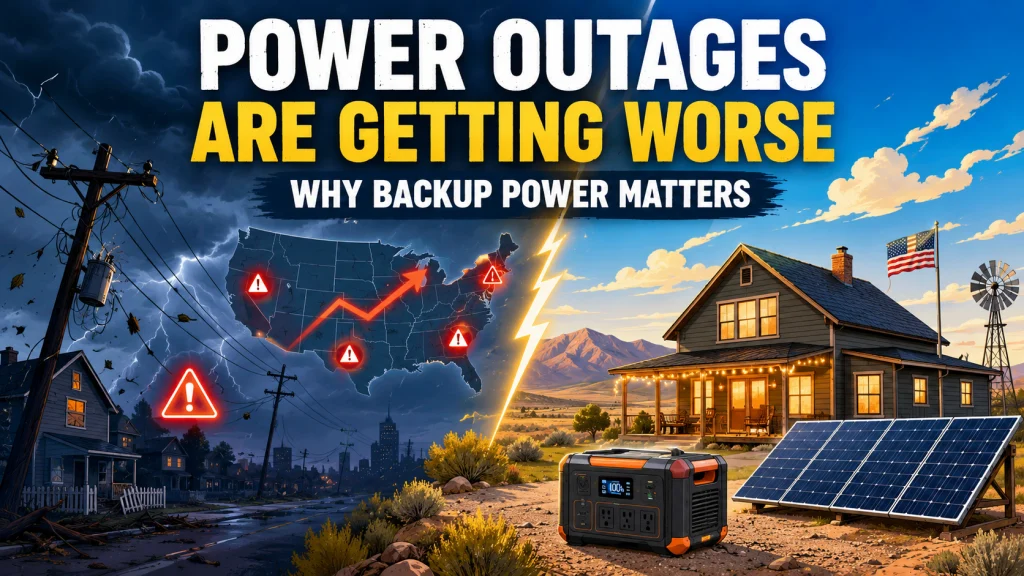
The EIA Electric Power Annual 2024 reported that U.S. electricity customers experienced an average of 11 hours of power interruptions during the year, nearly twice the annual average of the previous decade. Three storms, Hurricanes Beryl, Helene, and Milton, accounted for roughly 80 percent of those lost hours. The national headline number hides enormous variation at the state level. In South Carolina, the average was 53 hours per customer in 2024. That is more than two full days without power, folded into the same “national average” as a customer in Arizona who lost service for 90 minutes during a summer monsoon.
The word “average” is carrying a lot of weight in that statistic, and it is worth being clear about what it conceals. A customer in a Gulf Coast metro during an active hurricane season and a customer in the Pacific Northwest who had two brief outages all year are both contributing to the same number. What the national average cannot tell you is anything meaningful about your personal exposure. That is determined by your geography, your utility’s infrastructure, and the weather patterns specific to where you live.
| Context | Average Outage Hours (2024) |
|---|---|
| U.S. national average | 11 hours per customer |
| South Carolina state average | 53 hours per customer |
| U.S. annual average (2013 to 2022, excl. major events) | Approx. 5 to 6 hours per customer |
| Share of 2024 hours from Beryl, Helene, and Milton | Approx. 80 percent of total |
The gap between the national figure and South Carolina’s reality is not a statistical footnote. It is the difference between a minor inconvenience and a serious disruption to daily life for millions of people. 2024 may have been an unusually severe outage year, but it was not disconnected from the longer pattern: major weather events have become the variable that determines how bad a year feels for electric customers.
The Pattern Behind the Numbers
From 2013 to 2022, the EIA data showed U.S. customers averaging roughly 5 to 6 hours of outages per year when major weather events were excluded. That baseline was already higher than most people assumed for a developed grid, but it was relatively stable. What changed the picture was not the baseline getting worse. It was major events becoming the dominant variable, often swamping the underlying trend in any given year.
Climate Central has reported that around 80 percent of major U.S. power outages from 2000 to 2023 were weather-related. That figure covers more than two decades of grid performance, and the direction it points is consistent with what NOAA has documented about increasing frequency and intensity of major weather events across the same period. The grid is not being stressed by aging infrastructure alone. It is also being hit harder, more often, by weather events it was not designed to absorb at today’s scale.
Field Note: From what I saw at the shop, the customers who came in after a real outage were always the most informed buyers. They had lived through the inconvenience. They knew exactly what they wished they had running during those hours. The customers who came in as abstract preparedness shoppers often undersized because they were planning for a hypothetical, not a lived experience. The gap between those two groups was not intelligence or budget. It was whether the average had already become personal.
That observation holds up in the data as well. The customers who had already sat through a 48-hour outage did not need to be convinced that backup capacity mattered. The data makes the same case in aggregate that those experiences made individually.
Why the National Average Does Not Apply Equally
If your area has relatively stable weather patterns and modern distribution infrastructure, your personal outage exposure is probably well below 11 hours per year. If any of the following apply to you, your exposure is likely above it, and in some cases significantly so:
- You live along the Gulf Coast or Atlantic Seaboard, where hurricane landfalls have become more frequent and more severe over the past two decades.
- You live in the Midwest or Southern Great Plains, where tornado activity and severe thunderstorm seasons regularly affect overhead distribution lines across large areas.
- You live in parts of the Southeast or Texas, where winter ice storms have caused extended outages in recent years as systems not designed for prolonged hard freezes have failed.
- You live in the rural West, particularly in areas subject to wildfire-related Public Safety Power Shutoffs, which utilities use to prevent ignition during high-wind, low-humidity red flag conditions.
- You are served primarily by older overhead distribution lines, which are more vulnerable to storm damage than buried underground systems and take longer to restore.
None of this requires unusual analysis. The EIA publishes state-level outage data annually, and the geographic pattern follows major weather exposure closely enough that it is not difficult to read. What I notice is that most households in high-exposure areas do not think of themselves as high-exposure until they have personally been through a long outage. The national average gives people a sense of distance from a problem that their geography does not actually provide.
How I Would Read This Data for My Own House
When I look at the EIA numbers now, I do not read them as a national statistic. I read them as a starting point for four questions that are specific to my situation. They are the same four questions I would work through for any household that asked me where to begin.
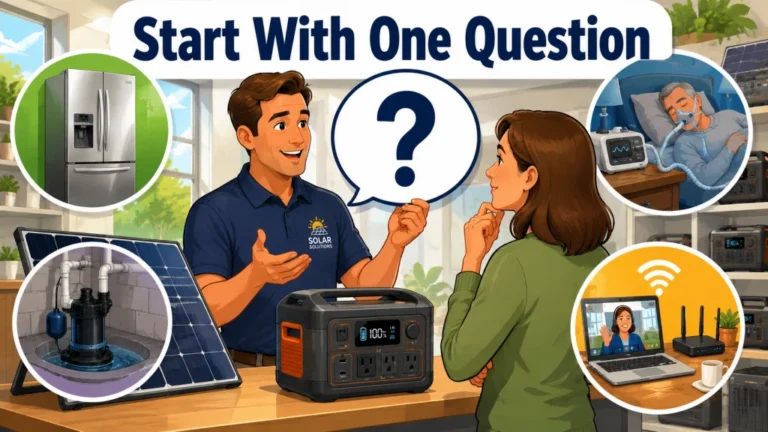
The first question is about your region: are you in a hurricane corridor, an ice storm belt, a wildfire shutoff zone, or an area served mostly by aging overhead lines? That answer tells you how likely a long outage is. The second question is about your appliances: if the power goes out for 12, 24, or 48 hours, what in your house starts to become a problem? A fridge after four hours without power, a medical device from the first minute, a sump pump the moment it rains. Those two questions together tell you the shape of your risk.
The third question is about your household: is there anyone with a health condition that makes heat, cold, or loss of a powered device a medical risk rather than just an inconvenience? The fourth is the one that determines what you actually buy: are you solving for comfort, food safety, work continuity, or health risk? Each of those answers leads to a different capacity and a different setup. Knowing which one you are actually solving for before you start looking at specs is most of the job.
What No Backup Power Actually Looks Like
During Hurricane Beryl in 2024, a story documented by The Survival Mom in April 2026 described two elderly neighbors in Houston who spent two days in a house that was getting dangerously hot, with no generator, no battery backup, and no plan of any kind. A neighbor lent them a portable power station for those two days. For 48 hours, that single battery unit was the practical difference between serious medical risk and manageable discomfort. The detail I keep coming back to is that they did not need much, just a fan running continuously, a way to charge phones, and some lights after dark. A modest battery system would have covered all of it.
Houston in July without power is not uncomfortable in the way that losing your Netflix is uncomfortable. It is physically dangerous for people with cardiovascular conditions, respiratory issues, or limited mobility. Forty-eight hours at indoor temperatures above 90 degrees Fahrenheit is a health risk that becomes a medical event for a meaningful share of the population. A battery system sized for a fan at 50 to 75 watts, basic LED lighting at 20 to 30 watts, and device charging under 10 watts per device is not a sophisticated piece of equipment. It is one of the more accessible and affordable forms of backup power available. If you want to think through what a setup like that actually needs to sustain across a multi-day event, the math for surviving a multi-day outage covers the watt-hour arithmetic before it becomes urgent.
In many situations I have seen, the gap is not only cost. It is that people have not worked through their specific load needs before the outage makes the question urgent. A frost-free refrigerator running at an average of 150 watts needs at least 2,000 watt-hours to get through an overnight period with reasonable margin. A fan and lights and device charging, the Houston scenario above, can be handled by a 300 to 500 watt-hour system. Knowing which situation you are actually in before you buy is the entire difference between a useful purchase and a useless one.
How the Data Shaped My Own Calculation
Going off-grid was partly about self-sufficiency in a direct sense. I like knowing where my power comes from and having the ability to manage it myself. But the EIA trend data made it a practical calculation, not just a lifestyle preference. The direction the numbers were pointing was clear enough that reducing my dependence on grid reliability felt like a rational response to available information, not a dramatic one.
I am not off-grid because I believe the grid is going to fail. I am off-grid because I assessed my own geographic exposure, ran the numbers on what a backup setup would cost relative to the outage hours I was likely to accumulate, and decided that the margin of control was worth more than the convenience of not having to manage it. That calculation will be different for every household and every budget. For people thinking through what a home backup setup looks like without the full homestead commitment, what to look for in home backup specifically covers the decisions that actually matter without overcomplicating the process.
Final Thoughts: The Hours the Average Hides
I am not writing this to alarm anyone. The EIA data is what it is, the trend line is what it is, and the geographic variation is real and documented at the state level in public data anyone can look at. The question I would ask anyone who reads through this is not whether outages concern them in the abstract. It is whether they have a specific plan for the specific hours the national average conceals for their specific location and situation.
Eleven hours per year sounds manageable until it is 53 hours in one week and you are in a house that is heating up around you. The number on the national chart is not the same thing as your lived risk. Your geography, your utility’s infrastructure age, and the weather patterns for your region are your experience. Most of those things are knowable well before an outage forces the question. I would rather you have worked through it before then.
Sources and References
- U.S. Energy Information Administration. Electric Power Annual 2024. EIA Today in Energy. U.S. customers averaged 11 hours of power interruptions in 2024, nearly twice the previous decade annual average.
- Utility Dive. Hurricane power outage, electricity, climate change: Helene and Milton. December 2025. Utility Dive. Reports EIA finding that Beryl, Helene, and Milton accounted for approximately 80 percent of 2024 total outage hours nationally.
- SolarTechOnline. Grid reliability and weather-related outages in the United States. January 2026. Cites Climate Central data documenting that approximately 80 percent of major U.S. power outages from 2000 to 2023 were weather-related.
- The Survival Mom. Preparing for a power outage. April 2026. Documents account of Houston-area residents managing during Hurricane Beryl 2024 with borrowed portable power station.
FAQs
⚡ How many hours did U.S. electricity customers lose to outages in 2024?
The EIA Electric Power Annual 2024 reported an average of 11 hours of power interruptions per customer for the year. That is nearly double the annual average of the previous decade. Hurricanes Beryl, Helene, and Milton drove roughly 80 percent of that total.
📈 Are U.S. power outages actually becoming more frequent?
The baseline hours per year from 2013 to 2022 held relatively steady at around 5 to 6 hours excluding major events. What shifted is that major weather events have become more frequent and more damaging, making them the dominant variable in any given year. Climate Central documented that around 80 percent of major U.S. outages since 2000 were weather-related, and both the frequency and intensity of those events have increased over that period.
🌎 Which U.S. states have the worst outage records?
South Carolina averaged 53 hours per customer in 2024, well above the national figure. Gulf Coast and Atlantic Seaboard states consistently rank among the highest due to hurricane exposure. The EIA publishes state-by-state outage data annually and the geographic pattern follows major weather risk closely.
🔋 How much battery capacity do I actually need for a basic outage?
It depends entirely on what you need to run. Fan, lights, and phone charging can be handled by a 300 to 500 watt-hour system. A frost-free refrigerator running through a 12-hour overnight period needs at least 1,500 to 2,000 watt-hours with reasonable margin. Know your specific loads before you size anything.
🌤️ Can a solar generator recharge during a storm outage when it is cloudy?
Yes, but at a significant reduction. A 200-watt panel under heavy overcast typically produces 10 to 25 percent of its rated output, which is 20 to 50 watt-hours per hour. That is meaningful for trickling charge back into a battery between load cycles. It is not enough to sustain a high-draw appliance through a multi-day event without supplemental charging from AC or a car.
🏠 Is a home backup system worth it if I live somewhere with relatively few outages?
That depends on what you cannot afford to lose and for how long. Short, infrequent outages may not justify a large investment. A smaller system covering only critical loads, a router, basic lighting, and device charging, is often a reasonable middle ground for lower-risk areas and does not require the same capacity as a full home backup setup.