What Selling Solar Generators Taught Me That No Spec Sheet Could
In six years behind the counter I watched the same five mistakes happen over and over. Not because people were careless. Because the information available to buyers is almost entirely written by people trying to sell them something. The reviews looked different across sites but the conclusions were nearly identical, and the conclusions always pointed to a product recommendation. Nobody was writing about what happens after the purchase, when the unit is sitting in someone’s garage during an actual outage and either does the job or does not.
I was not immune to getting things wrong either. I had my own failures at the counter, conversations where I did not ask the right qualifying question and a buyer paid for it later. But I had one advantage the affiliate listicles did not have: I saw the returns. I saw the buyers come back. I saw the look on someone’s face when they realized the unit they bought for emergency prep lasted four hours on a frost-free refrigerator and they still had two days of outage left. The mistakes I watched repeat were not random. They had a pattern, and they still do.
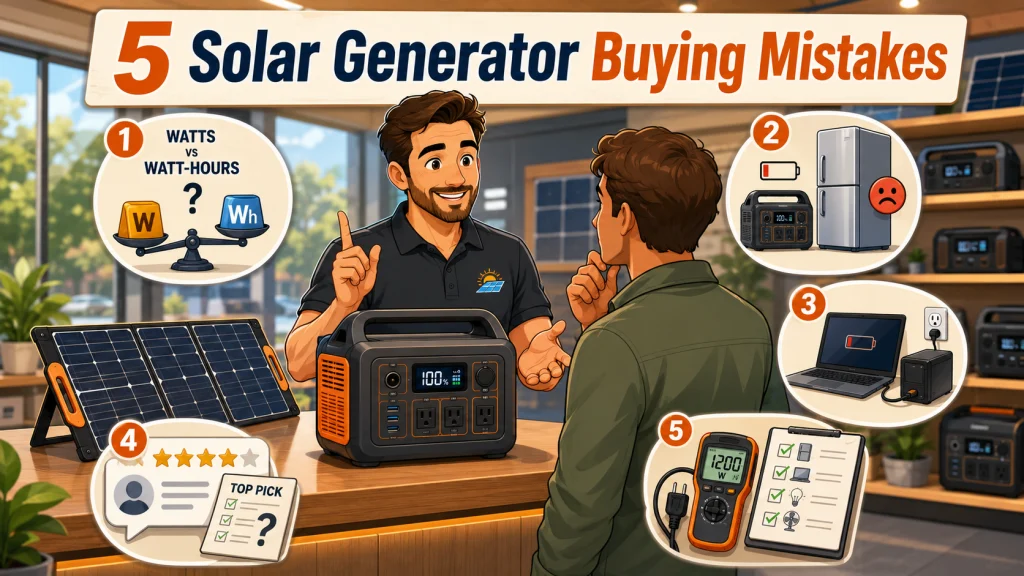
Pattern 1: The Wattage Fixation
Buyers almost universally walked in asking about watts. They had memorized the inverter output from the spec sheet, could recite it like it was the unit’s name. Almost none of them knew what watt-hours meant, and watt-hours is the number that tells you how long something actually runs. Watts is the flow rate. Watt-hours is the tank. A 2000W inverter connected to a 500Wh battery is like a fire hose connected to a kitchen pot. It sounds powerful. It empties fast.
I started keeping a notepad to track how many times I explained that analogy in a single day. The record was eleven times on one Tuesday. Every one of those conversations started the same way: the buyer had done their research, arrived confident, and was focused entirely on the wrong number. The math is not as simple as nameplate watts multiplied by hours. A frost-free refrigerator draws around 150W when the compressor is running, but the compressor cycles rather than running continuously, and on top of that you have a defrost cycle and startup surges of 400 to 600W. Measured real-world consumption for a standard frost-free upright over a ten-hour overnight window runs between 1,200 and 1,500Wh. A 1,000Wh unit will not cover it. A 2,000Wh unit will.
Field Note: The watt-hours confusion came up so consistently that I eventually put a handwritten sign near the demo display: “Watt-hours = how long it runs. Watts = how fast it drains.” Buyers would stop, read it, look back at the spec card, and come back with a completely different question. That one sign saved probably a dozen undersizing conversations per week.
Pattern 2: The “Just in Case” Buyer Who Bought Too Small
The most common return I processed was a compact 500Wh unit from someone who bought it for emergency preparedness, used it once during a real outage, and discovered their refrigerator ate through it in under four hours. They came back for a larger unit. Every single time. The sunk cost included the shipping to return the first unit, sometimes a restocking fee, and the price difference on the replacement. The worst part is that the smaller unit would have been perfectly fine for phone charging, a CPAP without a humidifier, keeping a fan running, or maintaining some lighting. It was not fine for the thing they actually cared about most.
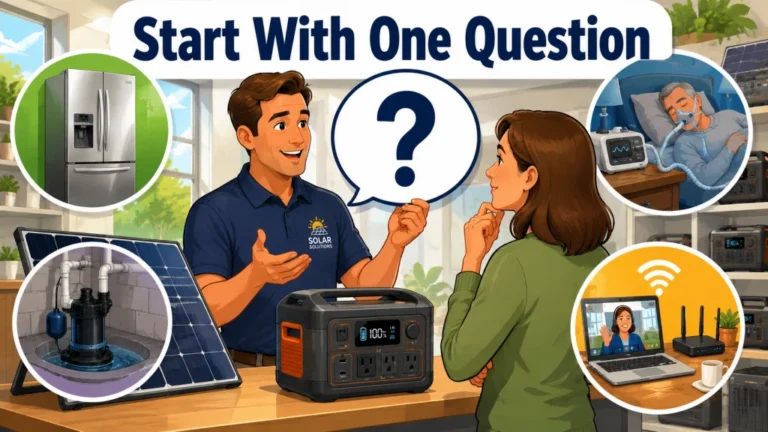
This is the core undersizing mistake, and it comes directly from buying without identifying the critical load first. If you have not asked yourself what you absolutely cannot afford to lose during an outage, the unit you choose is essentially a guess. A 500Wh unit is a real product with real use cases. A weekend camping trip, two nights of CPAP power, a phone and tablet charged multiple times. It is not a refrigerator unit. The label does not always make that clear, and the buyer almost never finds out until the outage is already happening and the percentage bar is dropping faster than they expected.
Pattern 3: The Person Who Needed UPS Mode and Did Not Know It
This one had a real cost to a real person. A work-from-home accountant bought a solar generator during tax season for the same reason most people do: she had experienced an outage and wanted a backup. What she needed, and what I did not ask enough questions to identify at the time of sale, was a unit with true UPS mode. That means a switchover time under 30 milliseconds, fast enough that a connected laptop or desktop never loses power and never shuts down mid-task. The unit she bought had a 30-second transfer time. During a subsequent outage her laptop shut down while she was mid-filing on a client’s tax return. She came back, and she was not wrong to be upset. That qualifying failure was on my side of the counter.
UPS mode is not a universal feature. Most solar generators are designed for sustained power delivery, not for instant seamless transfer. The ones that handle it correctly list it as a specific feature with a confirmed millisecond rating, and it matters most for work-from-home setups, anyone running a home server or NAS, medical devices with strict power continuity requirements, and any application where even a brief interruption causes data loss or equipment damage. If you are in any of those categories, the switchover time is not optional. I cover what to look for in detail at the guide to solar generators with true UPS mode, but the short version is this: confirm the millisecond rating before you buy, not after.
Note: A 30-second switchover is fine for a lamp, a space heater, or a refrigerator. It is not fine for a laptop mid-document or a desktop running active work. Know which category your critical load falls into before you buy.
Pattern 4: The Buyer Who Had Already Been Sold Before They Walked In
By the middle of my time at the shop, buyers were arriving with strong brand opinions formed entirely from affiliate review sites. I could usually tell which article they had read before they finished their first sentence. In a busy week I would hear the same phrase, sometimes nearly word for word, from three different people who had never spoken to each other. The reviews came from different sites with different names, but the recommendations converged in a way that had nothing to do with the buyers’ situations. Once you notice that pattern from behind a counter it is difficult to unsee. What none of those articles mentioned was that the site writing them received a commission on every purchase made through their links.
I am not saying those products were bad. Some of them were genuinely solid. But “the internet’s top-rated solar generator” and “the right solar generator for your specific situation” are two entirely different things, and review sites are structurally unable to answer the second question because they do not know your situation. The consequence showed up in a specific way: buyers would arrive confident, buy the “top pick,” and come back later because the unit had the wrong switchover time, or the surge rating could not start their sump pump, or the recharge time meant the battery never recovered between cloudy days. The product was not wrong in general. It was wrong for them. That distinction is the one the listicle could never make.
Pattern 5: The Buyer Who Had Already Gotten It Wrong Once
These were always the fastest transactions of the day. They arrived having already owned a unit, already experienced an outage with it, and already discovered exactly where it fell short. They had measured their actual appliance draws with a plug-in power meter, made a list of every load they needed to cover, and came back with real numbers. The conversation was direct. They knew what 2,000Wh looked like in practice because they had watched a smaller unit drain in real time. They understood surge wattage because they had watched a unit fail to start a compressor despite having plenty of stored capacity.
The uncomfortable truth is that the best solar generator buyer is often someone who has already bought the wrong one. Not because they are smarter, but because they have data. They know their frost-free refrigerator draws closer to 1,200 to 1,500Wh overnight, not the rough estimate a quick nameplate reading would produce. They know their sump pump needs a 2,400W startup surge even though it only runs at 800W steady state. They have skin in the game. That knowledge cost them a previous purchase. The lesson is replicable without paying for it twice if you measure before you buy. The full framework for doing that correctly is laid out in the solar generator sizing guide, and it starts with the same question I asked at the counter: what do you actually need to keep running?
The Five Patterns at a Glance
These five patterns account for the large majority of buyer frustration I witnessed. None of them are obscure edge cases. They are predictable, preventable, and still showing up in forum threads and Reddit comments today. The table below is a quick reference, but the details in each section are where the real lesson is.
| Buyer Pattern | Root Mistake | Real Cost |
|---|---|---|
| Wattage fixation | Focused on inverter watts, ignored watt-hours | Unit ran the target appliance for only a few hours instead of overnight |
| “Just in case” undersizing | Bought the smallest option to save money upfront | Return fees, price difference, and a failed first outage |
| Missing UPS requirement | Did not identify switchover time as a critical spec | Lost data, device shutdown, real work consequences |
| Pre-sold by affiliate content | Arrived with opinions formed from commission-driven reviews | Unit that was good in general but not matched to their specific load |
| Skipped the measurement step | Bought based on nameplate specs, not measured real-world draw | Double purchase: first unit returned, second unit correct |
None of this is meant to make these mistakes feel obvious in hindsight. With the information available online, most buyers are genuinely doing their best. The problem is structural: product marketing is well-funded, and honest retail experience is not. That asymmetry shows up consistently in buying outcomes.
What the Best-Informed Buyers Had in Common
After watching these patterns repeat, I started paying attention to the buyers who did not make them. The commonalities were consistent enough that I can list them now without much uncertainty. These are not obscure habits. They are the things that turn a complicated purchase into a fifteen-minute conversation.
- They started with the critical load, not the unit. They had already identified the one appliance or device they could not afford to lose during an outage. That single answer focused every other part of the conversation and eliminated most of the wrong options immediately.
- They knew their actual watt-hour draw from measurement, not the nameplate. A frost-free refrigerator that says 150W on the label often averages 60 to 80W over a full hour of real-world cycling because the compressor runs intermittently, not continuously. That difference matters significantly when you are calculating overnight runtime.
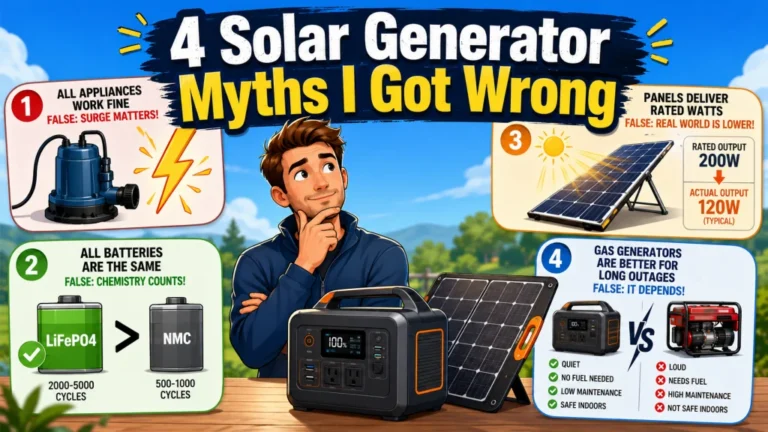
- They had identified any surge-dependent loads. Compressors, sump pumps, and motors all require substantially more power to start than to run. A pump rated at 800W running draw may require 2,400 to 4,000W to start. Skipping this check produces the most frustrating failure type: the unit is fully charged, everything looks fine, and the load still will not start.
- They understood the difference between solar generator power and UPS-grade power. Not every unit handles instantaneous transfer. If continuous power without any gap is a requirement, that needs to be confirmed before the purchase, not during the first real test.
- They asked about recharge time and not just runtime. How long does it take to recover from solar panels in their location and season? What is the realistic panel output on a cloudy December day? These questions almost never appear in product reviews, but they come up immediately in any real multi-day outage scenario.
Every buyer who walked in with that information on hand was out the door in under fifteen minutes with the right unit. Not because they were somehow better at research, but because they had done the one thing that produces a correct answer: they started with what they needed to keep running, not with what the internet had already decided they should buy.
The Question That Almost Nobody Asked at the Right Time
Almost every buyer asked some version of “how long will it run?” Almost none of them asked “how long will it take to recover?” In a single overnight outage, runtime is the whole question. In a three-day outage with overcast skies, recovery matters just as much. Most people only realize that when they are already watching the battery percentage fall on day two. I watched this play out more than once: a buyer had a unit genuinely sized correctly for their overnight load, and still ran into trouble by day two because the battery could not fully recharge before the next night.
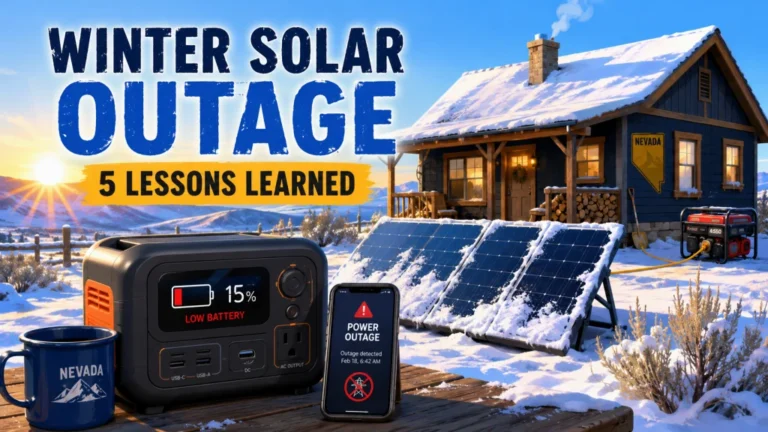
Solar panel output is not a fixed number. Rated wattage on the panel is a best-case measurement under lab conditions. Real-world output on a clear day at optimal angle is typically 70 to 80 percent of rated. On a heavy overcast day it can drop to 10 to 25 percent. In winter at northern latitudes, usable solar hours may be four hours or fewer even on a clear day. A 200W panel producing 140W for five hours gives you 700Wh of recovery input, before accounting for charging efficiency losses. If the unit used 1,400Wh overnight, that math does not close. The buyer who only sized for runtime discovered the recharge gap when the percentage bar on day two was lower than they expected, and dropping.
The buyers who avoided this problem asked one additional question before they bought: given my location, my panel wattage, and the time of year, can I realistically recover the battery between overnight use cycles? It is not a complicated calculation, but it requires knowing your solar hours, your panel output, and your overnight draw. Most of the time the answer is yes with a reasonable panel setup. Sometimes the honest answer is that the unit is sized correctly for a one-night event but not for a multi-day outage without a supplemental charging source. That distinction saved those buyers from a second surprise.
Final Thoughts: What Seeing the Returns Actually Does to You
Every return I processed was a conversation I had to have face to face. Every buyer who came back frustrated had trusted the shop, and often me specifically, and walked away with something that did not work for their situation. That is a useful kind of accountability. It makes you ask better qualifying questions. It makes you slow down the transaction when the buyer is already in a hurry. It makes you care whether the answer is right, not just whether the sale went through.
Most of the content written about solar generators online does not operate under that accountability. The site that recommended the wrong unit collects the commission and moves on. The buyer finds out during the outage. I am not writing this to criticize the entire category of review content. I am writing it because the gap is real, it has real consequences, and the five patterns above are exactly what fills that gap when it is left unaddressed. If this article changes one purchasing conversation before a real outage, that is a better outcome than any commission structure produces.
FAQs
⚡ What is the most common mistake people make when buying a solar generator?
Focusing on watt output rather than watt-hour capacity. Watts tells you how fast the unit can deliver power. Watt-hours tells you how long it can sustain a load before depleting. Most buyers arrive knowing the first number and do not know the second one exists, which leads directly to undersizing for their actual use case.
🔋 How many watt-hours do I need to run a refrigerator overnight?
A frost-free upright refrigerator typically consumes between 1,200 and 1,500Wh over a ten-hour overnight window, accounting for compressor cycling, the defrost draw, and startup surges. Plan for at least a 2,000Wh unit to run one comfortably through the night with reasonable headroom. A 1,000Wh unit will not reliably cover it.
🖥️ What is UPS mode and do I need it in a solar generator?
UPS mode means the unit switches to battery power in under 30 milliseconds when grid power fails, fast enough that connected devices never experience an interruption. You need it if you are protecting a computer, home server, NAS, or any device where even a brief power gap causes data loss or damage. Most solar generators do not offer true UPS mode, so confirm the switchover time in the spec sheet before purchasing.
📋 How do I find out my appliance’s real power draw before buying a solar generator?
Use a plug-in power meter on the appliance for at least 24 to 48 hours, long enough to capture full cycling behavior. Refrigerators, freezers, and other compressor-based appliances cycle on and off, so their real average draw is often 40 to 60 percent lower than the nameplate wattage. You also need to measure the startup surge separately, as that determines whether the unit can start the load at all.
🔍 Why do most solar generator review sites recommend the same products?
Most solar generator review sites earn affiliate commissions on purchases made through their links. The products that rank highest in those reviews often reflect which brands have the most favorable commission structures, not which unit is best for a given use case. A review that starts with your specific critical load is more reliable than one that starts with a ranked product list.
🔌 What is the difference between rated watt-hours and usable watt-hours in a solar generator?
Rated watt-hours is the total capacity printed on the spec sheet. Usable watt-hours is what you can actually draw before the unit’s protection circuits cut off, typically 80 to 90 percent of rated capacity for most units. On top of that, inverter conversion losses reduce real output by another 10 to 15 percent. A unit rated at 2,000Wh may deliver closer to 1,500 to 1,700Wh of actual work, depending on the load and conditions.