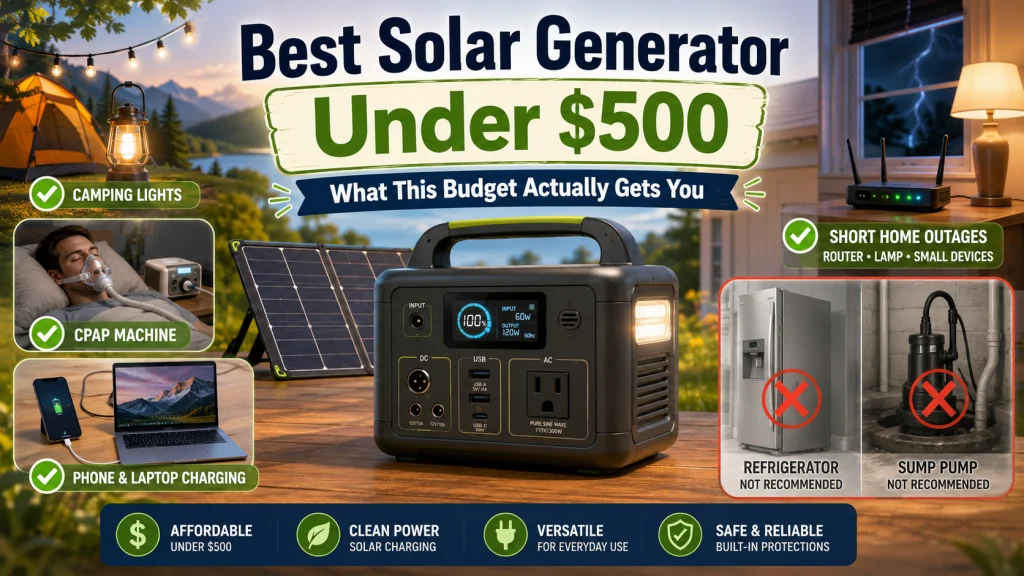
Best Solar Generator Under $500: What This Budget Actually Gets You
A $500 budget gets you a real solar generator. Not a novelty item, not a phone charger in a box. A unit in this range can handle camping weekends, keep your CPAP running through a power outage, charge your devices for days, and cover the kind of short overnight outage that most people actually experience. That is a genuinely useful machine.
What it cannot do is replace a 2,000 watt-hour home backup unit. The capacity reality in the under-$500 range is straightforward: most units here land between 500 and 1,000 watt-hours. Some budget options sit at the lower end of that range, around 300 to 500Wh. A few newer models from reputable brands have pushed 1,000Wh into this price window when discounted, which is worth watching for. The key number is watt-hours, not watts. Watt output tells you what the unit can run at once. Watt-hours tell you how long it can run anything before it needs a recharge.
I’ve seen a lot of first-time buyers show up at the counter holding a box with “2000W” printed on the side, convinced they had bought a 2,000Wh unit. Those are not the same number. The watts on the label are the inverter output peak, not the stored energy. A 500Wh unit with a 1000W inverter holds 500Wh of stored energy. It can push 1000W for short bursts, but it runs out of stored energy based on the 500Wh figure, not the inverter rating. This is the most common misread I see at this price tier and it sets up the wrong expectations before the unit even leaves the shelf.
What a Budget Solar Generator Does Well
Matching the unit to what it actually does well is where most buyers in this price range get good value. The use cases below are where a 500 to 1,000Wh unit works reliably and without compromise. If your situation matches one of them, this budget is the right call.
- CPAP backup without humidifier: A CPAP machine without a heated humidifier draws 15 to 40 watts. At 30 watts, a 500Wh unit at 85 percent efficiency covers roughly 14 hours, which is nearly two full nights on a single charge. Add a DC power adapter for your CPAP model and you bypass the inverter entirely, cutting draw by 20 to 30 percent and pushing that to closer to three nights. This is one of the best use cases at this price tier, and a 500Wh unit is genuinely sufficient.
- Weekend camping device charging and lighting: Phone at 10 watts, laptop at 40 to 60 watts, LED camp lights at 10 to 20 watts. A three-day camping trip with this combined draw uses roughly 500 to 700Wh total. A 1,000Wh unit handles the full weekend with room to spare. Even a 500Wh unit gets you through most weekends if you are not running anything heavier.
- Short overnight outages for essentials: Router at 10 watts plus device charging at 20 watts plus LED lighting at 20 watts equals roughly 50 watts combined. A 700Wh unit at that draw runs approximately 11 hours, well past morning. For the kind of outage that lasts one night and resolves the next day, a unit in this range does the job without being oversized.
- Tailgating with modest loads: Portable speaker, phone charging, small electric cooler for drinks. Combined draw at this level stays under 100 watts in most setups. A 500Wh unit handles a full day of tailgating at that draw without running dry.
The pattern across all four of these use cases is the same: loads that stay between 30 and 100 watts work well. When the draw is light and consistent, a modest battery capacity goes surprisingly far.
Field Note: The most common thing I ran into with buyers at this price level was the CPAP question. Almost every CPAP user who came in assumed they needed a 1,000Wh unit at minimum. Once I walked them through the DC adapter option and the actual watt draw, most of them left with something in the 300 to 500Wh range and came back to tell me it worked perfectly. The DC bypass is the part nobody reads on the box, but it changes the calculation completely.

This 12V and 24V DC converter comes with four dedicated CPAP cables covering ResMed S9, AirSense 10, AirCurve 10, AirMini, AirSense 11, Philips DreamStation, and DreamStation 2, making it one of the most broadly compatible CPAP travel chargers available. Three output ports deliver up to 84W via DC, 30W via USB-C, and 18W via USB-A for simultaneously powering a CPAP machine and other devices from a car outlet or battery pack. A one-button 12V and 24V selector and a power switch that cuts the cigarette lighter when not in use keep operation safe and straightforward.
Check On AmazonIf you click this link and buy, we earn a commission at no additional cost to you.
What This Budget Cannot Do
The honest part of any buying guide at a specific price point is being clear about where the ceiling is. A budget solar generator is not a compromise if you size it to what it can do. It becomes one when you buy it expecting something it cannot deliver.
Running a full-size refrigerator overnight is not realistic at this price tier. A modern Energy Star refrigerator draws 100 to 150 watts on average, which sounds manageable, but that average masks a critical problem: the compressor surge at startup pulls 350 to 600 watts for a fraction of a second every time the compressor cycles. At this price range, you are looking at inverter surge ratings of 1,500 to 2,000 watts, which handles the surge, but the bigger issue is energy volume. At 150 watts average draw, a 700Wh unit lasts roughly 3 to 4 hours before hitting the 20 percent reserve threshold. That is not overnight coverage.
Buyer purchases a 700Wh unit, plugs in a full-size refrigerator expecting overnight coverage. Unit trips or runs dry in 3 to 4 hours. Food is not kept cold overnight.
Use the budget unit for what it handles well: CPAP, lighting, device charging, and short outages. Size up to 2,000Wh if overnight refrigerator runtime is the actual requirement.
Beyond the refrigerator, sump pumps and home air conditioners are also outside this budget’s capability range. A typical 1/3 HP sump pump surges at 2,400 to 4,000 watts at startup. Most units in the under-$500 tier cap surge at 1,500 to 2,000 watts, which is not enough margin to start the pump motor reliably. Attempting it will trip the inverter protection every time.
The three-day outage strategy requires a different class of unit entirely. The daily energy budget to keep a fridge, router, and basic lighting running continuously over 72 hours is roughly 4,500 to 5,000Wh. That math exceeds what this price tier can hold, even before accounting for the recharge challenges on day two and three. If you need a genuine multi-day outage solution, the right starting point is understanding the full home backup picture covered in how to match a solar generator to your actual outage scenario, which routes you to the right capacity class for your situation.
| Load | Typical Draw | 500Wh Runtime | 1,000Wh Runtime | Verdict |
|---|---|---|---|---|
| CPAP (no humidifier, DC) | 20-30W | 12-18 hrs | 25-35 hrs | Works well |
| Device charging + LED lights | 40-60W | 6-9 hrs | 12-18 hrs | Works well |
| Router + lights (outage basics) | 40-50W | 8-10 hrs | 16-20 hrs | Works for 1-night outages |
| Full-size refrigerator | 100-150W avg | 2-3 hrs | 4-7 hrs | Not suitable overnight |
| Sump pump (1/3 HP) | 800W run / 3000W+ surge | N/A | N/A | Inverter likely to trip |
| Window AC unit | 900-1500W | Under 30 min | Under 1 hr | Not suitable |
The table above is not meant to discourage the purchase. It is meant to confirm whether this is the right unit for your situation before you buy it. A unit that is correctly matched to its use case is not a compromise at all.
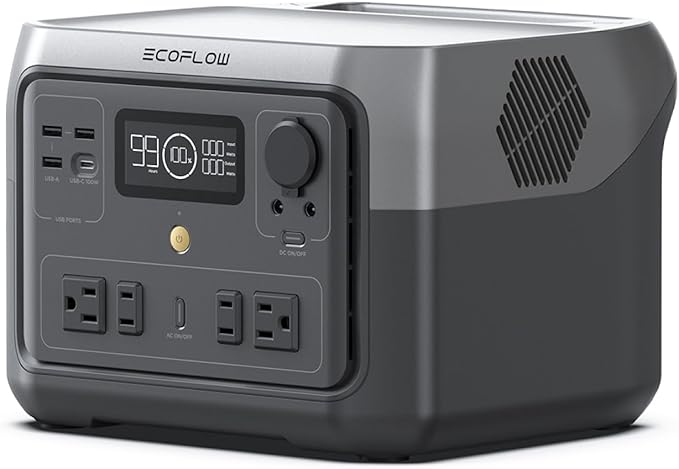
At just 13.3 lbs with 1,000W output across 11 ports, this LiFePO4 station handles everything from AC outlets to USB-C for camping, RV trips, or home backup. X-Stream technology delivers a full AC recharge in just 1 hour, or 2.3 hours with 220W of solar input. The battery is rated for over 10 years of use and ships with a 5-year service guarantee.
Check On AmazonIf you click this link and buy, we earn a commission at no additional cost to you.
The Brand Question at This Price Tier
The under-$500 range is where the brand decision matters more than at any other price point. The gap between a reputable brand and a no-name unit is larger here than it is at $1,500, because margins are thinner and the temptation to cut corners on components is higher.
At this price level, I’d stick to units from Anker, EcoFlow, Jackery, Bluetti, or OUPES. All five have US-based customer service, published warranty terms, and a track record of actually honoring those warranties when something goes wrong. That matters more at $400 than it does at $2,000, because a $400 unit that fails six months in and gets ignored by warranty support is not a $400 purchase. It becomes an $800 mistake when you factor in the replacement. From what I’ve watched play out over and over, the brand that saves you $50 at checkout by going no-name is often the one costing you the most later.
Within the reputable brands, a few specific things are worth checking at this price tier. First, confirm the battery chemistry. LiFePO4 (LFP) batteries in this price range are not a given, but they are available if you look. LFP holds charge longer during storage, tolerates more charge cycles before degrading, and is more stable at temperature extremes than NMC lithium-ion. If the unit you are looking at specifies LFP at this price point, that is a meaningful spec advantage over a competitor that does not.
Second, check the maximum solar input. Units in this range vary widely on how much solar panel wattage they accept. Some cap at 100 watts, others accept 200 watts. If you plan to recharge from panels rather than AC, that ceiling determines how fast you can top up in a day. A 500Wh unit with a 100W solar input cap and 5 peak sun hours produces roughly 500Wh of incoming charge per day, which is a complete recharge from empty. A unit that accepts 200W solar input reaches full charge in half that time. For anything beyond a single-night use, the solar input spec is the one to check after the watt-hour number.
Note: Pricing on solar generators at this tier fluctuates significantly. Presidents Day, Memorial Day, Prime Day, and Black Friday regularly push name-brand units to prices well below their standard retail. If a specific unit interests you, track it on Slickdeals or set a price alert before buying at full retail.
If the $500 ceiling is flexible, the next tier up changes the value equation meaningfully. You can read about how to evaluate solar generators across all price tiers to understand where the performance jumps per dollar are steepest. The under-$1000 range is where LFP becomes standard and home backup becomes genuinely practical for most buyers.

Built with IBC cells at 25% conversion efficiency, this bifacial panel absorbs sunlight from both sides and bends up to 221 degrees to conform to curved surfaces like car roofs and balconies. At just 4.52 lbs it is 56% lighter than rigid panels, and IP68 waterproofing plus IEC TS 63163 certification across 19 international tests ensure reliable output from -40 to 85 degrees Celsius. A 3-meter flat cable enables flexible installation in under 5 minutes.
Check On AmazonIf you click this link and buy, we earn a commission at no additional cost to you.
Final Thoughts: Getting the Expectations Right Before You Buy
A correctly-sized budget solar generator is not a lesser product. I’ve watched buyers use 500Wh units for years to cover their CPAP and keep a camping weekend running without a hitch. The ones who came back frustrated were almost always people who bought this tier expecting it to run a refrigerator through a three-day storm. Setting the expectation before the purchase is what prevents that outcome.
The framework here is simple. If your real load stays under 100 watts and you are covering a single overnight or a camping weekend, a unit in this range does the job. If your primary goal is overnight refrigerator coverage, sump pump backup, or multi-day outage protection, you need to step up to the 2,000Wh class regardless of what the marketing on the box suggests. The Wh math is not negotiable, and the spec sheet is always more optimistic than real-world conditions.
Before you buy anything in this range, run your own numbers. Add up the watt draws of everything you actually plan to run. Multiply by the hours you need to run them. Add 15 to 20 percent for conversion losses. Whatever that number is, that is the minimum watt-hour capacity you need. If it fits inside the under-$500 range, buy in this range. If it does not, buying smaller to save money just means buying twice.

This compact plug-in monitor tracks the energy consumption of any AC 115-volt appliance and displays real-time readings of volts, amps, and wattage at 0.2 to 2.0 percent accuracy. Its large LCD screen lets you calculate electricity costs by the day, week, month, or year, making it easy to spot energy-hungry devices and trim your utility bill. It is also compatible with inverters, adding flexibility for off-grid setups.
Check On AmazonIf you click this link and buy, we earn a commission at no additional cost to you.
FAQs
🔋 What can a solar generator under $500 actually power?
At this price tier you are typically looking at 500 to 1,000Wh of capacity. That handles CPAP backup for multiple nights, weekend camping with device charging and LED lighting, and short overnight outages covering a router and basic lights. It cannot reliably run a full-size refrigerator through the night or handle high-surge appliances like sump pumps.
⏱️ How long will a budget solar generator run a refrigerator?
A typical modern refrigerator draws 100 to 150 watts on average. A 700Wh unit at that draw lasts roughly 3 to 4 hours before hitting its reserve threshold. This is not overnight coverage. If keeping a refrigerator running through a full night is your primary need, size up to a 2,000Wh unit minimum.
🔌 Does a cheap solar generator work for CPAP?
Yes, and it often works better than buyers expect. A CPAP without a heated humidifier draws 15 to 40 watts. A 500Wh unit covers one to two full nights easily. If your CPAP model accepts a 12V DC power adapter, use it. Running DC-to-DC bypasses the inverter and reduces draw by 20 to 30 percent, pushing a 500Wh unit to cover nearly three nights without a recharge.
🏷️ Is it worth buying a no-name solar generator to save money?
Generally no. At this price tier the warranty and customer support difference between established brands and no-name units is the largest it gets. A no-name unit that fails outside a return window often comes with a warranty that is difficult or impossible to actually use. Stick to brands with a documented US support presence and a track record of honoring warranty claims.
⚡ What is the difference between watts and watt-hours on a solar generator?
Watts is the rate of power delivery at any instant. Watt-hours is the total energy stored in the battery. A unit labeled “2000W” is advertising its inverter output peak, not its storage capacity. To know how long it runs, look for the Wh number. A 500Wh unit running a 50W load lasts roughly 8 to 9 hours before the battery is depleted to its reserve threshold.
🌞 Can I recharge a budget solar generator with solar panels?
Yes, but check the maximum solar input spec for your unit first. Units at this price tier typically accept 100 to 200W of solar input. A 500Wh battery with 100W solar input in 5 peak sun hours can fully recharge in a day. A unit capped at 100W input cannot benefit from connecting more panels than the spec allows.
🧊 Can a solar generator under $500 run a sump pump?
In most cases no. A typical 1/3 HP sump pump surges to 2,400 to 4,000 watts at startup. Most units at this price tier max out their inverter surge at 1,500 to 2,000 watts, which is not enough margin to reliably start the motor. The surge trip will protect the unit, but the pump will not run. Sump pump backup requires a unit with confirmed 3,500 watts or more of surge capacity.