Series vs Parallel: What Each Configuration Actually Does to the Numbers
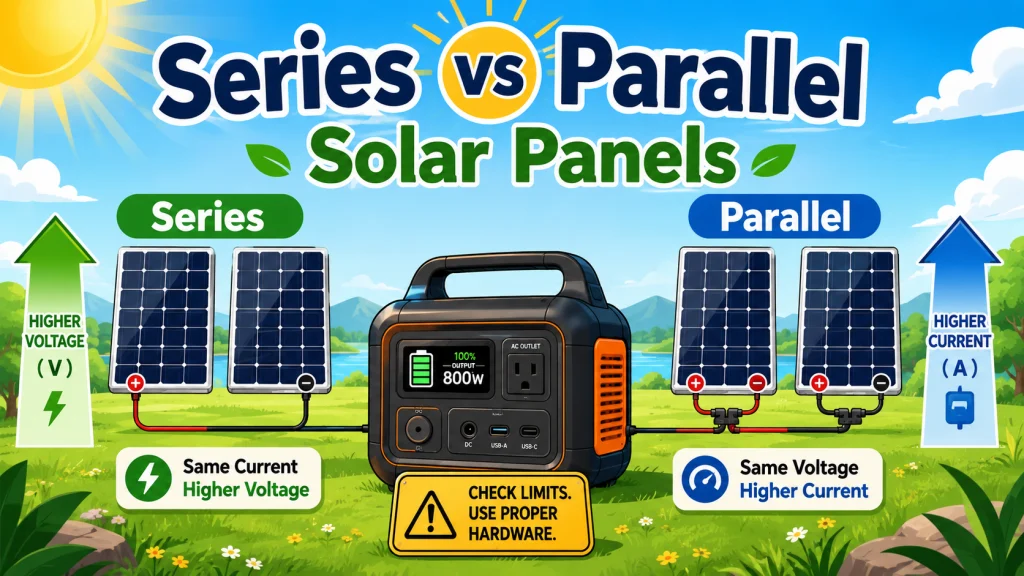
When you connect two solar panels together, you have two choices and they produce opposite results. Series wiring connects the positive lead of one panel to the negative lead of the next. The voltages add together and the current stays the same as a single panel. Parallel wiring connects positive to positive and negative to negative across both panels. The current doubles and the voltage stays the same as a single panel. That is the whole physics of it, and everything else about this decision flows from understanding those two outcomes.
Where buyers go wrong is treating this as a preference question rather than a spec question. Your solar generator has a maximum solar input voltage and a maximum solar input current. Series wiring raises voltage. Parallel wiring raises current. Whether series or parallel is correct for your setup depends entirely on which limit you are closer to exceeding, and that number is sitting in your unit’s spec sheet waiting to be checked. I have seen people at the shop connect two panels in series without looking at the voltage ceiling and end up with a unit that stopped accepting solar input entirely because the MPPT controller got a voltage it could not handle.
What the Numbers Look Like in Practice
Take two 100W panels, each with a 20V Open Circuit Voltage (Voc) and a 6A Short Circuit Current (Isc). In series, you get a combined Voc of 40V and the same 6A current. In parallel, you still have 20V Voc but now 12A combined current. The wattage potential is the same either way: around 200W under good conditions. What changed is the voltage and current profile your unit’s charge controller has to work with.
| Configuration | Combined Voltage (Voc) | Combined Current (Isc) | Wattage Potential |
|---|---|---|---|
| 2 x 100W panels, 20V / 6A each: Series | 40V | 6A | ~200W |
| 2 x 100W panels, 20V / 6A each: Parallel | 20V | 12A | ~200W |
| 3 x 100W panels, 20V / 6A each: Series | 60V | 6A | ~300W |
| 3 x 100W panels, 20V / 6A each: Parallel | 20V | 18A | ~300W |
The table makes clear why the unit’s input specs matter so much. A unit with a 30V maximum input voltage would be fine with two 20V panels in parallel (still 20V) but immediately over the limit with those same panels wired in series (40V). A unit with a 60V maximum would handle either configuration for two panels, but series wiring three panels (60V combined) would sit right at the edge, and on a cold morning when panel voltage runs slightly higher than rated, that configuration would be risky. A unit with a 150V maximum input has far more headroom and can accept series strings that smaller units cannot.
Cold temperature is worth mentioning here because it catches people off guard. On a cold clear day, the open circuit voltage of a panel can run 10 to 15 percent above its rated spec. A panel rated at 20V Voc might produce 22V or 23V in cold conditions. Two of those in series becomes 44 to 46V. If your unit’s ceiling is 45V, that is no longer a safe combination in winter. Always check the cold-weather behavior of your panels against the voltage ceiling of your unit, not just the room-temperature spec.
Voltage Is the Risk That Damages Hardware
Between the two limits, voltage is the one that matters more for hardware safety. Exceeding the maximum input voltage on a solar generator puts the MPPT charge controller at real risk of damage. Most units have some protection circuitry, but that protection is a last resort, not a design target. A controller that gets hit with over-voltage repeatedly will degrade faster than the spec suggests, and some units simply reject the connection rather than risk the circuit. I have seen units that came into the shop showing 0 watts of solar input where the only explanation was a voltage ceiling exceeded too many times by a series configuration the owner did not realize was too high.
Exceeding the current limit is less immediately dangerous in most cases because MPPT controllers often clip the incoming current to their rated maximum without failing. Excess current gets left on the table rather than forced through the circuit. This does not mean the current limit is irrelevant. Running at the ceiling continuously stresses the controller and generates excess heat. But the failure mode for over-voltage is more abrupt than for over-current, which is why voltage always gets checked first.
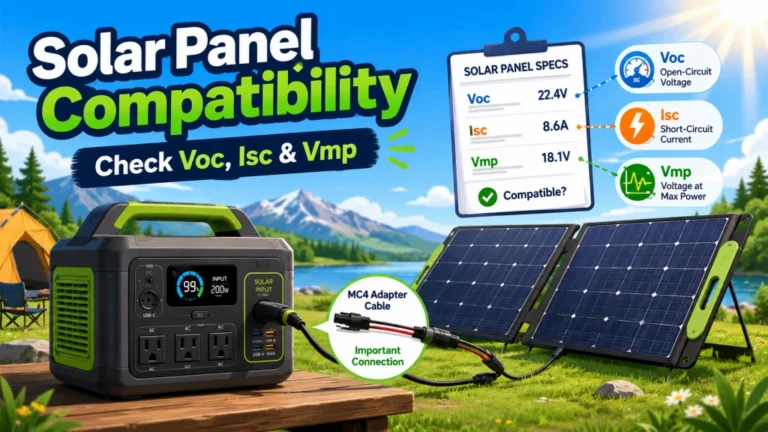
Warning: Always check the panel’s Open Circuit Voltage (Voc), not the operating voltage (Vmp), against your unit’s maximum input voltage. Voc is the voltage the panel produces in full sun with no load. It is the number that spikes highest during a connection and in cold conditions. Using Vmp to check compatibility understates the real voltage the unit will see.

This handheld PV analyzer tests solar panels up to 800W, 60V, and 35A, displaying wattage, open circuit voltage, and maximum power point in both auto and manual MPPT modes. No external battery needed as it powers directly from the panel being tested, and a backlit LCD stays readable in full sunlight or dark conditions. Includes MC4 connectors, alligator clip cables, a carrying case, and a 365-day warranty with lifetime technical support.
Check On AmazonIf you click this link and buy, we earn a commission at no additional cost to you.
Match the Wiring to Your Unit’s Input Window
The practical decision between series and parallel comes down to three input ranges, and most portable solar generators fall into one of them. Knowing which category your unit sits in makes the wiring choice straightforward.
Units with low maximum input voltage (under 35V)
This group includes many compact units in the 500Wh to 1000Wh class. With a voltage ceiling this low, series wiring two typical 20V-rated panels (combined 40V Voc) is already over the limit. Parallel is almost always the correct configuration here. Check the current limit before assuming parallel works across however many panels you want to connect, but voltage is usually not the constraint you can flex on with these units.
Units with mid-range maximum input voltage (35V to 80V)
This group covers many popular mid-range units in the 1000Wh to 2000Wh class. Two typical 20V panels in series (40V combined) often fits within this range with margin. Three panels in series (60V) may or may not fit depending on the exact ceiling and the cold-weather voltage behavior of the panels. For this group, series works for two panels in most cases and requires a careful check for three. Parallel is always available as the safe default when the series math gets close to the limit.
Units with high maximum input voltage (80V to 150V)
Larger units in the 2000Wh and up class often accept higher input voltages to accommodate the kind of panel arrays needed to charge a large battery in a reasonable amount of time. With a ceiling above 80V, series wiring two or three typical 20V-rated panels is comfortable. Series becomes genuinely useful here because higher voltage through a given cable length means lower current, which reduces resistive loss in long cable runs. If you are setting up panels at a distance from the unit, series wiring at higher voltage can recover some efficiency that parallel wiring would lose to cable resistance.
Field Note: The mistake I ran into at the shop most often with multi-panel setups was buyers who checked voltage for series but forgot to check current for parallel. They assumed parallel was automatically safe because it keeps voltage low. But two panels each producing 10A Isc in parallel is 20A combined. If the unit caps at 15A input current, you are over it. Parallel is safe for voltage; it still requires a current check before you assume it works for your specific panel count.

This TÜV-certified connector set includes one male-to-two-female and one female-to-two-male adapter for wiring solar panels in parallel, compatible with 14 to 10 AWG cable. PPO housing and tinned copper contacts handle temperatures from -40 to 230 degrees Fahrenheit, and an IP67 waterproof seal prevents corrosion in outdoor environments. Tool-free plug-and-play connection is backed by an 18-month support guarantee.
Check On AmazonIf you click this link and buy, we earn a commission at no additional cost to you.
How Shade Affects Series vs Parallel Differently
For portable solar generator setups used outdoors in variable conditions, shade behavior is a practical consideration that the electrical specs do not fully capture. In a series string, a shadow on one panel reduces the output of the entire string. One panel producing 50 percent of its rated output drags the whole string to approximately 50 percent because current is limited by the weakest panel. Bypass diodes inside the panel mitigate this to some degree, but a series configuration is more sensitive to uneven shading than a parallel one.
In a parallel configuration, each panel operates more independently. A shaded panel produces less and contributes less to the combined output, but the unshaded panels continue producing at their normal rate. The total output loss is proportional to the shaded panel’s individual contribution rather than multiplied across the whole string. For someone setting up panels in a campsite with trees nearby, or positioning panels in a spot where partial shade is likely at certain times of day, parallel wiring is the more forgiving configuration.
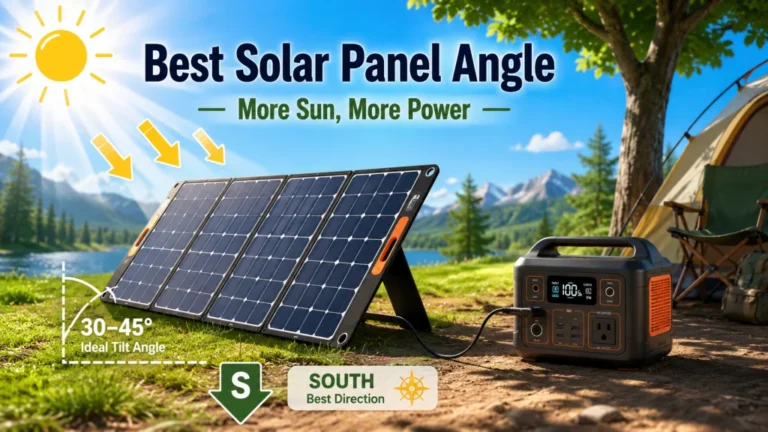
This does not make parallel universally better. It means shade tolerance is one more input to the decision. In a fixed outdoor location with unobstructed sun, shade is not a factor and series wiring can be used based entirely on whether the voltage math clears the unit’s input ceiling. For a more complete picture of placement decisions that affect real-world panel output, the solar generator panel setup guide covers angle, orientation, and placement in detail alongside the connector and wiring decisions.
The Physical Side: MC4 Y-Connectors and Extension Cables
Foldable portable panels typically ship with a single MC4 output pair. Combining two panels requires a Y-connector, also called a branch connector or MC4 parallel connector, which joins the positive leads of both panels into one positive MC4 output and does the same for the negative leads. This gets you parallel wiring in a single combined cable run to the unit. For series wiring, you connect the positive MC4 from panel one to the negative MC4 from panel two, and use the remaining positive from panel two and negative from panel one as your output pair. No additional connector is required for series, which is one of the reasons some people find it simpler to wire when the voltage math allows it.
Extension cables matter more in series configurations than in parallel, and for a reason that is easy to miss. Higher voltage at lower current, which is what series produces, handles resistive loss in cable runs better than lower voltage at higher current. If your panels need to be positioned 20 or 30 feet from the unit, a series configuration loses less power to cable resistance than a parallel configuration at the same wattage. For close-range portable setups where the panels are within a few feet of the unit, this difference is negligible and should not be the deciding factor. But if distance is part of your setup, the voltage advantage of series wiring has real value.
Note: MC4 Y-connectors come in male-positive to dual-male and female-negative to dual-female pairs. You need both: one to combine the positive leads and one to combine the negative leads. If a listing sells only one piece, it is half the pair. A complete parallel connection requires two branch connectors total.
How to Make the Decision for Your Specific Setup
The decision process is short once you have the numbers in front of you. Pull your unit’s spec sheet and find: maximum solar input voltage, maximum solar input current, and the MPPT input voltage range. Pull your panel’s spec label and find: Open Circuit Voltage (Voc), Short Circuit Current (Isc), and Maximum Power Voltage (Vmp). With those six numbers you can work through the following.
- Series check: Multiply the panel’s Voc by the number of panels you plan to connect in series. Add 10 to 15 percent to account for cold-weather voltage increase. If the result exceeds your unit’s maximum input voltage, series wiring is not safe for that configuration. Reduce the number of panels or switch to parallel.
- Parallel check: Multiply the panel’s Isc by the number of panels you plan to connect in parallel. If the result exceeds your unit’s maximum input current, you have too many panels for parallel wiring. Reduce the count or consider series if the voltage allows it.
- MPPT range check: Confirm that the wiring configuration you choose produces a combined Vmp that falls within your unit’s stated MPPT operating range. A voltage that is technically below the ceiling but far outside the MPPT range results in inefficient charging. Most configurations with typical 20V panels fall within the MPPT range of most units, but it is worth verifying if you are using unusual panels or chaining more than two.
- Shade consideration: If your setup location involves partial shade at any point during charging hours, parallel is the more tolerant choice. If the location is unobstructed, shade is not a deciding factor.
- Cable run consideration: If panels need to be positioned at a meaningful distance from the unit (15 feet or more), series wiring at higher voltage is more efficient if the voltage math permits it.
Most single-panel setups require none of this analysis because you are connecting one panel directly. The decision becomes necessary when you add a second panel, and the answer usually comes down to a single number: what is your unit’s maximum input voltage, and does the series combination of your panels’ Voc values stay under it with cold-weather margin included. If it does, you have a genuine choice. If it does not, parallel is the path.
One more thing worth addressing before you buy: use identical panels whenever possible. In a series string, current is limited by the weakest panel in the chain, so mismatched panels pull the stronger one down to the output of the weaker one. In parallel, voltage mismatch can cause the MPPT controller to operate inefficiently or pull current unevenly between panels. This does not mean you cannot use panels with slightly different specs in an emergency, but if you are buying a second panel to expand capacity, matching the wattage, Voc, and Isc of your existing panel is the configuration that produces what the math says it should.
Understanding how this wiring decision fits into the broader process of operating your unit correctly is part of what the complete solar generator operational guide covers from first charge through long-term ownership. Panel setup decisions and charging method decisions are connected, and working through them in order produces better outcomes than solving each in isolation.

Built with monocrystalline cells at 23% conversion efficiency, this 9.7 lb panel offers four preset angles at 30, 40, 50, and 80 degrees for optimal sun tracking in any season or location. ETFE coating and IP67 waterproofing ensure durability in rough outdoor conditions, and the stable MC4 connection minimizes energy loss. Includes MC4, MC4-to-XT60, and XT60-to-DC7909 cables for broad compatibility.
Check On AmazonIf you click this link and buy, we earn a commission at no additional cost to you.
Final Thoughts: Check the Voltage First, Then Check the Current
Series adds voltage, parallel adds current. Neither is inherently better. What matters is which configuration keeps both numbers inside the limits your unit can handle. Voltage is the check you cannot skip because it is the one with real hardware consequences. Current matters too, especially in parallel where combining enough panels can exceed the controller’s input current rating.
The math is not complicated. The problem is that most people never pull the numbers, and that is how a controller ends up seeing a voltage it was not designed for. Pull the spec sheet, run the checks, and the wiring decision takes care of itself.

Weighing just 23.8 lbs with a foldable handle, this 1,070Wh LFP power station delivers 1,500W of pure sine wave AC output with a 3,000W surge capacity, capable of running AC units, fridges, and electric pots. Its LFP battery sustains over 70% capacity after 4,000 cycles, translating to a lifespan of more than 10 years. Via the Jackery App, you can enable a full charge in as little as one hour, or switch to a whisper-quiet 30 dB overnight mode. Six output ports including two USB-C with 100W PD charging cover nearly any device simultaneously.
Check On AmazonIf you click this link and buy, we earn a commission at no additional cost to you.
FAQs
⚡ Is it better to wire solar panels in series or parallel for a solar generator?
Neither is universally better. Series wiring raises voltage and keeps current low. Parallel wiring keeps voltage low and raises current. The correct choice depends on your unit’s maximum input voltage and current limits. If series wiring exceeds the voltage ceiling, use parallel. If parallel wiring exceeds the current limit, reduce the panel count. Check both limits before connecting.
🔢 What happens if I wire solar panels in series and exceed my unit’s voltage limit?
The MPPT charge controller may reject the input entirely, show 0 watts, or sustain damage over time. Most units have over-voltage protection, but it is not a substitute for staying within rated limits. Always check that the combined Voc of your series string, with a 10 to 15 percent cold-weather buffer added, stays below the unit’s stated maximum input voltage.
🌥️ Does shading affect series and parallel wiring differently?
Yes. In a series string, shade on one panel reduces output across the entire string because current is limited by the weakest panel. In parallel, each panel operates more independently and a shaded panel only reduces its own contribution. For setups where partial shade is likely, parallel is the more tolerant configuration.
🔌 What connector do I need to wire two portable solar panels in parallel?
You need a pair of MC4 Y-branch connectors: one that combines the two positive leads into a single positive output, and one that combines the two negative leads into a single negative output. Both pieces are required for a complete parallel connection. Some listings sell them as a pair and some sell them individually, so confirm before buying.
📏 Does the cable length between panels and the unit affect which wiring I should choose?
It can. Series wiring produces higher voltage at lower current, which handles resistive loss in longer cable runs more efficiently than parallel wiring at lower voltage and higher current. If your panels are positioned more than 15 feet from the unit, series wiring (if the voltage math allows it) will deliver slightly more power through that cable run than parallel wiring at the same wattage.
🌡️ Can cold weather cause a series-wired panel array to exceed the voltage limit?
Yes. Panel open circuit voltage rises as temperature drops, typically 10 to 15 percent above the rated Voc on a cold clear morning. Two panels that are within the voltage limit at room temperature may exceed it in cold conditions. Always apply a cold-weather buffer when calculating the combined Voc of a series configuration. If the margin is tight, use parallel instead.