When Weight Is the Right Starting Point
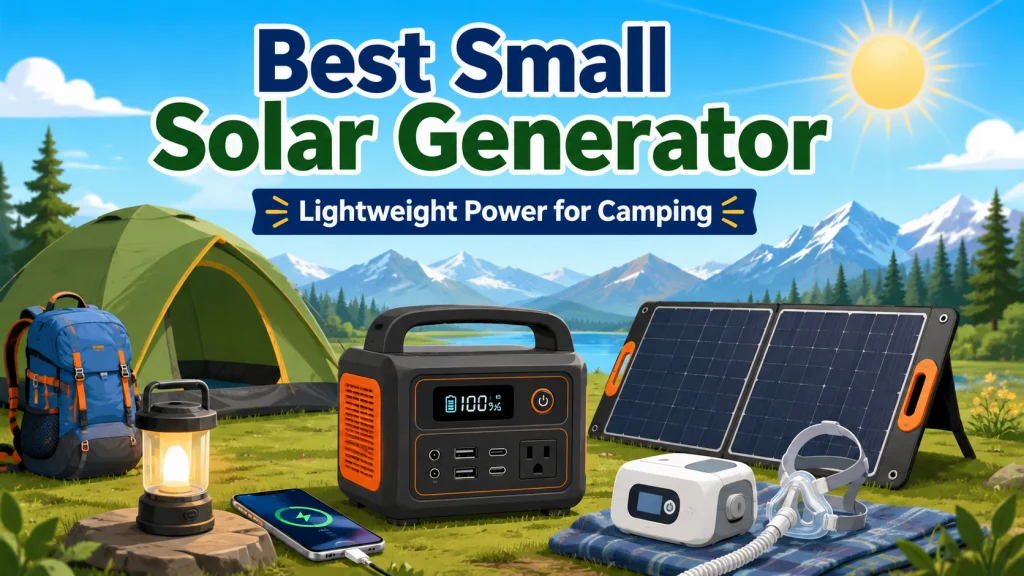
If you are carrying a small solar generator any distance beyond a parking lot, weight is the only spec that matters first. That sounds obvious, but most buyers start with watt-hours and work backward to weight. That gets the order wrong. A 2000Wh unit that handles almost everything weighs between 40 and 65 lbs. A 500Wh unit that handles CPAP, lighting, and device charging weighs 10 to 13 lbs. For someone hiking from their car to a campsite, for a traveler who needs reliable backup power in a hotel room, for a camper at a drive-in campsite who still has to carry their gear across uneven ground, the 2000Wh unit is the wrong answer regardless of what its spec sheet says.
Weight is the filter you apply first. Everything else, capacity, solar input, outlet count, comes after you have decided how much you are willing to carry. The buyers I have watched get this right are the ones who started with a realistic picture of their carry distance before they ever looked at a spec. The ones who got it wrong almost always did the opposite: found a unit with appealing capacity and noticed the weight as an afterthought on the product page.
It is also worth saying upfront what this article covers. Portability-first buying is specific to campers, hikers, and travelers for whom carry weight is a real constraint. If your solar generator lives in the back of a truck and never leaves the campsite, weight should stop being your primary filter. The guide on choosing the right solar generator for your camping style covers that full range, from car camping to ultra-light, and is the better starting point if you are still working out which category fits. But if you already know weight comes first, read through the tiers below before anything else.
The Three Portability Tiers
Portable solar generators fall into three practical weight classes, and each comes with a realistic capacity ceiling. Knowing which tier fits your carry situation before you look at features saves a lot of time filtering through units that are either too heavy or too limited for what you actually need.
| Weight Range | Typical Capacity | What It Reliably Runs |
|---|---|---|
| Under 5 lbs | 100 to 300Wh | Phones, tablets, laptop charging only |
| 5 to 15 lbs | 300 to 700Wh | CPAP without humidifier (1.5 to 2 nights), LED lighting, small fan, device charging |
| 15 to 35 lbs | 700 to 1500Wh | Mini fridge if surge rating is adequate, CPAP with humidifier, full weekend camp setup |
The under-5-lb tier is straightforward. You are looking at 100 to 300Wh, which handles a phone, tablet, or laptop over multiple charges. Nothing with a motor or compressor, nothing that heats or cools. This tier can fit a traveler who needs electronics backup on a day hike or at a destination, but the FAA cutoff matters here: only units under 100Wh board a plane without approval, and 101 to 160Wh requires airline approval. A unit at 200 to 300Wh may weigh under 5 lbs, but it is not flight-friendly. If you are buying specifically for air travel, verify the exact watt-hour rating before you assume it qualifies.
The 5-to-15-lb tier is the most practical range for most light campers. A well-designed unit at 500 to 700Wh handles a CPAP machine without a humidifier for one to two nights depending on draw and whether you use a DC adapter, powers LED lighting reliably across a full weekend, and keeps every device you bring topped off. The weight is manageable for a carry from the parking lot to a campsite, and the capacity is enough to feel like a real power solution rather than a trickle charger.
The 15-to-35-lb tier overlaps with car camping territory, but it belongs here because the weight is still realistic for a buyer loading gear into a vehicle and walking a short distance. At 700 to 1500Wh, a unit in this range can start a small portable compressor fridge if the surge watt rating is sufficient, and can sustain a CPAP with the humidifier running. Adding the humidifier pushes the requirement up into this heavier tier for most users, because the higher draw eats through a 500Wh battery before a full night is complete.

At just 14 lbs with 512Wh capacity and 500W output, this is the lightest LiFePO4 station in its class, reaching 80% charge in just 52 minutes via AC. Its 6,000-cycle battery delivers 10 plus years of reliable use with only 5% self-discharge over six months of storage. A 10ms UPS switchover, 28 dB operation, and built-in LED light make it equally suited for home backup, camping, and emergencies.
Check On AmazonIf you click this link and buy, we earn a commission at no additional cost to you.
What the Capacity Numbers Actually Mean
Runtime math is simpler than the marketing makes it. Take the unit’s rated watt-hours, multiply by 0.85 to account for inverter and conversion losses, then divide by your load in watts. That gives you usable hours before the unit hits its low-battery reserve. A 500Wh unit running a 50W combined load, which covers a small fan, LED light, and phone charging, delivers roughly 8.5 hours. At 100W it runs about four hours. At 150W, under three hours.
CPAP runtime deserves its own numbers because I have watched buyers get this wrong often enough that it is worth spelling out clearly. A CPAP without humidifier draws roughly 25 to 35W, call it 30W as a working average. Over an 8-hour sleep, that is 240Wh consumed at the machine. Accounting for battery conversion losses, the unit is actually drawing about 282Wh per night. A 500Wh unit handles one night with roughly 40 percent remaining. A 700Wh unit gets you through one full night and most of a second. If you use a DC adapter and run the CPAP directly from the unit’s 12V DC output, you bypass the inverter entirely and cut conversion loss to about 5 percent instead of 15. That stretches a 500Wh unit to approximately two nights and a 700Wh unit to close to three.
Field Note: The most common return I processed with small unit buyers was not a defective product. It was a mismatch. They bought a 500Wh unit expecting it to handle two or three nights of CPAP with humidifier. The humidifier alone pulls 50 to 80W, which means a single night of CPAP with humidifier uses 480 to 640Wh before efficiency losses. A 500Wh unit is gone before sunrise. Once I walked buyers through the actual watt draw on the humidifier, the unit made complete sense to them. The problem was never the product.
Here is a practical load audit for a buyer in the 5-to-15-lb tier:
- CPAP without humidifier via DC adapter: 25 to 35W
- LED camp lantern: 8 to 12W
- Phone charging: 5W
- Small USB fan: 8 to 12W
- Occasional laptop use: 40 to 60W when active
Running CPAP, a light, and a fan simultaneously puts you at roughly 50 to 60W. A 500Wh unit at that combined draw gives you about 7 to 8 hours, enough for a full night but with little margin for morning device charging. A 700Wh unit at the same load runs about 10 hours and leaves a meaningful reserve for the morning before a solar panel tops it back up. If you are adding a laptop into the mix, your combined draw climbs to 90 to 120W and a 700Wh unit gets you through about 5 to 6 hours, which is a problem if you need it to last a full night. This is where the math matters before you buy, not after.

This compact plug-in monitor tracks the energy consumption of any AC 115-volt appliance and displays real-time readings of volts, amps, and wattage at 0.2 to 2.0 percent accuracy. Its large LCD screen lets you calculate electricity costs by the day, week, month, or year, making it easy to spot energy-hungry devices and trim your utility bill. It is also compatible with inverters, adding flexibility for off-grid setups.
Check On AmazonIf you click this link and buy, we earn a commission at no additional cost to you.
The FAA Battery Threshold Air Travelers Need to Know
If you are a frequent flyer who wants portable power at a destination, the FAA’s lithium battery threshold changes everything about which unit you can travel with. Most buyers shopping for compact solar generators have no idea this rule exists until they get to the security checkpoint.
FAA rules on lithium-ion batteries set three tiers. Under 100Wh: permitted in carry-on without any airline approval, no limit on quantity for personal use. Between 101Wh and 160Wh: permitted in carry-on with prior airline approval, limited to two spare batteries per passenger. Above 160Wh: not permitted on passenger aircraft for standard portable power banks and solar generator batteries. There is no approval process that unlocks a higher limit for this product category. The TSA enforces these FAA rules at US airport checkpoints, so the ceiling that governs your unit is 160Wh with approval, not some higher threshold that varies by carrier.
Note: Airline policies on battery wattage can vary, including internationally where rules may differ from US domestic requirements. Always verify with your specific carrier before you travel.
For a buyer whose primary use case is hotel backup, international work travel, or weekend trips involving flights, the 100Wh threshold is the most important spec on the sheet. A unit just under 100Wh handles a phone through several full charges, a laptop for a couple of hours, and runs a CPAP on DC power for two to three hours, enough for a nap or partial backup during a red-eye, not a full-night CPAP solution. It is not an overnight camping solution, but as a travel safety net it boards the plane without paperwork. If your needs go beyond basic electronics, a unit in the 100 to 160Wh range with airline confirmation in hand is the more practical answer.

Weighing just 23.8 lbs with a foldable handle, this 1,070Wh LFP power station delivers 1,500W of pure sine wave AC output with a 3,000W surge capacity, capable of running AC units, fridges, and electric pots. Its LFP battery sustains over 70% capacity after 4,000 cycles, translating to a lifespan of more than 10 years. Via the Jackery App, you can enable a full charge in as little as one hour, or switch to a whisper-quiet 30 dB overnight mode. Six output ports including two USB-C with 100W PD charging cover nearly any device simultaneously.
Check On AmazonIf you click this link and buy, we earn a commission at no additional cost to you.
Portability Is More Than Weight
Weight gets all the attention in portable solar generator reviews, but there are several other factors that determine whether a unit is actually easy to carry and use in the field. I have handed a lot of units across the counter and watched people pick them up for the first time. The reaction to a 13-lb unit with a bad handle or an awkward shape is sometimes worse than the reaction to a 17-lb unit that sits perfectly in a hand.
Handle design matters more than most buyers expect. A single top handle with a firm grip makes a 12-lb unit feel manageable on a longer carry. No handle, or a flimsy strap handle, makes the same weight feel punishing after 200 feet. Units with a vertical form factor, taller and narrower rather than wide and flat, tend to fit more cleanly into a vehicle cargo area, alongside gear bags, and in tight spaces. A flat, wide unit that sits like a toolbox takes up more floor space and slides around more in the back of a vehicle.
Packability also means what you have to carry alongside the unit. A 12-lb solar generator is 14 lbs by the time you add a foldable panel, the DC adapter for the CPAP, and the bag or case you put it in. Buyers who do not account for the full carry weight are sometimes surprised when they actually load the bag. If you are planning a carry of more than a few hundred feet, mentally add two to three lbs to whatever the unit’s listed weight is.
Port placement and the unit’s display readability in low light are worth checking before you buy. If all the AC outlets face a wall when the unit sits on the ground, you are repositioning it every time you plug something in. If the display is not backlit or is very small, reading the remaining charge percentage inside a tent at night requires guessing. These are small things that do not show up in spec sheets but accumulate into daily friction.
What a Small Solar Generator Cannot Do
Setting honest expectations before you buy matters more with compact units than with any other class. The gap between what buyers expect and what the physics allows is widest at the small end of the market, and marketing materials rarely close that gap for you.
Most units under 700Wh cannot reliably start a compressor-based refrigerator or freezer. The surge watt problem is the culprit. A standard portable fridge compressor starts with a surge draw of 350 to 600W, lasting less than a second, but the inverter has to handle it or the protection circuit trips and the unit shuts off. Most compact units with a 700W to 800W continuous inverter carry peak surge ratings around 1,200W. That handles the startup in theory, but only barely. In warmer temperatures, with a fully loaded fridge, or with an older compressor drawing higher than rated, the surge can exceed the inverter’s tolerance. The result is a unit that cuts power at the moment you need it most, not because it is broken, but because the spec math was never right for that load.
A fridge draws 60W running, so any unit with a 600W inverter can start it. The running draw is not the issue. The startup surge is what trips the protection circuit on a compact unit.
Check the fridge’s startup surge spec, not just its running watts. For reliable fridge operation, target a unit in the 700 to 1500Wh tier with a surge rating well above the fridge’s startup draw, typically 2,000W or higher.
Beyond the fridge issue, here is what the under-15-lb tier handles well and what it does not:
- CPAP without humidifier via DC adapter: yes, 1.5 to 2 nights on 500Wh, 2.5 to 3 nights on 700Wh
- LED camp lighting across a full weekend: yes
- Phone, tablet, and laptop charging: yes
- Small USB fans and personal electronics: yes
- Camera batteries and accessories: yes
- Full-size or portable compressor refrigerator: not reliably in the 5-to-15-lb tier
- Microwave or resistive heating loads: no
- Power tools with large motors: no
- Any air conditioning unit: no
- CPAP with humidifier for a full night on a 500Wh unit: no, humidifier draw exceeds available capacity
The list is not a criticism of compact solar generators. It is what the physics allows at that capacity and inverter size. A unit in the 5-to-15-lb range is genuinely excellent at what it does. The buyers who regret the purchase are the ones who bought it expecting fridge or multi-appliance performance from a personal electronics class unit.
Which Tier Is Right for You
If you have read through the tiers and the runtime math, the buying decision usually comes down to three questions: how far are you carrying it, what is the single most power-hungry thing you need to run overnight, and are you flying with it. Here is how those answers map to the tiers above.
- Flying and need power at the destination: Under 100Wh for no-hassle travel. Between 101Wh and 160Wh with prior airline approval, limited to two batteries per passenger. Above 160Wh is not permitted on passenger flights for this product category. Most units in the 5-to-15-lb camping tier are 300 to 700Wh and cannot fly at all. Keep air travel and camping power as separate purchase decisions.
- Camping and the main overnight load is CPAP without humidifier: 500Wh covers roughly 1.5 to 2 nights on DC power depending on draw. 700Wh gets you closer to 2.5 to 3 nights. Either unit in the 5-to-15-lb tier works for this. Use the DC adapter if your CPAP model supports it.
- Camping with CPAP plus lights and a fan overnight: 700Wh is the minimum that reliably covers a full night at that combined draw. A 500Wh unit at 50 to 60W gets you through 7 to 8 hours, which is right at the edge depending on your sleep schedule.
- Weekend camping and you want a fridge: Move to the 15-to-35-lb tier. You need both the capacity and the surge rating. A unit in this range weighs more, but it is sized for the load.
- Camping with electronics only and no overnight appliances: A unit under 5 lbs at 200 to 300Wh handles it if you are charging phones and a laptop. The 5-to-15-lb range is for when lighting and a fan are also in the mix.
The most common oversizing mistake at this end of the market is buying into the 15-to-35-lb tier for a load that a 700Wh unit handles fine. The most common undersizing mistake is buying under 5 lbs expecting a CPAP backup that is not mathematically possible at that capacity. Both of those mismatches show up in returns. Neither is hard to avoid once you do the load math before the purchase.
For the broader decision, including how a small portability-first unit fits alongside a larger home backup unit or a car camping setup, matching the right solar generator to your full situation walks through the complete picture. For the portability-focused buyer who has already done that work, the tiers and the decision points above are what you need.

At 17.2 lbs with 1,600W output across 11 ports, this LFP station handles 80% of common appliances and fully recharges via AC in just 70 minutes using X-Stream technology, or in 3.5 hours with 220W of solar input. The battery is rated for 3,000 plus cycles across nearly 10 years of use, and the package includes a 5-year service guarantee.
Check On AmazonIf you click this link and buy, we earn a commission at no additional cost to you.
Final Thoughts: Buy for the Carry Distance, Then Do the Math
Two things determine whether a compact solar generator is right for you: whether the weight tier matches your actual carry situation and whether the capacity covers your real overnight load. Both of those are checkable before you buy. The buyers who are happy with their unit did the math upfront. The ones who are not almost always skipped it.
Small solar generators are not compromised products. They are purpose-built for portability. That purpose has specific limits, and those limits are honest ones. Know your carry distance, know your overnight watt draw, and the right tier is usually obvious.

Built with IBC cells at 25% conversion efficiency, this bifacial panel absorbs sunlight from both sides and bends up to 221 degrees to conform to curved surfaces like car roofs and balconies. At just 4.52 lbs it is 56% lighter than rigid panels, and IP68 waterproofing plus IEC TS 63163 certification across 19 international tests ensure reliable output from -40 to 85 degrees Celsius. A 3-meter flat cable enables flexible installation in under 5 minutes.
Check On AmazonIf you click this link and buy, we earn a commission at no additional cost to you.
FAQs
🎒 What qualifies as a small solar generator?
Generally a unit under 15 lbs with 300 to 700Wh of capacity. These handle personal electronics, CPAP without humidifier, and LED lighting well. They are not designed for appliances with compressors, motors, or heating elements.
✈️ Can I bring a solar generator on an airplane?
Under 100Wh: permitted as carry-on without prior airline approval. Between 101Wh and 160Wh: permitted as carry-on with prior airline approval, limited to two batteries per passenger. Above 160Wh: not permitted on passenger aircraft for portable power banks and solar generator batteries. Most camping-class units (300 to 700Wh) exceed this limit and cannot fly. Keep your travel power bank and your camping unit as separate purchases.
🌙 How many nights can a small solar generator run a CPAP?
Without humidifier and using a DC adapter: a 500Wh unit covers roughly 1.5 to 2 nights depending on your CPAP draw, a 700Wh unit about two and a half to three nights. With a humidifier, the draw climbs to 50 to 80W per hour, which exhausts a 500Wh unit before a single full night is complete. You need to move up to the 700 to 1500Wh tier for CPAP with humidifier.
🧊 Will a compact solar generator run a portable fridge?
Not reliably in the under-700Wh range. The problem is startup surge, not running watts. A portable compressor fridge surges to 350 to 600W at compressor start. Most compact units have peak surge ratings around 1,200W, which handles this marginally at best. For reliable fridge operation, target a unit in the 700 to 1500Wh tier with a surge rating well above the fridge’s startup draw.
⚡ How do I recharge a small solar generator while camping?
Three practical options: a foldable 100W panel staked or weighted at your site recovers 400 to 500Wh in five to six hours of good sun. Your vehicle’s 12V outlet charges most compact units in two to four hours while you drive. AC wall charging at a campground hookup is the fastest, typically 60 to 90 minutes for a 500Wh unit.
🔋 Is LFP better than NMC chemistry for a portable unit?
LFP lasts roughly 2,000 to 3,500 charge cycles versus 500 to 800 for NMC. For a unit you carry and use regularly, that lifespan difference matters over time. NMC units are sometimes slightly lighter at equivalent capacity, which is the relevant tradeoff at this weight tier. Given how often a camping unit gets charged and discharged, LFP is the better long-term choice if weight is otherwise comparable.