Solar Generator Battery Maintenance Is Simpler Than You Think
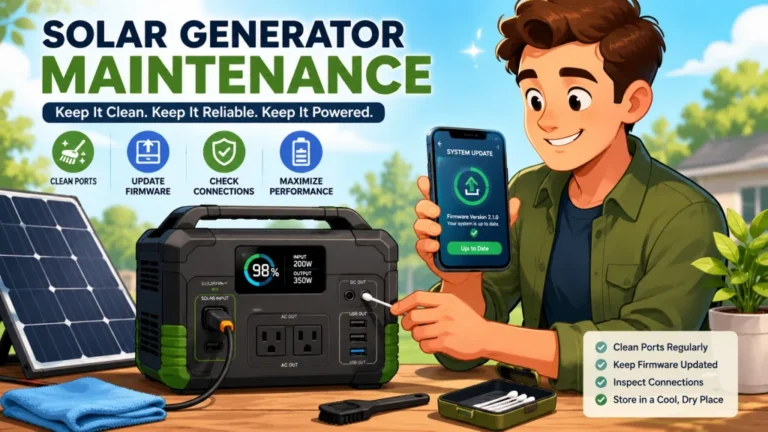
Solar generator battery maintenance is one of those topics that has been made to feel complicated when it really is not. If you have a LiFePO4 unit, and most modern solar generators do, the honest list of required maintenance tasks fits on a single index card. No monthly calibration cycles. No equalizing charges. No distilled water. That list belongs to lead-acid batteries, and it has been showing up in LiFePO4 guides ever since people started copying the structure of older battery care articles without updating the chemistry.
What LiFePO4 actually requires is three things, applied consistently. I have watched a lot of owners skip at least one of them, usually the storage charge, and wonder a few years later why their unit holds noticeably less capacity than it used to. The degradation is real, it is gradual, and it is almost entirely preventable with habits that take minutes, not hours. If you want the broader picture of what routine upkeep looks like for your full setup, the solar generator maintenance overview covers the other tasks alongside this one.
Before going further: confirm your unit actually uses LiFePO4. Check the spec label on the unit, the product page, or the manual under battery type. Most solar generators sold in the past few years use LiFePO4, but some models use NMC lithium-ion. If your unit uses NMC, the three requirements below still apply in principle, but cycle life ratings and optimal storage behavior may differ. The advice in this article is specifically written for LiFePO4 chemistry.
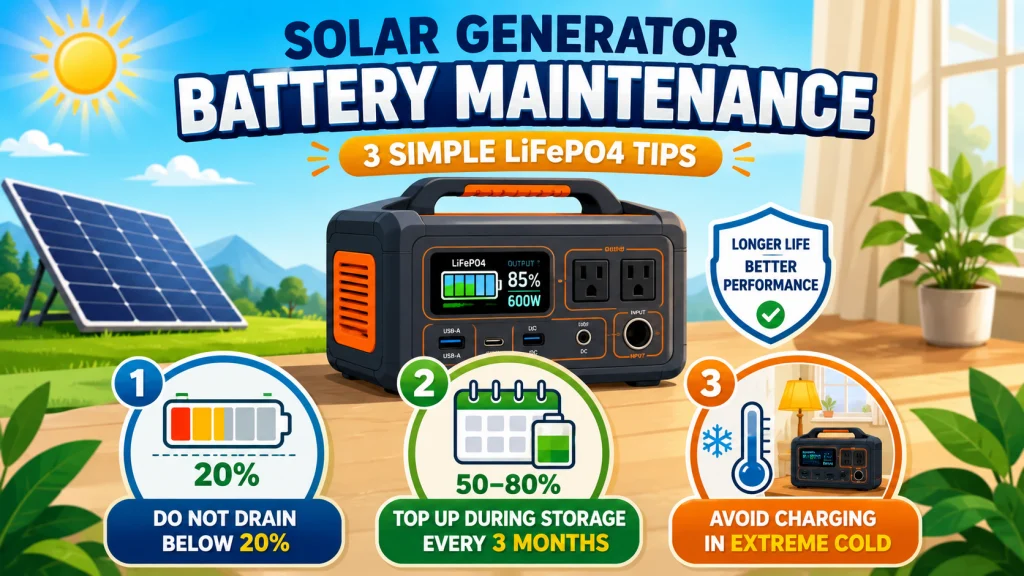
Requirement 1: Do Not Drain the Battery Below 20 Percent Regularly
LiFePO4 handles deep discharge better than NMC lithium-ion. That is one of its genuine advantages, and it is worth acknowledging. But “handles it better” does not mean deep discharges are consequence-free. Every discharge below 20 percent remaining puts measurable stress on the cell structure, and the pattern of regular deep discharges adds up over time in ways that show up as early capacity loss.
The practical rule is straightforward: run the unit down to 20 to 25 percent, then recharge. If you are in the middle of a multi-day outage and cannot avoid draining it further, do it when you have to. But in everyday use and during managed outage prep, stopping at 20 percent and plugging in is a habit worth building. A 1,000 Wh unit at 20 percent still has 200 Wh available, which runs a phone charger for several hours or a laptop for two to three hours if you need a last round of charging before grid power comes back on.
Field Note: One of the things I ran into consistently at the shop was customers who treated their solar generators like a phone, letting them drain to zero before charging. They had picked up the habit from decades of NiCad advice that said full discharge was healthy. On LiFePO4, it is exactly the wrong approach. I stopped counting how many times I had to walk that back during a sales conversation.

Starting at 2kWh and expandable to 6kWh with two additional batteries, this LFP station reaches 80% in just 43 minutes via combined AC and solar input. Its 3,000-cycle battery outlasts the industry average by 6 times and includes a 5-year service guarantee. With 2,400W output across 15 outlets and X-Boost pushing to 3,400W, it handles 99% of household appliances at a whisper-quiet 30 dB.
Check On AmazonIf you click this link and buy, we earn a commission at no additional cost to you.
Requirement 2: Top Up the Battery During Long Storage
LiFePO4 self-discharges at approximately 1 to 3 percent per month. That rate is slow enough that a week or two of sitting unused does not matter. Over six months at a low state of charge, the math becomes a problem. A unit stored at 10 percent charge that drops another 6 to 18 percent over six months through natural self-discharge can fall into a range where the BMS triggers over-discharge protection. Some units recover from this with a slow AC wall charge. Others come back with permanently reduced capacity.
The maintenance habit here is simple: charge the unit to 50 to 80 percent before any storage period longer than a month, and top it off at least once every three months if the unit is not being used. A 30-minute wall charge session quarterly costs almost nothing in electricity. The units that are marketed with extended charge retention through standby management are somewhat more forgiving on this schedule, but the quarterly top-up habit is still worth keeping regardless of what the spec sheet suggests.
For seasonal storage, I charge to 60 to 70 percent before putting the unit away. Not 100 percent, because holding a LiFePO4 cell at 100 percent for months under sustained voltage is harder on the chemistry than storing it at partial charge. Not zero, for the reason above. Sixty to seventy percent is the middle of the charge window where the cell sits under the least stress. A 2,000 Wh unit stored at 70 percent holds 1,400 Wh. You want to come back to it in spring with that number intact, not with the unit refusing to power on.

Weighing just 23.8 lbs with a foldable handle, this 1,070Wh LFP power station delivers 1,500W of pure sine wave AC output with a 3,000W surge capacity, capable of running AC units, fridges, and electric pots. Its LFP battery sustains over 70% capacity after 4,000 cycles, translating to a lifespan of more than 10 years. Via the Jackery App, you can enable a full charge in as little as one hour, or switch to a whisper-quiet 30 dB overnight mode. Six output ports including two USB-C with 100W PD charging cover nearly any device simultaneously.
Check On AmazonIf you click this link and buy, we earn a commission at no additional cost to you.
Requirement 3: Do Not Charge in Extreme Temperatures
Charging a LiFePO4 battery below 32 degrees Fahrenheit causes a specific type of permanent damage called lithium plating on the anode. Unlike the slow capacity fade from deep cycling, lithium plating is cumulative and irreversible. Each cold-temperature charge session can deposit a small amount of metallic lithium that cannot be fully reabsorbed. Over enough charge cycles in the cold, the cell capacity drops in a way that cannot be explained by normal cycle aging.
Most modern solar generators have built-in BMS low-temperature protection that cuts off charging when the battery is too cold. That protection exists precisely because the damage is permanent and the manufacturer wants units covered under warranty to survive normal use patterns. The protection is not a bug or a malfunction when it triggers. It is the unit working correctly. Do not work around it, and do not charge the unit outdoors in below-freezing conditions if you can avoid it. Bring it inside to room temperature for an hour and charge it there.
The high end matters too. A battery that has just been discharged heavily is warmer than ambient temperature. The BMS manages this in most units, but if you have run a 2,000 Wh unit down to 20 percent under a heavy load, the battery is not at room temperature. Give it 15 to 20 minutes to cool before plugging in for a fast AC charge. This is less critical than the cold-temperature rule, but it is worth the wait when the unit has been working hard.
What Lead-Acid Advice Does Not Apply to LiFePO4
If you search for solar generator battery care, you will find guides that recommend monthly calibration cycles, periodic full discharge and recharge cycles to maintain capacity, equalizing charges, and adding distilled water. Those recommendations usually come from older lead-acid, flooded-cell, or nickel-based battery care advice, not from LiFePO4 maintenance. None of them apply to LiFePO4, and some actively cause the kind of damage I described above if you follow them on a LiFePO4 unit.
The table below shows which common battery maintenance tasks matter for LiFePO4 and which ones belong to the wrong chemistry entirely.
| Maintenance Task | LiFePO4 | Where It Comes From |
|---|---|---|
| Avoid draining below 20% | Required | LiFePO4 cell chemistry |
| Top up every 3 months in storage | Required | LiFePO4 self-discharge rate |
| Avoid charging below 32°F | Required | LiFePO4 anode chemistry |
| Monthly full 0 to 100 percent calibration cycle | Not required | NiCad and NiMH battery memory effect |
| Equalizing charge | Not required | Flooded lead-acid cell balancing |
| Adding distilled water | Not applicable | Flooded lead-acid wet cells |
| Storing fully charged at 100% | Not recommended | Applies to some NMC packs, reversed for LiFePO4 |
The mismatch between what these guides say and what LiFePO4 actually needs is a real problem, because the advice is not obviously wrong to someone who does not know battery chemistry. It sounds reasonable. The calibration cycle, for example, makes complete sense for NiCad batteries where memory effect is a real phenomenon. It just does not apply here, and running regular full discharges to zero on your LiFePO4 unit because an article told you to is exactly the habit that causes the early capacity loss owners then blame on build quality.
- Do not do monthly deep discharge cycles. LiFePO4 does not have a memory effect. Deep cycling for “calibration” just accelerates cell wear.
- Do not try to apply an equalizing charge. LiFePO4 cells are balanced internally by the BMS. Attempting an external equalizing charge on a unit not designed for it can damage the BMS.
- Do not store at 100 percent. Sustained high state of charge increases oxidation at the cathode over time. Store between 50 and 80 percent for any period longer than a few days.
- Do not add water. This one should be obvious, but the number of lead-acid maintenance articles that still circulate is enough that it is worth stating directly. LiFePO4 cells are sealed. There is no access point and nothing to add.

This 1152Wh LiFePO4 station outputs 1800W across 8 outlets and can be boosted to 2700W through the BLUETTI app for demanding appliances. A full AC charge takes just 1 hour at 1440W input, or 2.8 to 3.3 hours with up to 500W of solar. It doubles as a home UPS with a 20-millisecond switchover for emergency backup. Comes with a 5-year warranty and all essential charging cables included.
Check On AmazonIf you click this link and buy, we earn a commission at no additional cost to you.
The One Optional Habit That Is Worth Doing Anyway
None of the three requirements above take more than a few minutes to apply. There is one additional habit that falls outside the mandatory list but that I have come to think is worth building: a monthly functional check. Run the unit under a real load for 15 to 20 minutes. Plug in something that draws a known wattage, check the input and output numbers on the display, and make sure everything responds as expected.
This does two things. It confirms the unit is functional before you actually need it, which matters more than it sounds like it should when you are talking about emergency backup power. It also gives you a baseline. If the unit used to run a 150 W device for six hours on a full charge and it is now running it for four and a half hours, you have noticed something worth investigating before it becomes a real problem. The complete guide to using a solar generator correctly covers the broader set of operational habits that keep a unit performing well over years of use, but the monthly check is one of the fastest ways to catch a developing issue early.
In practice, I do this before the seasons where I expect to use the unit most, plus once or twice in between. It takes 20 minutes, tells you everything is working, and costs a few cents of electricity to top the battery back up afterward. For a piece of equipment you are depending on during a power outage, that is a reasonable trade.

This compact plug-in monitor tracks the energy consumption of any AC 115-volt appliance and displays real-time readings of volts, amps, and wattage at 0.2 to 2.0 percent accuracy. Its large LCD screen lets you calculate electricity costs by the day, week, month, or year, making it easy to spot energy-hungry devices and trim your utility bill. It is also compatible with inverters, adding flexibility for off-grid setups.
Check On AmazonIf you click this link and buy, we earn a commission at no additional cost to you.
Final Thoughts: What the Units That Last Have in Common
The solar generators that arrive at the end of their rated cycle life still holding strong capacity are almost always the ones whose owners treated storage correctly and never made a habit of deep discharging. The maintenance list really is that short. Whatever else you read online, check it against the chemistry of the battery you actually own before following it. Most of the advice circulating for lithium batteries was written for a different chemistry entirely, and following it on LiFePO4 does the opposite of what it promises.

At 39.5 lbs with 2,042Wh capacity and 2,200W output, this CTB-built station is 41% lighter and 34% smaller than typical 2kWh units. It charges from 0 to 80% in just 66 minutes via AC, operates at under 30 dB in silent mode, and switches to UPS backup in under 20 milliseconds. The LiFePO4 battery is rated for a full 10-year lifespan.
Check On AmazonIf you click this link and buy, we earn a commission at no additional cost to you.
FAQs
🔋 How often should I charge my solar generator battery to maintain it?
During active use, charge whenever the battery drops to 20 to 25 percent remaining. During storage or periods of non-use, top the battery up to 50 to 80 percent every three months to prevent over-discharge damage from self-discharge. LiFePO4 self-discharges at about 1 to 3 percent per month, which is slow enough that short idle periods are not a concern.
🌡️ What happens if I charge my solar generator in cold weather?
Charging a LiFePO4 battery below 32 degrees Fahrenheit causes permanent lithium plating on the anode, which reduces capacity irreversibly over repeated cold-temperature charge cycles. Most units have BMS cold-temperature protection that stops charging automatically when the battery is too cold. If your unit will not charge in a cold garage, bring it inside to room temperature before plugging it in.
🔌 Do I need to do a full discharge cycle monthly to maintain LiFePO4 capacity?
No. The monthly full discharge cycle is a NiCad recommendation that gets misapplied to LiFePO4 constantly. LiFePO4 does not have a memory effect, and regular deep discharges accelerate cell wear rather than prevent it. The correct approach is the opposite: avoid draining below 20 percent and skip the calibration cycle entirely.
📦 How should I store my solar generator long term?
Store between 50 and 80 percent charge in a dry location at room temperature or slightly below. Avoid storing fully charged at 100 percent for months at a time, and never store depleted near zero. Top off every three months with a short AC wall charge to offset self-discharge. Avoid locations with extreme heat or freezing temperatures.
⚡ Does LiFePO4 last longer than other lithium battery types in a solar generator?
LiFePO4 is rated for significantly more charge cycles than NMC lithium-ion under comparable conditions, with most quality units rated at 3,000 to 3,500 cycles before dropping to 80 percent capacity. In practice the gap is meaningful for a unit used regularly over several years. The lower energy density of LiFePO4 means the unit is heavier for the same capacity, but the cycle life advantage is real.
🛠️ What maintenance does a solar generator battery actually need?
Three things: avoid regular discharges below 20 percent, charge to 50 to 80 percent every three months during storage, and avoid charging in temperatures below 32 degrees Fahrenheit. Everything else commonly listed in battery maintenance guides, equalizing charges, calibration cycles, distilled water, applies to older battery chemistries and does not apply to LiFePO4.